Transcription factor PU.1 (31 kDa-transforming protein)
1_MLQAC 6_ KMEGF 11_ PLVPP 16_ PSEDL 21_ VPYDT 26_ DLYQR 31_ QTHEY 36_ YPYLS 41_ SDGES 46_ HSDHY 51_ WDFHP 56_ HHVHS 61_ EFESF 66_ AENNF 71_ TELQS 76_ VQPPQ 81_ LQQLY 86_ RHMEL 91_ EQMHV 96_ LDTPM 101_ VPPHP 106_ SLGHQ 111_ VSYLP 116_ RMCLQ 121_ YPSLS 126_ PAQPS 131_ SDEEE 136_ GERQS 141_ PPLEV 146_ SDGEA 151_ DGLEP 156_ GPGLL 161_ PGETG 166_ SKKKI 171_ RLYQF 176_ LLDLL 181_ RSGDM 186_ KDSIW 191_ WVDKD 196_ KGTFQ 201_ FSSKH 206_ KEALA 211_ HRWGI 216_ QKGNR 221_ KKMTY 226_ QKMAR 231_ ALRNY 236_ GKTGE 241_ VKKVK 246_ KKLTY 251_ QFSGE 256_ VLGRG 261_GLAER
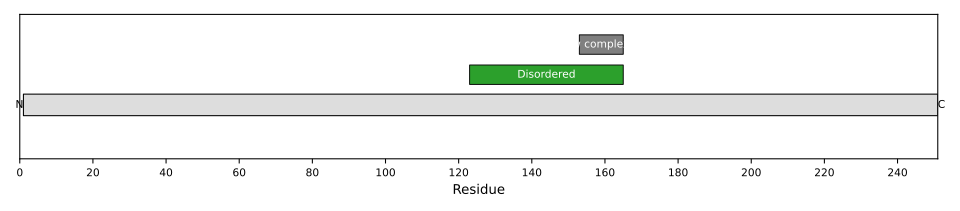
1: Pioneer transcription factor, which controls hematopoietic cell fate by decompacting stem cell heterochromatin and allowing other transcription factors to enter otherwise inaccessible genomic sites. Once in open chromatin, can directly control gene expression by binding genetic regulatory elements and can also more broadly influence transcription by recruiting transcription factors, such as interferon regulatory factors (IRFs), to otherwise inaccessible genomic regions (PubMed:23658224, PubMed:33951726). Transcriptionally activates genes important for myeloid and lymphoid lineages, such as CSF1R (By similarity). Transcriptional activation from certain promoters, possibly containing low affinity binding sites, is achieved cooperatively with other transcription factors. FCER1A transactivation is achieved in cooperation with GATA1 (By similarity). May be particularly important for the pro- to pre-B cell transition (PubMed:33951726). Binds (via the ETS domain) onto the purine-rich DNA core sequence 5'-GAGGAA-3', also known as the PU-box (PubMed:33951726). In vitro can bind RNA and interfere with pre-mRNA splicing (By similarity)