General transcription and DNA repair factor IIH helicase subunit XPD (TFIIH subunit XPD) (EC 3.6.4.12) (Basic transcription factor 2 80 kDa subunit) (BTF2 p80) (CXPD) (DNA excision repair protein ERCC-2) (DNA repair protein complementing XP-D cells) (TFIIH basal transcription factor complex 80 kDa subunit) (TFIIH 80 kDa subunit) (TFIIH p80) (Xeroderma pigmentosum group D-complementing protein)
1_MKLNV 6_ DGLLV 11_ YFPYD 16_ YIYPE 21_ QFSYM 26_ RELKR 31_ TLDAK 36_ GHGVL 41_ EMPSG 46_ TGKTV 51_ SLLAL 56_ IMAYQ 61_ RAYPL 66_ EVTKL 71_ IYCSR 76_ TVPEI 81_ EKVIE 86_ ELRKL 91_ LNFYE 96_ KQEGE 101_ KLPFL 106_ GLALS 111_ SRKNL 116_ CIHPE 121_ VTPLR 126_ FGKDV 131_ DGKCH 136_ SLTAS 141_ YVRAQ 146_ YQHDT 151_ SLPHC 156_ RFYEE 161_ FDAHG 166_ REVPL 171_ PAGIY 176_ NLDDL 181_ KALGR 186_ RQGWC 191_ PYFLA 196_ RYSIL 201_ HANVV 206_ VYSYH 211_ YLLDP 216_ KIADL 221_ VSKEL 226_ ARKAV 231_ VVFDE 236_ AHNID 241_ NVCID 246_ SMSVN 251_ LTRRT 256_ LDRCQ 261_ GNLET 266_ LQKTV 271_ LRIKE 276_ TDEQR 281_ LRDEY 286_ RRLVE 291_ GLREA 296_ SAARE 301_ TDAHL 306_ ANPVL 311_ PDEVL 316_ QEAVP 321_ GSIRT 326_ AEHFL 331_ GFLRR 336_ LLEYV 341_ KWRLR 346_ VQHVV 351_ QESPP 356_ AFLSG 361_ LAQRV 366_ CIQRK 371_ PLRFC 376_ AERLR 381_ SLLHT 386_ LEITD 391_ LADFS 396_ PLTLL 401_ ANFAT 406_ LVSTY 411_ AKGFT 416_ IIIEP 421_ FDDRT 426_ PTIAN 431_ PILHF 436_ SCMDA 441_ SLAIK 446_ PVFER 451_ FQSVI 456_ ITSGT 461_ LSPLD 466_ IYPKI 471_ LDFHP 476_ VTMAT 481_ FTMTL 486_ ARVCL 491_ CPMII 496_ GRGND 501_ QVAIS 506_ SKFET 511_ REDIA 516_ VIRNY 521_ GNLLL 526_ EMSAV 531_ VPDGI 536_ VAFFT 541_ SYQYM 546_ ESTVA 551_ SWYEQ 556_ GILEN 561_ IQRNK 566_ LLFIE 571_ TQDGA 576_ ETSVA 581_ LEKYQ 586_ EACEN 591_ GRGAI 596_ LLSVA 601_ RGKVS 606_ EGIDF 611_ VHHYG 616_ RAVIM 621_ FGVPY 626_ VYTQS 631_ RILKA 636_ RLEYL 641_ RDQFQ 646_ IREND 651_ FLTFD 656_ AMRHA 661_ AQCVG 666_ RAIRG 671_ KTDYG 676_ LMVFA 681_ DKRFA 686_ RGDKR 691_ GKLPR 696_ WIQEH 701_ LTDAN 706_ LNLTV 711_ DEGVQ 716_ VAKYF 721_ LRQMA 726_ QPFHR 731_ EDQLG 736_ LSLLS 741_ LEQLE 746_ SEETL 751_KRIEQ
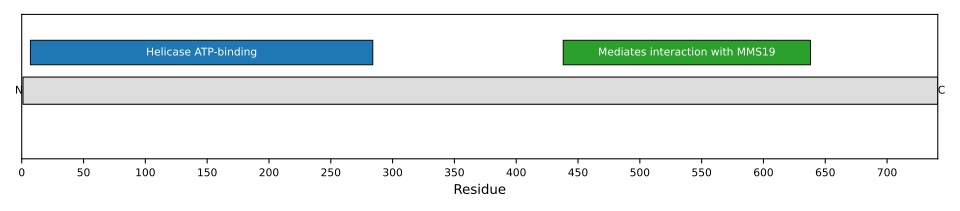
1: ATP-dependent 5'-3' DNA helicase (PubMed:31253769, PubMed:8413672, PubMed:9771713). Component of the general transcription and DNA repair factor IIH (TFIIH) core complex, not absolutely essential for minimal transcription in vitro (PubMed:10024882, PubMed:17466626, PubMed:9771713). Required for transcription-coupled nucleotide excision repair (NER) of damaged DNA; recognizes damaged bases (PubMed:17466626, PubMed:23352696, PubMed:9771713). Sequestered in chromatin on UV-damaged DNA (PubMed:23352696). When complexed to CDK-activating kinase (CAK), involved in transcription by RNA polymerase II. In NER, TFIIH acts by opening DNA around the lesion to allow the excision of the damaged oligonucleotide and its replacement by a new DNA fragment. The ATP-dependent helicase activity of XPD/ERCC2 is required for DNA opening. Involved in DNA lesion verification (PubMed:31253769). In transcription, TFIIH has an essential role in transcription initiation. When the pre-initiation complex (PIC) has been established, TFIIH is required for promoter opening and promoter escape. Phosphorylation of the C-terminal tail (CTD) of the largest subunit of RNA polymerase II by the kinase module CAK controls the initiation of transcription. XPD/ERCC2 acts by forming a bridge between CAK and the core-TFIIH complex. The structure of the TFIIH transcription complex differs from the NER-TFIIH complex; large movements by XPD/ERCC2 and XPB/ERCC3 are stabilized by XPA which allow this subunit to contact ssDNA (PubMed:31253769, PubMed:33902107). Involved in the regulation of vitamin-D receptor activity. As part of the mitotic spindle-associated MMXD complex it plays a role in chromosome segregation. Might have a role in aging process and could play a causative role in the generation of skin cancers