Pituitary adenylate cyclase-activating polypeptide (PACAP) [Cleaved into: PACAP-related peptide (PRP-48); Pituitary adenylate cyclase-activating polypeptide 27 (PACAP-27) (PACAP27); Pituitary adenylate cyclase-activating polypeptide 38 (PACAP-38) (PACAP38)]
1_MTMCS 6_ GARLA 11_ LLVYG 16_ IIMHS 21_ SVYSS 26_ PAAAG 31_ LRFPG 36_ IRPEE 41_ EAYGE 46_ DGNPL 51_ PDFDG 56_ SEPPG 61_ AGSPA 66_ SAPRA 71_ AAAWY 76_ RPAGR 81_ RDVAH 86_ GILNE 91_ AYRKV 96_ LDQLS 101_ AGKHL 106_ QSLVA 111_ RGVGG 116_ SLGGG 121_ AGDDA 126_ EPLSK 131_ RHSDG 136_ IFTDS 141_ YSRYR 146_ KQMAV 151_ KKYLA 156_ AVLGK 161_ RYKQR 166_ VKNKG 171_RRIAY
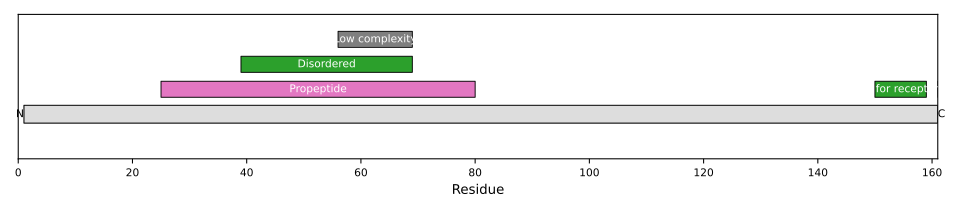
1: PACAP is a neuropeptide involved in diverse array of physiological processes through activating the PACAP subfamily of class B1 G protein-coupled receptors: VIP receptor 1 (VIPR1), VIP receptor 2 (VIPR2), and PACAP type I receptor (ADCYAP1R1) (PubMed:11175907, PubMed:23800469, PubMed:32047270, PubMed:36385145). Exerts neuroprotective and general cytoprotective effects due to anti-apoptotic, anti-inflammatory, and antioxidant actions (PubMed:23800469). Promotes neuron projection development through the RAPGEF2/Rap1/B-Raf/ERK pathway (PubMed:23800469). In chromaffin cells, induces long-lasting increase of intracellular calcium concentrations and neuroendocrine secretion (By similarity). Involved in the control of glucose homeostasis, induces insulin secretion by pancreatic beta cells (By similarity). PACAP exists in two bioactive forms from proteolysis of the same precursor protein, PACAP27 and PACAP38, which differ by eleven amino acid residues in the C-terminus (PubMed:32047270)