Lymphocyte activation gene 3 protein (LAG-3) (CD antigen CD223) [Cleaved into: Secreted lymphocyte activation gene 3 protein (sLAG-3)]
1_MWEAQ 6_ FLGLL 11_ FLQPL 16_ WVAPV 21_ KPLQP 26_ GAEVP 31_ VVWAQ 36_ EGAPA 41_ QLPCS 46_ PTIPL 51_ QDLSL 56_ LRRAG 61_ VTWQH 66_ QPDSG 71_ PPAAA 76_ PGHPL 81_ APGPH 86_ PAAPS 91_ SWGPR 96_ PRRYT 101_ VLSVG 106_ PGGLR 111_ SGRLP 116_ LQPRV 121_ QLDER 126_ GRQRG 131_ DFSLW 136_ LRPAR 141_ RADAG 146_ EYRAA 151_ VHLRD 156_ RALSC 161_ RLRLR 166_ LGQAS 171_ MTASP 176_ PGSLR 181_ ASDWV 186_ ILNCS 191_ FSRPD 196_ RPASV 201_ HWFRN 206_ RGQGR 211_ VPVRE 216_ SPHHH 221_ LAESF 226_ LFLPQ 231_ VSPMD 236_ SGPWG 241_ CILTY 246_ RDGFN 251_ VSIMY 256_ NLTVL 261_ GLEPP 266_ TPLTV 271_ YAGAG 276_ SRVGL 281_ PCRLP 286_ AGVGT 291_ RSFLT 296_ AKWTP 301_ PGGGP 306_ DLLVT 311_ GDNGD 316_ FTLRL 321_ EDVSQ 326_ AQAGT 331_ YTCHI 336_ HLQEQ 341_ QLNAT 346_ VTLAI 351_ ITVTP 356_ KSFGS 361_ PGSLG 366_ KLLCE 371_ VTPVS 376_ GQERF 381_ VWSSL 386_ DTPSQ 391_ RSFSG 396_ PWLEA 401_ QEAQL 406_ LSQPW 411_ QCQLY 416_ QGERL 421_ LGAAV 426_ YFTEL 431_ SSPGA 436_ QRSGR 441_ APGAL 446_ PAGHL 451_ LLFLI 456_ LGVLS 461_ LLLLV 466_ TGAFG 471_ FHLWR 476_ RQWRP 481_ RRFSA 486_ LEQGI 491_ HPPQA 496_ QSKIE 501_ ELEQE 506_ PEPEP 511_ EPEPE 516_PEPEP
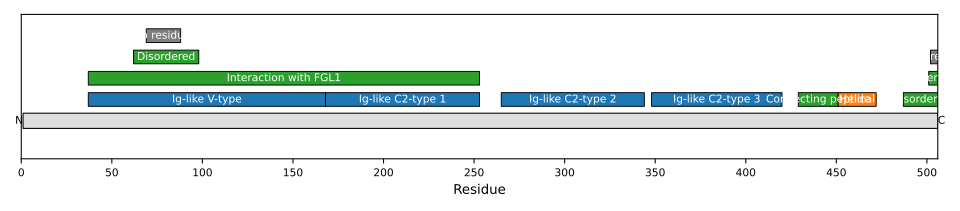
1: Lymphocyte activation gene 3 protein: Inhibitory receptor on antigen activated T-cells (PubMed:20421648, PubMed:7805750, PubMed:8647185). Delivers inhibitory signals upon binding to ligands, such as FGL1 (By similarity). FGL1 constitutes a major ligand of LAG3 and is responsible for LAG3 T-cell inhibitory function (By similarity). Following TCR engagement, LAG3 associates with CD3-TCR in the immunological synapse and directly inhibits T-cell activation (By similarity). May inhibit antigen-specific T-cell activation in synergy with PDCD1/PD-1, possibly by acting as a coreceptor for PDCD1/PD-1 (By similarity). Negatively regulates the proliferation, activation, effector function and homeostasis of both CD8(+) and CD4(+) T-cells (PubMed:20421648, PubMed:7805750, PubMed:8647185). Also mediates immune tolerance: constitutively expressed on a subset of regulatory T-cells (Tregs) and contributes to their suppressive function (By similarity). Also acts as a negative regulator of plasmacytoid dendritic cell (pDCs) activation (By similarity). Binds MHC class II (MHC-II); the precise role of MHC-II-binding is however unclear (PubMed:8647185)
2: May function as a ligand for MHC class II (MHC-II) on antigen-presenting cells (APC), promoting APC activation/maturation and driving Th1 immune response