Cyclic AMP-dependent transcription factor ATF-4 (cAMP-dependent transcription factor ATF-4) (Activating transcription factor 4) (Cyclic AMP-responsive element-binding protein 2) (CREB-2) (cAMP-responsive element-binding protein 2) (Tax-responsive enhancer element-binding protein 67) (TaxREB67)
1_MTEMS 6_ FLSSE 11_ VLVGD 16_ LMSPF 21_ DQSGL 26_ GAEES 31_ LGLLD 36_ DYLEV 41_ AKHFK 46_ PHGFS 51_ SDKAK 56_ AGSSE 61_ WLAVD 66_ GLVSP 71_ SNNSK 76_ EDAFS 81_ GTDWM 86_ LEKMD 91_ LKEFD 96_ LDALL 101_ GIDDL 106_ ETMPD 111_ DLLTT 116_ LDDTC 121_ DLFAP 126_ LVQET 131_ NKQPP 136_ QTVNP 141_ IGHLP 146_ ESLTK 151_ PDQVA 156_ PFTFL 161_ QPLPL 166_ SPGVL 171_ SSTPD 176_ HSFSL 181_ ELGSE 186_ VDITE 191_ GDRKP 196_ DYTAY 201_ VAMIP 206_ QCIKE 211_ EDTPS 216_ DNDSG 221_ ICMSP 226_ ESYLG 231_ SPQHS 236_ PSTRG 241_ SPNRS 246_ LPSPG 251_ VLCGS 256_ ARPKP 261_ YDPPG 266_ EKMVA 271_ AKVKG 276_ EKLDK 281_ KLKKM 286_ EQNKT 291_ AATRY 296_ RQKKR 301_ AEQEA 306_ LTGEC 311_ KELEK 316_ KNEAL 321_ KERAD 326_ SLAKE 331_ IQYLK 336_ DLIEE 341_ VRKAR 346_GKKRV
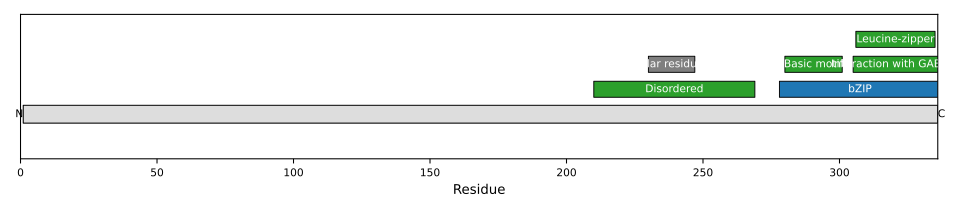
1: Transcription factor that binds the cAMP response element (CRE) (consensus: 5'-GTGACGT[AC][AG]-3') and displays two biological functions, as regulator of metabolic and redox processes under normal cellular conditions, and as master transcription factor during integrated stress response (ISR) (PubMed:16682973, PubMed:17684156, PubMed:31023583, PubMed:31444471, PubMed:32132707). Binds to asymmetric CRE's as a heterodimer and to palindromic CRE's as a homodimer (By similarity). Core effector of the ISR, which is required for adaptation to various stress such as endoplasmic reticulum (ER) stress, amino acid starvation, mitochondrial stress or oxidative stress (PubMed:31023583, PubMed:32132707). During ISR, ATF4 translation is induced via an alternative ribosome translation re-initiation mechanism in response to EIF2S1/eIF-2-alpha phosphorylation, and stress-induced ATF4 acts as a master transcription factor of stress-responsive genes in order to promote cell recovery (PubMed:31023583, PubMed:32132706, PubMed:32132707). Promotes the transcription of genes linked to amino acid sufficiency and resistance to oxidative stress to protect cells against metabolic consequences of ER oxidation (By similarity). Activates the transcription of NLRP1, possibly in concert with other factors in response to ER stress (PubMed:26086088). Activates the transcription of asparagine synthetase (ASNS) in response to amino acid deprivation or ER stress (PubMed:11960987). However, when associated with DDIT3/CHOP, the transcriptional activation of the ASNS gene is inhibited in response to amino acid deprivation (PubMed:18940792). Together with DDIT3/CHOP, mediates programmed cell death by promoting the expression of genes involved in cellular amino acid metabolic processes, mRNA translation and the terminal unfolded protein response (terminal UPR), a cellular response that elicits programmed cell death when ER stress is prolonged and unresolved (By similarity). Activates the expression of COX7A2L/SCAF1 downstream of the EIF2AK3/PERK-mediated unfolded protein response, thereby promoting formation of respiratory chain supercomplexes and increasing mitochondrial oxidative phosphorylation (PubMed:31023583). Together with DDIT3/CHOP, activates the transcription of the IRS-regulator TRIB3 and promotes ER stress-induced neuronal cell death by regulating the expression of BBC3/PUMA in response to ER stress (PubMed:15775988). May cooperate with the UPR transcriptional regulator QRICH1 to regulate ER protein homeostasis which is critical for cell viability in response to ER stress (PubMed:33384352). In the absence of stress, ATF4 translation is at low levels and it is required for normal metabolic processes such as embryonic lens formation, fetal liver hematopoiesis, bone development and synaptic plasticity (By similarity). Acts as a regulator of osteoblast differentiation in response to phosphorylation by RPS6KA3/RSK2: phosphorylation in osteoblasts enhances transactivation activity and promotes expression of osteoblast-specific genes and post-transcriptionally regulates the synthesis of Type I collagen, the main constituent of the bone matrix (PubMed:15109498). Cooperates with FOXO1 in osteoblasts to regulate glucose homeostasis through suppression of beta-cell production and decrease in insulin production (By similarity). Activates transcription of SIRT4 (By similarity). Regulates the circadian expression of the core clock component PER2 and the serotonin transporter SLC6A4 (By similarity). Binds in a circadian time-dependent manner to the cAMP response elements (CRE) in the SLC6A4 and PER2 promoters and periodically activates the transcription of these genes (By similarity). Mainly acts as a transcriptional activator in cellular stress adaptation, but it can also act as a transcriptional repressor: acts as a regulator of synaptic plasticity by repressing transcription, thereby inhibiting induction and maintenance of long-term memory (By similarity). Regulates synaptic functions via interaction with DISC1 in neurons, which inhibits ATF4 transcription factor activity by disrupting ATF4 dimerization and DNA-binding (PubMed:31444471)
2: (Microbial infection) Binds to a Tax-responsive enhancer element in the long terminal repeat of HTLV-I