Casein kinase II subunit alpha' (CK II alpha') (EC 2.7.11.1)
1_MPGPA 6_ AGSRA 11_ RVYAE 16_ VNSLR 21_ SREYW 26_ DYEAH 31_ VPSWG 36_ NQDDY 41_ QLVRK 46_ LGRGK 51_ YSEVF 56_ EAINI 61_ TNNER 66_ VVVKI 71_ LKPVK 76_ KKKIK 81_ REVKI 86_ LENLR 91_ GGTNI 96_ IKLID 101_ TVKDP 106_ VSKTP 111_ ALVFE 116_ YINNT 121_ DFKQL 126_ YQILT 131_ DFDIR 136_ FYMYE 141_ LLKAL 146_ DYCHS 151_ KGIMH 156_ RDVKP 161_ HNVMI 166_ DHQQK 171_ KLRLI 176_ DWGLA 181_ EFYHP 186_ AQEYN 191_ VRVAS 196_ RYFKG 201_ PELLV 206_ DYQMY 211_ DYSLD 216_ MWSLG 221_ CMLAS 226_ MIFRR 231_ EPFFH 236_ GQDNY 241_ DQLVR 246_ IAKVL 251_ GTEEL 256_ YGYLK 261_ KYHID 266_ LDPHF 271_ NDILG 276_ QHSRK 281_ RWENF 286_ IHSEN 291_ RHLVS 296_ PEALD 301_ LLDKL 306_ LRYDH 311_ QQRLT 316_ AKEAM 321_ EHPYF 326_ YPVVK 331_ EQSQP 336_ CADNA 341_VLSSG
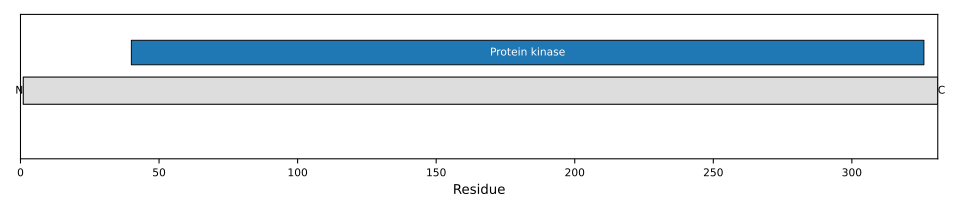
1: Catalytic subunit of a constitutively active serine/threonine-protein kinase complex that phosphorylates a large number of substrates containing acidic residues C-terminal to the phosphorylated serine or threonine (PubMed:11239457, PubMed:11704824, PubMed:16193064, PubMed:30898438). Regulates numerous cellular processes, such as cell cycle progression, apoptosis and transcription, as well as viral infection (PubMed:11704824, PubMed:16193064, PubMed:30898438). May act as a regulatory node which integrates and coordinates numerous signals leading to an appropriate cellular response (PubMed:12631575, PubMed:19387551, PubMed:19387552). During mitosis, functions as a component of the p53/TP53-dependent spindle assembly checkpoint (SAC) that maintains cyclin-B-CDK1 activity and G2 arrest in response to spindle damage (PubMed:12631575, PubMed:19387551, PubMed:19387552). Also required for p53/TP53-mediated apoptosis, phosphorylating 'Ser-392' of p53/TP53 following UV irradiation (PubMed:11239457). Phosphorylates a number of DNA repair proteins in response to DNA damage, such as MDC1, RAD9A, RAD51 and HTATSF1, promoting their recruitment to DNA damage sites (PubMed:20545769, PubMed:21482717, PubMed:22325354, PubMed:26811421, PubMed:30898438, PubMed:35597237). Can also negatively regulate apoptosis (PubMed:19387551, PubMed:19387552). Phosphorylates the caspases CASP9 and CASP2 and the apoptotic regulator NOL3 (PubMed:12631575, PubMed:19387551, PubMed:19387552). Phosphorylation protects CASP9 from cleavage and activation by CASP8, and inhibits the dimerization of CASP2 and activation of CASP8 (PubMed:12631575, PubMed:19387551, PubMed:19387552). Regulates transcription by direct phosphorylation of RNA polymerases I, II, III and IV (PubMed:12631575, PubMed:19387551, PubMed:19387552). Also phosphorylates and regulates numerous transcription factors including NF-kappa-B, STAT1, CREB1, IRF1, IRF2, ATF1, SRF, MAX, JUN, FOS, MYC and MYB (PubMed:12631575, PubMed:19387551, PubMed:19387552). Phosphorylates Hsp90 and its co-chaperones FKBP4 and CDC37, which is essential for chaperone function (PubMed:19387550). Regulates Wnt signaling by phosphorylating CTNNB1 and the transcription factor LEF1 (PubMed:19387549). Acts as an ectokinase that phosphorylates several extracellular proteins (PubMed:12631575, PubMed:19387551, PubMed:19387552). During viral infection, phosphorylates various proteins involved in the viral life cycles of EBV, HSV, HBV, HCV, HIV, CMV and HPV (PubMed:12631575, PubMed:19387551, PubMed:19387552). May phosphorylate histone H2A on 'Ser-1' (PubMed:38334665)