Nuclear factor NF-kappa-B p105 subunit (DNA-binding factor KBF1) (EBP-1) (Nuclear factor of kappa light polypeptide gene enhancer in B-cells 1) [Cleaved into: Nuclear factor NF-kappa-B p50 subunit]
1_MAEDD 6_ PYLGR 11_ PEQMF 16_ HLDPS 21_ LTHTI 26_ FNPEV 31_ FQPQM 36_ ALPTD 41_ GPYLQ 46_ ILEQP 51_ KQRGF 56_ RFRYV 61_ CEGPS 66_ HGGLP 71_ GASSE 76_ KNKKS 81_ YPQVK 86_ ICNYV 91_ GPAKV 96_ IVQLV 101_ TNGKN 106_ IHLHA 111_ HSLVG 116_ KHCED 121_ GICTV 126_ TAGPK 131_ DMVVG 136_ FANLG 141_ ILHVT 146_ KKKVF 151_ ETLEA 156_ RMTEA 161_ CIRGY 166_ NPGLL 171_ VHPDL 176_ AYLQA 181_ EGGGD 186_ RQLGD 191_ REKEL 196_ IRQAA 201_ LQQTK 206_ EMDLS 211_ VVRLM 216_ FTAFL 221_ PDSTG 226_ SFTRR 231_ LEPVV 236_ SDAIY 241_ DSKAP 246_ NASNL 251_ KIVRM 256_ DRTAG 261_ CVTGG 266_ EEIYL 271_ LCDKV 276_ QKDDI 281_ QIRFY 286_ EEEEN 291_ GGVWE 296_ GFGDF 301_ SPTDV 306_ HRQFA 311_ IVFKT 316_ PKYKD 321_ INITK 326_ PASVF 331_ VQLRR 336_ KSDLE 341_ TSEPK 346_ PFLYY 351_ PEIKD 356_ KEEVQ 361_ RKRQK 366_ LMPNF 371_ SDSFG 376_ GGSGA 381_ GAGGG 386_ GMFGS 391_ GGGGG 396_ GTGST 401_ GPGYS 406_ FPHYG 411_ FPTYG 416_ GITFH 421_ PGTTK 426_ SNAGM 431_ KHGTM 436_ DTESK 441_ KDPEG 446_ CDKSD 451_ DKNTV 456_ NLFGK 461_ VIETT 466_ EQDQE 471_ PSEAT 476_ VGNGE 481_ VTLTY 486_ ATGTK 491_ EESAG 496_ VQDNL 501_ FLEKA 506_ MQLAK 511_ RHANA 516_ LFDYA 521_ VTGDV 526_ KMLLA 531_ VQRHL 536_ TAVQD 541_ ENGDS 546_ VLHLA 551_ IIHLH 556_ SQLVR 561_ DLLEV 566_ TSGLI 571_ SDDII 576_ NMRND 581_ LYQTP 586_ LHLAV 591_ ITKQE 596_ DVVED 601_ LLRAG 606_ ADLSL 611_ LDRLG 616_ NSVLH 621_ LAAKE 626_ GHDKV 631_ LSILL 636_ KHKKA 641_ ALLLD 646_ HPNGD 651_ GLNAI 656_ HLAMM 661_ SNSLP 666_ CLLLL 671_ VAAGA 676_ DVNAQ 681_ EQKSG 686_ RTALH 691_ LAVEH 696_ DNISL 701_ AGCLL 706_ LEGDA 711_ HVDST 716_ TYDGT 721_ TPLHI 726_ AAGRG 731_ STRLA 736_ ALLKA 741_ AGADP 746_ LVENF 751_ EPLYD 756_ LDDSW 761_ ENAGE 766_ DEGVV 771_ PGTTP 776_ LDMAT 781_ SWQVF 786_ DILNG 791_ KPYEP 796_ EFTSD 801_ DLLAQ 806_ GDMKQ 811_ LAEDV 816_ KLQLY 821_ KLLEI 826_ PDPDK 831_ NWATL 836_ AQKLG 841_ LGILN 846_ NAFRL 851_ SPAPS 856_ KTLMD 861_ NYEVS 866_ GGTVR 871_ ELVEA 876_ LRQMG 881_ YTEAI 886_ EVIQA 891_ ASSPV 896_ KTTSQ 901_ AHSLP 906_ LSPAS 911_ TRQQI 916_ DELRD 921_ SDSVC 926_ DSGVE 931_ TSFRK 936_ LSFTE 941_ SLTSG 946_ ASLLT 951_ LNKMP 956_ HDYGQ 961_EGPLE
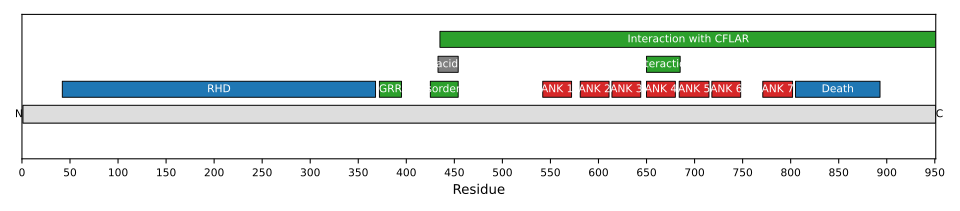
1: NF-kappa-B is a pleiotropic transcription factor present in almost all cell types and is the endpoint of a series of signal transduction events that are initiated by a vast array of stimuli related to many biological processes such as inflammation, immunity, differentiation, cell growth, tumorigenesis and apoptosis. NF-kappa-B is a homo- or heterodimeric complex formed by the Rel-like domain-containing proteins RELA/p65, RELB, NFKB1/p105, NFKB1/p50, REL and NFKB2/p52 and the heterodimeric p65-p50 complex appears to be most abundant one. The dimers bind at kappa-B sites in the DNA of their target genes and the individual dimers have distinct preferences for different kappa-B sites that they can bind with distinguishable affinity and specificity. Different dimer combinations act as transcriptional activators or repressors, respectively. NF-kappa-B is controlled by various mechanisms of post-translational modification and subcellular compartmentalization as well as by interactions with other cofactors or corepressors. NF-kappa-B complexes are held in the cytoplasm in an inactive state complexed with members of the NF-kappa-B inhibitor (I-kappa-B) family. In a conventional activation pathway, I-kappa-B is phosphorylated by I-kappa-B kinases (IKKs) in response to different activators, subsequently degraded thus liberating the active NF-kappa-B complex which translocates to the nucleus. NF-kappa-B heterodimeric p65-p50 and RelB-p50 complexes are transcriptional activators. The NF-kappa-B p50-p50 homodimer is a transcriptional repressor, but can act as a transcriptional activator when associated with BCL3. NFKB1 appears to have dual functions such as cytoplasmic retention of attached NF-kappa-B proteins by p105 and generation of p50 by a cotranslational processing. The proteasome-mediated process ensures the production of both p50 and p105 and preserves their independent function, although processing of NFKB1/p105 also appears to occur post-translationally. p50 binds to the kappa-B consensus sequence 5'-GGRNNYYCC-3', located in the enhancer region of genes involved in immune response and acute phase reactions. In a complex with MAP3K8, NFKB1/p105 represses MAP3K8-induced MAPK signaling; active MAP3K8 is released by proteasome-dependent degradation of NFKB1/p105
2: P105 is the precursor of the active p50 subunit (Nuclear factor NF-kappa-B p50 subunit) of the nuclear factor NF-kappa-B (PubMed:1423592). Acts as a cytoplasmic retention of attached NF-kappa-B proteins by p105 (PubMed:1423592)
3: Constitutes the active form, which associates with RELA/p65 to form the NF-kappa-B p65-p50 complex to form a transcription factor (PubMed:1740106, PubMed:7830764). Together with RELA/p65, binds to the kappa-B consensus sequence 5'-GGRNNYYCC-3', located in the enhancer region of genes involved in immune response and acute phase reactions (PubMed:1740106, PubMed:7830764)