Nuclear receptor subfamily 1 group D member 1 (Rev-erbA-alpha) (V-erbA-related protein 1) (EAR-1)
1_MTTLD 6_ SNNNT 11_ GGVIT 16_ YIGSS 21_ GSSPS 26_ RTSPE 31_ SLYSD 36_ NSNGS 41_ FQSLT 46_ QGCPT 51_ YFPPS 56_ PTGSL 61_ TQDPA 66_ RSFGS 71_ IPPSL 76_ SDDGS 81_ PSSSS 86_ SSSSS 91_ SSSFY 96_ NGSPP 101_ GSLQV 106_ AMEDS 111_ SRVSP 116_ SKSTS 121_ NITKL 126_ NGMVL 131_ LCKVC 136_ GDVAS 141_ GFHYG 146_ VHACE 151_ GCKGF 156_ FRRSI 161_ QQNIQ 166_ YKRCL 171_ KNENC 176_ SIVRI 181_ NRNRC 186_ QQCRF 191_ KKCLS 196_ VGMSR 201_ DAVRF 206_ GRIPK 211_ REKQR 216_ MLAEM 221_ QSAMN 226_ LANNQ 231_ LSSQC 236_ PLETS 241_ PTQHP 246_ TPGPM 251_ GPSPP 256_ PAPVP 261_ SPLVG 266_ FSQFP 271_ QQLTP 276_ PRSPS 281_ PEPTV 286_ EDVIS 291_ QVARA 296_ HREIF 301_ TYAHD 306_ KLGSS 311_ PGNFN 316_ ANHAS 321_ GSPPA 326_ TTPHR 331_ WENQG 336_ CPPAP 341_ NDNNT 346_ LAAQR 351_ HNEAL 356_ NGLRQ 361_ APSSY 366_ PPTWP 371_ PGPAH 376_ HSCHQ 381_ SNSNG 386_ HRLCP 391_ THVYA 396_ APEGK 401_ APANS 406_ PRQGN 411_ SKNVL 416_ LACPM 421_ NMYPH 426_ GRSGR 431_ TVQEI 436_ WEDFS 441_ MSFTP 446_ AVREV 451_ VEFAK 456_ HIPGF 461_ RDLSQ 466_ HDQVT 471_ LLKAG 476_ TFEVL 481_ MVRFA 486_ SLFNV 491_ KDQTV 496_ MFLSR 501_ TTYSL 506_ QELGA 511_ MGMGD 516_ LLSAM 521_ FDFSE 526_ KLNSL 531_ ALTEE 536_ ELGLF 541_ TAVVL 546_ VSADR 551_ SGMEN 556_ SASVE 561_ QLQET 566_ LLRAL 571_ RALVL 576_ KNRPL 581_ ETSRF 586_ TKLLL 591_ KLPDL 596_ RTLNN 601_ MHSEK 606_LLSFR
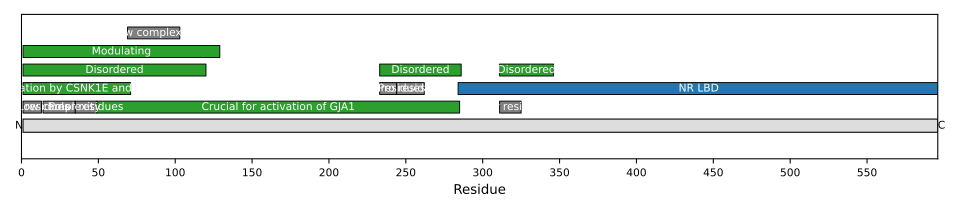
1: Transcriptional repressor which coordinates circadian rhythm and metabolic pathways in a heme-dependent manner. Integral component of the complex transcription machinery that governs circadian rhythmicity and forms a critical negative limb of the circadian clock by directly repressing the expression of core clock components BMAL1, CLOCK and CRY1. Also regulates genes involved in metabolic functions, including lipid and bile acid metabolism, adipogenesis, gluconeogenesis and the macrophage inflammatory response. Acts as a receptor for heme which stimulates its interaction with the NCOR1/HDAC3 corepressor complex, enhancing transcriptional repression. Recognizes two classes of DNA response elements within the promoter of its target genes and can bind to DNA as either monomers or homodimers, depending on the nature of the response element. Binds as a monomer to a response element composed of the consensus half-site motif 5'-[A/G]GGTCA-3' preceded by an A/T-rich 5' sequence (RevRE), or as a homodimer to a direct repeat of the core motif spaced by two nucleotides (RevDR-2). Acts as a potent competitive repressor of ROR alpha (RORA) function and regulates the levels of its ligand heme by repressing the expression of PPARGC1A, a potent inducer of heme synthesis. Regulates lipid metabolism by repressing the expression of APOC3 and by influencing the activity of sterol response element binding proteins (SREBPs); represses INSIG2 which interferes with the proteolytic activation of SREBPs which in turn govern the rhythmic expression of enzymes with key functions in sterol and fatty acid synthesis. Regulates gluconeogenesis via repression of G6PC1 and PEPCK and adipocyte differentiation via repression of PPARG. Regulates glucagon release in pancreatic alpha-cells via the AMPK-NAMPT-SIRT1 pathway and the proliferation, glucose-induced insulin secretion and expression of key lipogenic genes in pancreatic-beta cells. Positively regulates bile acid synthesis by increasing hepatic expression of CYP7A1 via repression of NR0B2 and NFIL3 which are negative regulators of CYP7A1. Modulates skeletal muscle oxidative capacity by regulating mitochondrial biogenesis and autophagy; controls mitochondrial biogenesis and respiration by interfering with the STK11-PRKAA1/2-SIRT1-PPARGC1A signaling pathway. Represses the expression of SERPINE1/PAI1, an important modulator of cardiovascular disease and the expression of inflammatory cytokines and chemokines in macrophages. Represses gene expression at a distance in macrophages by inhibiting the transcription of enhancer-derived RNAs (eRNAs). Plays a role in the circadian regulation of body temperature and negatively regulates thermogenic transcriptional programs in brown adipose tissue (BAT); imposes a circadian oscillation in BAT activity, increasing body temperature when awake and depressing thermogenesis during sleep. In concert with NR2E3, regulates transcriptional networks critical for photoreceptor development and function. In addition to its activity as a repressor, can also act as a transcriptional activator. In the ovarian granulosa cells acts as a transcriptional activator of STAR which plays a role in steroid biosynthesis. In collaboration with SP1, activates GJA1 transcription in a heme-independent manner. Represses the transcription of CYP2B10, CYP4A10 and CYP4A14 (By similarity). Represses the transcription of CES2 (By similarity). Represses and regulates the circadian expression of TSHB in a NCOR1-dependent manner (By similarity). Negatively regulates the protein stability of NR3C1 and influences the time-dependent subcellular distribution of NR3C1, thereby affecting its transcriptional regulatory activity (By similarity). Plays a critical role in the circadian control of neutrophilic inflammation in the lung; under resting, non-stress conditions, acts as a rhythmic repressor to limit inflammatory activity whereas in the presence of inflammatory triggers undergoes ubiquitin-mediated degradation thereby relieving inhibition of the inflammatory response (By similarity). Plays a key role in the circadian regulation of microglial activation and neuroinflammation; suppresses microglial activation through the NF-kappaB pathway in the central nervous system (By similarity). Plays a role in the regulation of the diurnal rhythms of lipid and protein metabolism in the skeletal muscle via transcriptional repression of genes controlling lipid and amino acid metabolism in the muscle (By similarity)