T-cell surface glycoprotein CD3 zeta chain (T-cell receptor T3 zeta chain) (CD antigen CD247)
1_MKWKA 6_ LFTAA 11_ ILQAQ 16_ LPITE 21_ AQSFG 26_ LLDPK 31_ LCYLL 36_ DGILF 41_ IYGVI 46_ LTALF 51_ LRVKF 56_ SRSAD 61_ APAYQ 66_ QGQNQ 71_ LYNEL 76_ NLGRR 81_ EEYDV 86_ LDKRR 91_ GRDPE 96_ MGGKP 101_ QRRKN 106_ PQEGL 111_ YNELQ 116_ KDKMA 121_ EAYSE 126_ IGMKG 131_ ERRRG 136_ KGHDG 141_ LYQGL 146_ STATK 151_ DTYDA 156_LHMQA
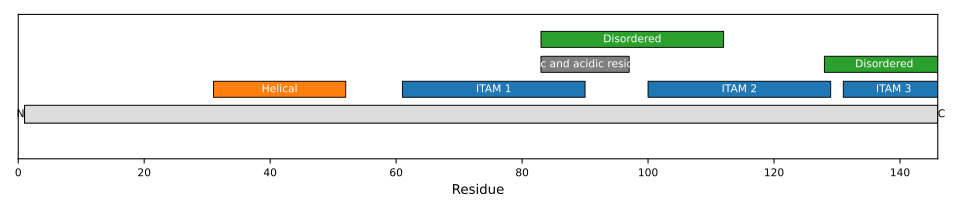
1: Part of the TCR-CD3 complex present on T-lymphocyte cell surface that plays an essential role in adaptive immune response. When antigen presenting cells (APCs) activate T-cell receptor (TCR), TCR-mediated signals are transmitted across the cell membrane by the CD3 chains CD3D, CD3E, CD3G and CD3Z. All CD3 chains contain immunoreceptor tyrosine-based activation motifs (ITAMs) in their cytoplasmic domain. Upon TCR engagement, these motifs become phosphorylated by Src family protein tyrosine kinases LCK and FYN, resulting in the activation of downstream signaling pathways (PubMed:1384049, PubMed:1385158, PubMed:2470098, PubMed:7509083). CD3Z ITAMs phosphorylation creates multiple docking sites for the protein kinase ZAP70 leading to ZAP70 phosphorylation and its conversion into a catalytically active enzyme (PubMed:7509083). Plays an important role in intrathymic T-cell differentiation. Additionally, participates in the activity-dependent synapse formation of retinal ganglion cells (RGCs) in both the retina and dorsal lateral geniculate nucleus (dLGN) (By similarity)