Cannabinoid receptor 1 (CB-R) (CB1) (CANN6)
1_MKSIL 6_ DGLAD 11_ TTFRT 16_ ITTDL 21_ LYVGS 26_ NDIQY 31_ EDIKG 36_ DMASK 41_ LGYFP 46_ QKFPL 51_ TSFRG 56_ SPFQE 61_ KMTAG 66_ DNPQL 71_ VPADQ 76_ VNITE 81_ FYNKS 86_ LSSFK 91_ ENEEN 96_ IQCGE 101_ NFMDI 106_ ECFMV 111_ LNPSQ 116_ QLAIA 121_ VLSLT 126_ LGTFT 131_ VLENL 136_ LVLCV 141_ ILHSR 146_ SLRCR 151_ PSYHF 156_ IGSLA 161_ VADLL 166_ GSVIF 171_ VYSFI 176_ DFHVF 181_ HRKDS 186_ RNVFL 191_ FKLGG 196_ VTASF 201_ TASVG 206_ SLFLT 211_ AIDRY 216_ ISIHR 221_ PLAYK 226_ RIVTR 231_ PKAVV 236_ AFCLM 241_ WTIAI 246_ VIAVL 251_ PLLGW 256_ NCEKL 261_ QSVCS 266_ DIFPH 271_ IDETY 276_ LMFWI 281_ GVTSV 286_ LLLFI 291_ VYAYM 296_ YILWK 301_ AHSHA 306_ VRMIQ 311_ RGTQK 316_ SIIIH 321_ TSEDG 326_ KVQVT 331_ RPDQA 336_ RMDIR 341_ LAKTL 346_ VLILV 351_ VLIIC 356_ WGPLL 361_ AIMVY 366_ DVFGK 371_ MNKLI 376_ KTVFA 381_ FCSML 386_ CLLNS 391_ TVNPI 396_ IYALR 401_ SKDLR 406_ HAFRS 411_ MFPSC 416_ EGTAQ 421_ PLDNS 426_ MGDSD 431_ CLHKH 436_ ANNAA 441_ SVHRA 446_ AESCI 451_ KSTVK 456_ IAKVT 461_ MSVST 466_DTSAE
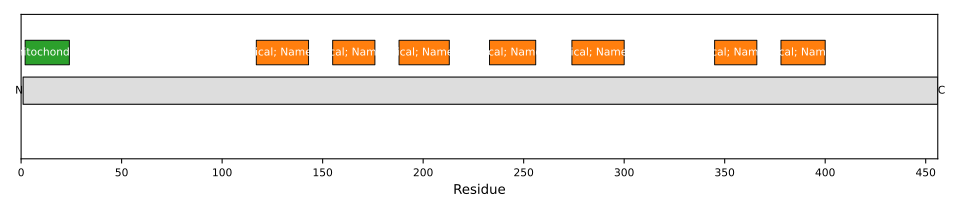
1: G-protein coupled receptor for endogenous cannabinoids (eCBs), including N-arachidonoylethanolamide (also called anandamide or AEA) and 2-arachidonoylglycerol (2-AG), as well as phytocannabinoids, such as delta(9)-tetrahydrocannabinol (THC) (PubMed:15620723, PubMed:27768894, PubMed:27851727). Mediates many cannabinoid-induced effects, acting, among others, on food intake, memory loss, gastrointestinal motility, catalepsy, ambulatory activity, anxiety, chronic pain. Signaling typically involves reduction in cyclic AMP (PubMed:1718258, PubMed:21895628, PubMed:27768894). In the hypothalamus, may have a dual effect on mitochondrial respiration depending upon the agonist dose and possibly upon the cell type. Increases respiration at low doses, while decreases respiration at high doses. At high doses, CNR1 signal transduction involves G-protein alpha-i protein activation and subsequent inhibition of mitochondrial soluble adenylate cyclase, decrease in cyclic AMP concentration, inhibition of protein kinase A (PKA)-dependent phosphorylation of specific subunits of the mitochondrial electron transport system, including NDUFS2. In the hypothalamus, inhibits leptin-induced reactive oxygen species (ROS) formation and mediates cannabinoid-induced increase in SREBF1 and FASN gene expression. In response to cannabinoids, drives the release of orexigenic beta-endorphin, but not that of melanocyte-stimulating hormone alpha/alpha-MSH, from hypothalamic POMC neurons, hence promoting food intake. In the hippocampus, regulates cellular respiration and energy production in response to cannabinoids. Involved in cannabinoid-dependent depolarization-induced suppression of inhibition (DSI), a process in which depolarization of CA1 postsynaptic pyramidal neurons mobilizes eCBs, which retrogradely activate presynaptic CB1 receptors, transiently decreasing GABAergic inhibitory neurotransmission. Also reduces excitatory synaptic transmission (By similarity). In superior cervical ganglions and cerebral vascular smooth muscle cells, inhibits voltage-gated Ca(2+) channels in a constitutive, as well as agonist-dependent manner (PubMed:17895407). In cerebral vascular smooth muscle cells, cannabinoid-induced inhibition of voltage-gated Ca(2+) channels leads to vasodilation and decreased vascular tone (By similarity). Induces leptin production in adipocytes and reduces LRP2-mediated leptin clearance in the kidney, hence participating in hyperleptinemia. In adipose tissue, CNR1 signaling leads to increased expression of SREBF1, ACACA and FASN genes (By similarity). In the liver, activation by endocannabinoids leads to increased de novo lipogenesis and reduced fatty acid catabolism, associated with increased expression of SREBF1/SREBP-1, GCK, ACACA, ACACB and FASN genes. May also affect de novo cholesterol synthesis and HDL-cholesteryl ether uptake. Peripherally modulates energy metabolism (By similarity). In high carbohydrate diet-induced obesity, may decrease the expression of mitochondrial dihydrolipoyl dehydrogenase/DLD in striated muscles, as well as that of selected glucose/ pyruvate metabolic enzymes, hence affecting energy expenditure through mitochondrial metabolism (By similarity). In response to cannabinoid anandamide, elicits a pro-inflammatory response in macrophages, which involves NLRP3 inflammasome activation and IL1B and IL18 secretion (By similarity). In macrophages infiltrating pancreatic islets, this process may participate in the progression of type-2 diabetes and associated loss of pancreatic beta-cells (PubMed:23955712)
2: Binds both 2-arachidonoylglycerol (2-AG) and anandamide
3: Only binds 2-arachidonoylglycerol (2-AG) with high affinity. Contrary to its effect on isoform 1, 2-AG behaves as an inverse agonist on isoform 2 in assays measuring GTP binding to membranes
4: Only binds 2-arachidonoylglycerol (2-AG) with high affinity. Contrary to its effect on isoform 1, 2-AG behaves as an inverse agonist on isoform 3 in assays measuring GTP binding to membranes