Tumor necrosis factor alpha-induced protein 3 (TNF alpha-induced protein 3) (EC 2.3.2.-) (EC 3.4.19.12) (OTU domain-containing protein 7C) (Putative DNA-binding protein A20) (Zinc finger protein A20) [Cleaved into: A20p50; A20p37]
1_MAEQV 6_ LPQAL 11_ YLSNM 16_ RKAVK 21_ IRERT 26_ PEDIF 31_ KPTNG 36_ IIHHF 41_ KTMHR 46_ YTLEM 51_ FRTCQ 56_ FCPQF 61_ REIIH 66_ KALID 71_ RNIQA 76_ TLESQ 81_ KKLNW 86_ CREVR 91_ KLVAL 96_ KTNGD 101_ GNCLM 106_ HATSQ 111_ YMWGV 116_ QDTDL 121_ VLRKA 126_ LFSTL 131_ KETDT 136_ RNFKF 141_ RWQLE 146_ SLKSQ 151_ EFVET 156_ GLCYD 161_ TRNWN 166_ DEWDN 171_ LIKMA 176_ STDTP 181_ MARSG 186_ LQYNS 191_ LEEIH 196_ IFVLC 201_ NILRR 206_ PIIVI 211_ SDKML 216_ RSLES 221_ GSNFA 226_ PLKVG 231_ GIYLP 236_ LHWPA 241_ QECYR 246_ YPIVL 251_ GYDSH 256_ HFVPL 261_ VTLKD 266_ SGPEI 271_ RAVPL 276_ VNRDR 281_ GRFED 286_ LKVHF 291_ LTDPE 296_ NEMKE 301_ KLLKE 306_ YLMVI 311_ EIPVQ 316_ GWDHG 321_ TTHLI 326_ NAAKL 331_ DEANL 336_ PKEIN 341_ LVDDY 346_ FELVQ 351_ HEYKK 356_ WQENS 361_ EQGRR 366_ EGHAQ 371_ NPMEP 376_ SVPQL 381_ SLMDV 386_ KCETP 391_ NCPFF 396_ MSVNT 401_ QPLCH 406_ ECSER 411_ RQKNQ 416_ NKLPK 421_ LNSKP 426_ GPEGL 431_ PGMAL 436_ GASRG 441_ EAYEP 446_ LAWNP 451_ EESTG 456_ GPHSA 461_ PPTAP 466_ SPFLF 471_ SETTA 476_ MKCRS 481_ PGCPF 486_ TLNVQ 491_ HNGFC 496_ ERCHN 501_ ARQLH 506_ ASHAP 511_ DHTRH 516_ LDPGK 521_ CQACL 526_ QDVTR 531_ TFNGI 536_ CSTCF 541_ KRTTA 546_ EASSS 551_ LSTSL 556_ PPSCH 561_ QRSKS 566_ DPSRL 571_ VRSPS 576_ PHSCH 581_ RAGND 586_ APAGC 591_ LSQAA 596_ RTPGD 601_ RTGTS 606_ KCRKA 611_ GCVYF 616_ GTPEN 621_ KGFCT 626_ LCFIE 631_ YRENK 636_ HFAAA 641_ SGKVS 646_ PTASR 651_ FQNTI 656_ PCLGR 661_ ECGTL 666_ GSTMF 671_ EGYCQ 676_ KCFIE 681_ AQNQR 686_ FHEAK 691_ RTEEQ 696_ LRSSQ 701_ RRDVP 706_ RTTQS 711_ TSRPK 716_ CARAS 721_ CKNIL 726_ ACRSE 731_ ELCME 736_ CQHPN 741_ QRMGP 746_ GAHRG 751_ EPAPE 756_ DPPKQ 761_ RCRAP 766_ ACDHF 771_ GNAKC 776_ NGYCN 781_ECFQF
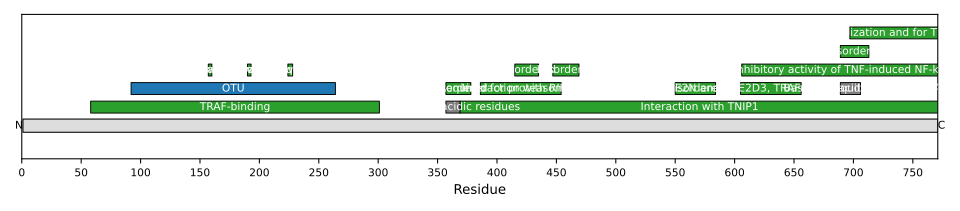
1: Ubiquitin-editing enzyme that contains both ubiquitin ligase and deubiquitinase activities. Involved in immune and inflammatory responses signaled by cytokines, such as TNF-alpha and IL-1 beta, or pathogens via Toll-like receptors (TLRs) through terminating NF-kappa-B activity. Essential component of a ubiquitin-editing protein complex, comprising also RNF11, ITCH and TAX1BP1, that ensures the transient nature of inflammatory signaling pathways. In cooperation with TAX1BP1 promotes disassembly of E2-E3 ubiquitin protein ligase complexes in IL-1R and TNFR-1 pathways; affected are at least E3 ligases TRAF6, TRAF2 and BIRC2, and E2 ubiquitin-conjugating enzymes UBE2N and UBE2D3. In cooperation with TAX1BP1 promotes ubiquitination of UBE2N and proteasomal degradation of UBE2N and UBE2D3. Upon TNF stimulation, deubiquitinates 'Lys-63'-polyubiquitin chains on RIPK1 and catalyzes the formation of 'Lys-48'-polyubiquitin chains. This leads to RIPK1 proteasomal degradation and consequently termination of the TNF- or LPS-mediated activation of NF-kappa-B. Deubiquitinates TRAF6 probably acting on 'Lys-63'-linked polyubiquitin. Upon T-cell receptor (TCR)-mediated T-cell activation, deubiquitinates 'Lys-63'-polyubiquitin chains on MALT1 thereby mediating disassociation of the CBM (CARD11:BCL10:MALT1) and IKK complexes and preventing sustained IKK activation. Deubiquitinates NEMO/IKBKG; the function is facilitated by TNIP1 and leads to inhibition of NF-kappa-B activation. Upon stimulation by bacterial peptidoglycans, probably deubiquitinates RIPK2. Can also inhibit I-kappa-B-kinase (IKK) through a non-catalytic mechanism which involves polyubiquitin; polyubiquitin promotes association with IKBKG and prevents IKK MAP3K7-mediated phosphorylation. Targets TRAF2 for lysosomal degradation. In vitro able to deubiquitinate 'Lys-11'-, 'Lys-48'- and 'Lys-63' polyubiquitin chains. Inhibitor of programmed cell death. Has a role in the function of the lymphoid system. Required for LPS-induced production of pro-inflammatory cytokines and IFN beta in LPS-tolerized macrophages