Kit ligand (Mast cell growth factor) (MGF) (Stem cell factor) (SCF) (c-Kit ligand) [Cleaved into: Soluble KIT ligand (sKITLG)]
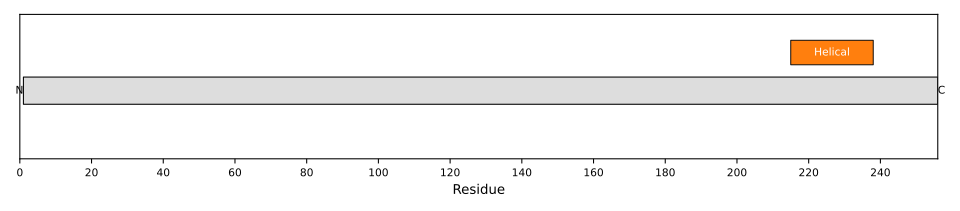
1_MKKTQ 6_ TWILT 11_ CIYLQ 16_ LLLFN 21_ PLVKT 26_ EGICR 31_ NRVTN 36_ NVKDV 41_ TKLVA 46_ NLPKD 51_ YMITL 56_ KYVPG 61_ MDVLP 66_ SHCWI 71_ SEMVV 76_ QLSDS 81_ LTDLL 86_ DKFSN 91_ ISEGL 96_ SNYSI 101_ IDKLV 106_ NIVDD 111_ LVECV 116_ KENSS 121_ KDLKK 126_ SFKSP 131_ EPRLF 136_ TPEEF 141_ FRIFN 146_ RSIDA 151_ FKDFV 156_ VASET 161_ SDCVV 166_ SSTLS 171_ PEKDS 176_ RVSVT 181_ KPFML 186_ PPVAA 191_ SSLRN 196_ DSSSS 201_ NRKAK 206_ NPPGD 211_ SSLHW 216_ AAMAL 221_ PALFS 226_ LIIGF 231_ AFGAL 236_ YWKKR 241_ QPSLT 246_ RAVEN 251_ IQINE 256_ EDNEI 261_ SMLQE 266_KEREF
1: Ligand for the receptor-type protein-tyrosine kinase KIT. Plays an essential role in the regulation of cell survival and proliferation, hematopoiesis, stem cell maintenance, gametogenesis, mast cell development, migration and function, and in melanogenesis. KITLG/SCF binding can activate several signaling pathways. Promotes phosphorylation of PIK3R1, the regulatory subunit of phosphatidylinositol 3-kinase, and subsequent activation of the kinase AKT1. KITLG/SCF and KIT also transmit signals via GRB2 and activation of RAS, RAF1 and the MAP kinases MAPK1/ERK2 and/or MAPK3/ERK1. KITLG/SCF and KIT promote activation of STAT family members STAT1, STAT3 and STAT5. KITLG/SCF and KIT promote activation of PLCG1, leading to the production of the cellular signaling molecules diacylglycerol and inositol 1,4,5-trisphosphate. KITLG/SCF acts synergistically with other cytokines, probably interleukins