Potassium voltage-gated channel subfamily A member 4 (HPCN2) (Voltage-gated K(+) channel HuKII) (Voltage-gated potassium channel HBK4) (Voltage-gated potassium channel HK1) (Voltage-gated potassium channel subunit Kv1.4)
1_MEVAM 6_ VSAES 11_ SGCNS 16_ HMPYG 21_ YAAQA 26_ RARER 31_ ERLAH 36_ SRAAA 41_ AAAVA 46_ AATAA 51_ VEGSG 56_ GSGGG 61_ SHHHH 66_ QSRGA 71_ CTSHD 76_ PQSSR 81_ GSRRR 86_ RRQRS 91_ EKKKA 96_ HYRQS 101_ SFPHC 106_ SDLMP 111_ SGSEE 116_ KILRE 121_ LSEEE 126_ EDEEE 131_ EEEEE 136_ EEGRF 141_ YYSED 146_ DHGDE 151_ CSYTD 156_ LLPQD 161_ EGGGG 166_ YSSVR 171_ YSDCC 176_ ERVVI 181_ NVSGL 186_ RFETQ 191_ MKTLA 196_ QFPET 201_ LLGDP 206_ EKRTQ 211_ YFDPL 216_ RNEYF 221_ FDRNR 226_ PSFDA 231_ ILYYY 236_ QSGGR 241_ LKRPV 246_ NVPFD 251_ IFTEE 256_ VKFYQ 261_ LGEEA 266_ LLKFR 271_ EDEGF 276_ VREEE 281_ DRALP 286_ ENEFK 291_ KQIWL 296_ LFEYP 301_ ESSSP 306_ ARGIA 311_ IVSVL 316_ VILIS 321_ IVIFC 326_ LETLP 331_ EFRDD 336_ RDLVM 341_ ALSAG 346_ GHGGL 351_ LNDTS 356_ APHLE 361_ NSGHT 366_ IFNDP 371_ FFIVE 376_ TVCIV 381_ WFSFE 386_ FVVRC 391_ FACPS 396_ QALFF 401_ KNIMN 406_ IIDIV 411_ SILPY 416_ FITLG 421_ TDLAQ 426_ QQGGG 431_ NGQQQ 436_ QAMSF 441_ AILRI 446_ IRLVR 451_ VFRIF 456_ KLSRH 461_ SKGLQ 466_ ILGHT 471_ LRASM 476_ RELGL 481_ LIFFL 486_ FIGVI 491_ LFSSA 496_ VYFAE 501_ ADEPT 506_ THFQS 511_ IPDAF 516_ WWAVV 521_ TMTTV 526_ GYGDM 531_ KPITV 536_ GGKIV 541_ GSLCA 546_ IAGVL 551_ TIALP 556_ VPVIV 561_ SNFNY 566_ FYHRE 571_ TENEE 576_ QTQLT 581_ QNAVS 586_ CPYLP 591_ SNLLK 596_ KFRSS 601_ TSSSL 606_ GDKSE 611_ YLEME 616_ EGVKE 621_ SLCAK 626_ EEKCQ 631_ GKGDD 636_ SETDK 641_ NNCSN 646_AKAVE
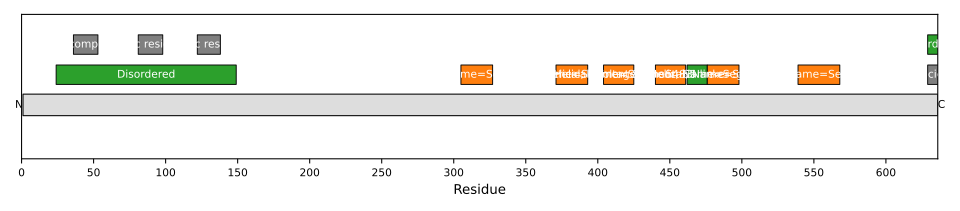
1: Voltage-gated potassium channel that mediates transmembrane potassium transport in excitable membranes. Forms tetrameric potassium-selective channels through which potassium ions pass in accordance with their electrochemical gradient. The channel alternates between opened and closed conformations in response to the voltage difference across the membrane (PubMed:19912772, PubMed:8495559). Can form functional homotetrameric channels and heterotetrameric channels that contain variable proportions of KCNA1, KCNA2, KCNA4, KCNA5, and possibly other family members as well; channel properties depend on the type of alpha subunits that are part of the channel (PubMed:8495559). Channel properties are modulated by cytoplasmic beta subunits that regulate the subcellular location of the alpha subunits and promote rapid inactivation. In vivo, membranes probably contain a mixture of heteromeric potassium channel complexes, making it difficult to assign currents observed in intact tissues to any particular potassium channel family member. Homotetrameric KCNA4 forms a potassium channel that opens in response to membrane depolarization, followed by rapid spontaneous channel closure (PubMed:19912772, PubMed:8495559). Likewise, a heterotetrameric channel formed by KCNA1 and KCNA4 shows rapid inactivation (PubMed:17156368)