Splicing factor, proline- and glutamine-rich (100 kDa DNA-pairing protein) (hPOMp100) (DNA-binding p52/p100 complex, 100 kDa subunit) (Polypyrimidine tract-binding protein-associated-splicing factor) (PSF) (PTB-associated-splicing factor)
1_MSRDR 6_ FRSRG 11_ GGGGG 16_ FHRRG 21_ GGGGR 26_ GGLHD 31_ FRSPP 36_ PGMGL 41_ NQNRG 46_ PMGPG 51_ PGQSG 56_ PKPPI 61_ PPPPP 66_ HQQQQ 71_ QPPPQ 76_ QPPPQ 81_ QPPPH 86_ QPPPH 91_ PQPHQ 96_ QQQPP 101_ PPPQD 106_ SSKPV 111_ VAQGP 116_ GPAPG 121_ VGSAP 126_ PASSS 131_ APPAT 136_ PPTSG 141_ APPGS 146_ GPGPT 151_ PTPPP 156_ AVTSA 161_ PPGAP 166_ PPTPP 171_ SSGVP 176_ TTPPQ 181_ AGGPP 186_ PPPAA 191_ VPGPG 196_ PGPKQ 201_ GPGPG 206_ GPKGG 211_ KMPGG 216_ PKPGG 221_ GPGLS 226_ TPGGH 231_ PKPPH 236_ RGGGE 241_ PRGGR 246_ QHHPP 251_ YHQQH 256_ HQGPP 261_ PGGPG 266_ GRSEE 271_ KISDS 276_ EGFKA 281_ NLSLL 286_ RRPGE 291_ KTYTQ 296_ RCRLF 301_ VGNLP 306_ ADITE 311_ DEFKR 316_ LFAKY 321_ GEPGE 326_ VFINK 331_ GKGFG 336_ FIKLE 341_ SRALA 346_ EIAKA 351_ ELDDT 356_ PMRGR 361_ QLRVR 366_ FATHA 371_ AALSV 376_ RNLSP 381_ YVSNE 386_ LLEEA 391_ FSQFG 396_ PIERA 401_ VVIVD 406_ DRGRS 411_ TGKGI 416_ VEFAS 421_ KPAAR 426_ KAFER 431_ CSEGV 436_ FLLTT 441_ TPRPV 446_ IVEPL 451_ EQLDD 456_ EDGLP 461_ EKLAQ 466_ KNPMY 471_ QKERE 476_ TPPRF 481_ AQHGT 486_ FEYEY 491_ SQRWK 496_ SLDEM 501_ EKQQR 506_ EQVEK 511_ NMKDA 516_ KDKLE 521_ SEMED 526_ AYHEH 531_ QANLL 536_ RQDLM 541_ RRQEE 546_ LRRME 551_ ELHNQ 556_ EMQKR 561_ KEMQL 566_ RQEEE 571_ RRRRE 576_ EEMMI 581_ RQREM 586_ EEQMR 591_ RQREE 596_ SYSRM 601_ GYMDP 606_ RERDM 611_ RMGGG 616_ GAMNM 621_ GDPYG 626_ SGGQK 631_ FPPLG 636_ GGGGI 641_ GYEAN 646_ PGVPP 651_ ATMSG 656_ SMMGS 661_ DMRTE 666_ RFGQG 671_ GAGPV 676_ GGQGP 681_ RGMGP 686_ GTPAG 691_ YGRGR 696_ EEYEG 701_PNKKP
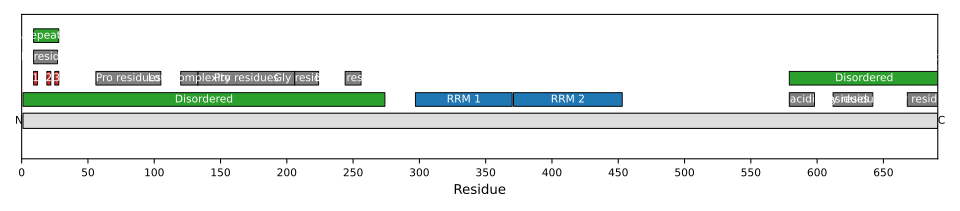
1: DNA- and RNA binding protein, involved in several nuclear processes. Essential pre-mRNA splicing factor required early in spliceosome formation and for splicing catalytic step II, probably as a heteromer with NONO. Binds to pre-mRNA in spliceosome C complex, and specifically binds to intronic polypyrimidine tracts. Involved in regulation of signal-induced alternative splicing. During splicing of PTPRC/CD45, a phosphorylated form is sequestered by THRAP3 from the pre-mRNA in resting T-cells; T-cell activation and subsequent reduced phosphorylation is proposed to lead to release from THRAP3 allowing binding to pre-mRNA splicing regulatotry elements which represses exon inclusion. Interacts with U5 snRNA, probably by binding to a purine-rich sequence located on the 3' side of U5 snRNA stem 1b. May be involved in a pre-mRNA coupled splicing and polyadenylation process as component of a snRNP-free complex with SNRPA/U1A. The SFPQ-NONO heteromer associated with MATR3 may play a role in nuclear retention of defective RNAs. SFPQ may be involved in homologous DNA pairing; in vitro, promotes the invasion of ssDNA between a duplex DNA and produces a D-loop formation. The SFPQ-NONO heteromer may be involved in DNA unwinding by modulating the function of topoisomerase I/TOP1; in vitro, stimulates dissociation of TOP1 from DNA after cleavage and enhances its jumping between separate DNA helices. The SFPQ-NONO heteromer binds DNA (PubMed:25765647). The SFPQ-NONO heteromer may be involved in DNA non-homologous end joining (NHEJ) required for double-strand break repair and V(D)J recombination and may stabilize paired DNA ends; in vitro, the complex strongly stimulates DNA end joining, binds directly to the DNA substrates and cooperates with the Ku70/G22P1-Ku80/XRCC5 (Ku) dimer to establish a functional preligation complex. SFPQ is involved in transcriptional regulation. Functions as a transcriptional activator (PubMed:25765647). Transcriptional repression is mediated by an interaction of SFPQ with SIN3A and subsequent recruitment of histone deacetylases (HDACs). The SFPQ-NONO-NR5A1 complex binds to the CYP17 promoter and regulates basal and cAMP-dependent transcriptional activity. SFPQ isoform Long binds to the DNA binding domains (DBD) of nuclear hormone receptors, like RXRA and probably THRA, and acts as a transcriptional corepressor in absence of hormone ligands. Binds the DNA sequence 5'-CTGAGTC-3' in the insulin-like growth factor response element (IGFRE) and inhibits IGF1-stimulated transcriptional activity. Regulates the circadian clock by repressing the transcriptional activator activity of the CLOCK-BMAL1 heterodimer. Required for the transcriptional repression of circadian target genes, such as PER1, mediated by the large PER complex through histone deacetylation (By similarity). Required for the assembly of nuclear speckles (PubMed:25765647). Plays a role in the regulation of DNA virus-mediated innate immune response by assembling into the HDP-RNP complex, a complex that serves as a platform for IRF3 phosphorylation and subsequent innate immune response activation through the cGAS-STING pathway (PubMed:28712728)