Cerebellin-1 (Precerebellin) [Cleaved into: Cerebellin (CER); [des-Ser1]-cerebellin]
1_MLGVL 6_ ELLLL 11_ GAAWL 16_ AGPAR 21_ GQNET 26_ EPIVL 31_ EGKCL 36_ VVCDS 41_ NPTSD 46_ PTGTA 51_ LGISV 56_ RSGSA 61_ KVAFS 66_ AIRST 71_ NHEPS 76_ EMSNR 81_ TMIIY 86_ FDQVL 91_ VNIGN 96_ NFDSE 101_ RSTFI 106_ APRKG 111_ IYSFN 116_ FHVVK 121_ VYNRQ 126_ TIQVS 131_ LMLNG 136_ WPVIS 141_ AFAGD 146_ QDVTR 151_ EAASN 156_ GVLIQ 161_ MEKGD 166_ RAYLK 171_ LERGN 176_ LMGGW 181_ KYSTF 186_SGFLV
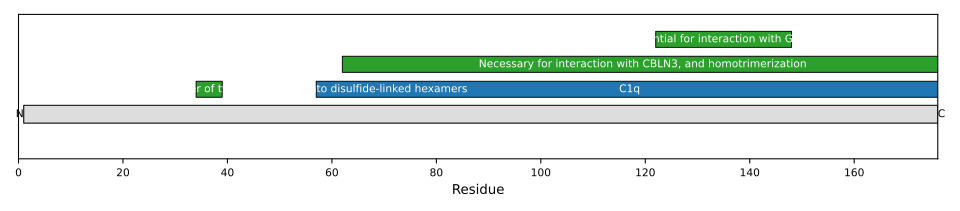
1: Required for synapse integrity and synaptic plasticity. During cerebellar synapse formation, essential for the matching and maintenance of pre- and post-synaptic elements at parallel fiber-Purkinje cell synapses, the establishment of the proper pattern of climbing fiber-Purkinje cell innervation, and induction of long-term depression at parallel fiber-Purkinje cell synapses. Plays a role as a synaptic organizer that acts bidirectionally on both pre- and post-synaptic components. On the one hand induces accumulation of synaptic vesicles in the pre-synaptic part by binding with NRXN1 and in other hand induces clustering of GRID2 and its associated proteins at the post-synaptic site through association of GRID2. NRXN1-CBLN1-GRID2 complex directly induces parallel fiber protrusions that encapsulate spines of Purkinje cells leading to accumulation of GRID2 and synaptic vesicles. Required for CBLN3 export from the endoplasmic reticulum and secretion (By similarity). NRXN1-CBLN1-GRID2 complex mediates the D-Serine-dependent long term depression signals and AMPA receptor endocytosis (PubMed:27418511). Essential for long-term maintenance but not establishment of excitatory synapses (By similarity). Inhibits the formation and function of inhibitory GABAergic synapses in cerebellar Purkinje cells (By similarity)
2: The cerebellin peptide exerts neuromodulatory functions. Directly stimulates norepinephrine release via the adenylate cyclase/PKA-dependent signaling pathway; and indirectly enhances adrenocortical secretion in vivo, through a paracrine mechanism involving medullary catecholamine release (By similarity)