Ribosomal protein S6 kinase beta-1 (S6K-beta-1) (S6K1) (EC 2.7.11.1) (70 kDa ribosomal protein S6 kinase 1) (P70S6K1) (p70-S6K 1) (Ribosomal protein S6 kinase I) (Serine/threonine-protein kinase 14A) (p70 ribosomal S6 kinase alpha) (p70 S6 kinase alpha) (p70 S6K-alpha) (p70 S6KA)
1_MRRRR 6_ RRDGF 11_ YPAPD 16_ FRDRE 21_ AEDMA 26_ GVFDI 31_ DLDQP 36_ EDAGS 41_ EDELE 46_ EGGQL 51_ NESMD 56_ HGGVG 61_ PYELG 66_ MEHCE 71_ KFEIS 76_ ETSVN 81_ RGPEK 86_ IRPEC 91_ FELLR 96_ VLGKG 101_ GYGKV 106_ FQVRK 111_ VTGAN 116_ TGKIF 121_ AMKVL 126_ KKAMI 131_ VRNAK 136_ DTAHT 141_ KAERN 146_ ILEEV 151_ KHPFI 156_ VDLIY 161_ AFQTG 166_ GKLYL 171_ ILEYL 176_ SGGEL 181_ FMQLE 186_ REGIF 191_ MEDTA 196_ CFYLA 201_ EISMA 206_ LGHLH 211_ QKGII 216_ YRDLK 221_ PENIM 226_ LNHQG 231_ HVKLT 236_ DFGLC 241_ KESIH 246_ DGTVT 251_ HTFCG 256_ TIEYM 261_ APEIL 266_ MRSGH 271_ NRAVD 276_ WWSLG 281_ ALMYD 286_ MLTGA 291_ PPFTG 296_ ENRKK 301_ TIDKI 306_ LKCKL 311_ NLPPY 316_ LTQEA 321_ RDLLK 326_ KLLKR 331_ NAASR 336_ LGAGP 341_ GDAGE 346_ VQAHP 351_ FFRHI 356_ NWEEL 361_ LARKV 366_ EPPFK 371_ PLLQS 376_ EEDVS 381_ QFDSK 386_ FTRQT 391_ PVDSP 396_ DDSTL 401_ SESAN 406_ QVFLG 411_ FTYVA 416_ PSVLE 421_ SVKEK 426_ FSFEP 431_ KIRSP 436_ RRFIG 441_ SPRTP 446_ VSPVK 451_ FSPGD 456_ FWGRG 461_ ASAST 466_ ANPQT 471_ PVEYP 476_ METSG 481_ IEQMD 486_ VTMSG 491_ EASAP 496_ LPIRQ 501_ PNSGP 506_ YKKQA 511_ FPMIS 516_KRPEH
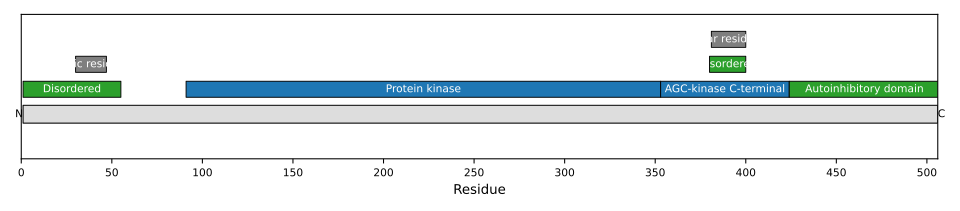
1: Serine/threonine-protein kinase that acts downstream of mTOR signaling in response to growth factors and nutrients to promote cell proliferation, cell growth and cell cycle progression (PubMed:11500364, PubMed:12801526, PubMed:14673156, PubMed:15071500, PubMed:15341740, PubMed:16286006, PubMed:17052453, PubMed:17053147, PubMed:17936702, PubMed:18952604, PubMed:19085255, PubMed:19720745, PubMed:19935711, PubMed:19995915, PubMed:22017876, PubMed:23429703, PubMed:28178239). Regulates protein synthesis through phosphorylation of EIF4B, RPS6 and EEF2K, and contributes to cell survival by repressing the pro-apoptotic function of BAD (PubMed:11500364, PubMed:12801526, PubMed:14673156, PubMed:15071500, PubMed:15341740, PubMed:16286006, PubMed:17052453, PubMed:17053147, PubMed:17936702, PubMed:18952604, PubMed:19085255, PubMed:19720745, PubMed:19935711, PubMed:19995915, PubMed:22017876, PubMed:23429703, PubMed:28178239). Under conditions of nutrient depletion, the inactive form associates with the EIF3 translation initiation complex (PubMed:16286006). Upon mitogenic stimulation, phosphorylation by the mechanistic target of rapamycin complex 1 (mTORC1) leads to dissociation from the EIF3 complex and activation (PubMed:16286006). The active form then phosphorylates and activates several substrates in the pre-initiation complex, including the EIF2B complex and the cap-binding complex component EIF4B (PubMed:16286006). Also controls translation initiation by phosphorylating a negative regulator of EIF4A, PDCD4, targeting it for ubiquitination and subsequent proteolysis (PubMed:17053147). Promotes initiation of the pioneer round of protein synthesis by phosphorylating POLDIP3/SKAR (PubMed:15341740). In response to IGF1, activates translation elongation by phosphorylating EEF2 kinase (EEF2K), which leads to its inhibition and thus activation of EEF2 (PubMed:11500364). Also plays a role in feedback regulation of mTORC2 by mTORC1 by phosphorylating MAPKAP1/SIN1, MTOR and RICTOR, resulting in the inhibition of mTORC2 and AKT1 signaling (PubMed:15899889, PubMed:19720745, PubMed:19935711, PubMed:19995915). Also involved in feedback regulation of mTORC1 and mTORC2 by phosphorylating DEPTOR (PubMed:22017876). Mediates cell survival by phosphorylating the pro-apoptotic protein BAD and suppressing its pro-apoptotic function (By similarity). Phosphorylates mitochondrial URI1 leading to dissociation of a URI1-PPP1CC complex (PubMed:17936702). The free mitochondrial PPP1CC can then dephosphorylate RPS6KB1 at Thr-412, which is proposed to be a negative feedback mechanism for the RPS6KB1 anti-apoptotic function (PubMed:17936702). Mediates TNF-alpha-induced insulin resistance by phosphorylating IRS1 at multiple serine residues, resulting in accelerated degradation of IRS1 (PubMed:18952604). In cells lacking functional TSC1-2 complex, constitutively phosphorylates and inhibits GSK3B (PubMed:17052453). May be involved in cytoskeletal rearrangement through binding to neurabin (By similarity). Phosphorylates and activates the pyrimidine biosynthesis enzyme CAD, downstream of MTOR (PubMed:23429703). Following activation by mTORC1, phosphorylates EPRS and thereby plays a key role in fatty acid uptake by adipocytes and also most probably in interferon-gamma-induced translation inhibition (PubMed:28178239)