DNA-directed RNA polymerase II subunit RPB1 (RNA polymerase II subunit B1) (EC 2.7.7.6) (DNA-directed RNA polymerase II subunit A) (DNA-directed RNA polymerase III largest subunit) (RNA-directed RNA polymerase II subunit RPB1) (EC 2.7.7.48)
1_MHGGG 6_ PPSGD 11_ SACPL 16_ RTIKR 21_ VQFGV 26_ LSPDE 31_ LKRMS 36_ VTEGG 41_ IKYPE 46_ TTEGG 51_ RPKLG 56_ GLMDP 61_ RQGVI 66_ ERTGR 71_ CQTCA 76_ GNMTE 81_ CPGHF 86_ GHIEL 91_ AKPVF 96_ HVGFL 101_ VKTMK 106_ VLRCV 111_ CFFCS 116_ KLLVD 121_ SNNPK 126_ IKDIL 131_ AKSKG 136_ QPKKR 141_ LTHVY 146_ DLCKG 151_ KNICE 156_ GGEEM 161_ DNKFG 166_ VEQPE 171_ GDEDL 176_ TKEKG 181_ HGGCG 186_ RYQPR 191_ IRRSG 196_ LELYA 201_ EWKHV 206_ NEDSQ 211_ EKKIL 216_ LSPER 221_ VHEIF 226_ KRISD 231_ EECFV 236_ LGMEP 241_ RYARP 246_ EWMIV 251_ TVLPV 256_ PPLSV 261_ RPAVV 266_ MQGSA 271_ RNQDD 276_ LTHKL 281_ ADIVK 286_ INNQL 291_ RRNEQ 296_ NGAAA 301_ HVIAE 306_ DVKLL 311_ QFHVA 316_ TMVDN 321_ ELPGL 326_ PRAMQ 331_ KSGRP 336_ LKSLK 341_ QRLKG 346_ KEGRV 351_ RGNLM 356_ GKRVD 361_ FSART 366_ VITPD 371_ PNLSI 376_ DQVGV 381_ PRSIA 386_ ANMTF 391_ AEIVT 396_ PFNID 401_ RLQEL 406_ VRRGN 411_ SQYPG 416_ AKYII 421_ RDNGD 426_ RIDLR 431_ FHPKP 436_ SDLHL 441_ QTGYK 446_ VERHM 451_ CDGDI 456_ VIFNR 461_ QPTLH 466_ KMSMM 471_ GHRVR 476_ ILPWS 481_ TFRLN 486_ LSVTT 491_ PYNAD 496_ FDGDE 501_ MNLHL 506_ PQSLE 511_ TRAEI 516_ QELAM 521_ VPRMI 526_ VTPQS 531_ NRPVM 536_ GIVQD 541_ TLTAV 546_ RKFTK 551_ RDVFL 556_ ERGEV 561_ MNLLM 566_ FLSTW 571_ DGKVP 576_ QPAIL 581_ KPRPL 586_ WTGKQ 591_ IFSLI 596_ IPGHI 601_ NCIRT 606_ HSTHP 611_ DDEDS 616_ GPYKH 621_ ISPGD 626_ TKVVV 631_ ENGEL 636_ IMGIL 641_ CKKSL 646_ GTSAG 651_ SLVHI 656_ SYLEM 661_ GHDIT 666_ RLFYS 671_ NIQTV 676_ INNWL 681_ LIEGH 686_ TIGIG 691_ DSIAD 696_ SKTYQ 701_ DIQNT 706_ IKKAK 711_ QDVIE 716_ VIEKA 721_ HNNEL 726_ EPTPG 731_ NTLRQ 736_ TFENQ 741_ VNRIL 746_ NDARD 751_ KTGSS 756_ AQKSL 761_ SEYNN 766_ FKSMV 771_ VSGAK 776_ GSKIN 781_ ISQVI 786_ AVVGQ 791_ QNVEG 796_ KRIPF 801_ GFKHR 806_ TLPHF 811_ IKDDY 816_ GPESR 821_ GFVEN 826_ SYLAG 831_ LTPTE 836_ FFFHA 841_ MGGRE 846_ GLIDT 851_ AVKTA 856_ ETGYI 861_ QRRLI 866_ KSMES 871_ VMVKY 876_ DATVR 881_ NSINQ 886_ VVQLR 891_ YGEDG 896_ LAGES 901_ VEFQN 906_ LATLK 911_ PSNKA 916_ FEKKF 921_ RFDYT 926_ NERAL 931_ RRTLQ 936_ EDLVK 941_ DVLSN 946_ AHIQN 951_ ELERE 956_ FERMR 961_ EDREV 966_ LRVIF 971_ PTGDS 976_ KVVLP 981_ CNLLR 986_ MIWNA 991_ QKIFH 996_ INPRL 1001_ PSDLH 1006_ PIKVV 1011_ EGVKE 1016_ LSKKL 1021_ VIVNG 1026_ DDPLS 1031_ RQAQE 1036_ NATLL 1041_ FNIHL 1046_ RSTLC 1051_ SRRMA 1056_ EEFRL 1061_ SGEAF 1066_ DWLLG 1071_ EIESK 1076_ FNQAI 1081_ AHPGE 1086_ MVGAL 1091_ AAQSL 1096_ GEPAT 1101_ QMTLN 1106_ TFHYA 1111_ GVSAK 1116_ NVTLG 1121_ VPRLK 1126_ ELINI 1131_ SKKPK 1136_ TPSLT 1141_ VFLLG 1146_ QSARD 1151_ AERAK 1156_ DILCR 1161_ LEHTT 1166_ LRKVT 1171_ ANTAI 1176_ YYDPN 1181_ PQSTV 1186_ VAEDQ 1191_ EWVNV 1196_ YYEMP 1201_ DFDVA 1206_ RISPW 1211_ LLRVE 1216_ LDRKH 1221_ MTDRK 1226_ LTMEQ 1231_ IAEKI 1236_ NAGFG 1241_ DDLNC 1246_ IFNDD 1251_ NAEKL 1256_ VLRIR 1261_ IMNSD 1266_ ENKMQ 1271_ EEEEV 1276_ VDKMD 1281_ DDVFL 1286_ RCIES 1291_ NMLTD 1296_ MTLQG 1301_ IEQIS 1306_ KVYMH 1311_ LPQTD 1316_ NKKKI 1321_ IITED 1326_ GEFKA 1331_ LQEWI 1336_ LETDG 1341_ VSLMR 1346_ VLSEK 1351_ DVDPV 1356_ RTTSN 1361_ DIVEI 1366_ FTVLG 1371_ IEAVR 1376_ KALER 1381_ ELYHV 1386_ ISFDG 1391_ SYVNY 1396_ RHLAL 1401_ LCDTM 1406_ TCRGH 1411_ LMAIT 1416_ RHGVN 1421_ RQDTG 1426_ PLMKC 1431_ SFEET 1436_ VDVLM 1441_ EAAAH 1446_ GESDP 1451_ MKGVS 1456_ ENIML 1461_ GQLAP 1466_ AGTGC 1471_ FDLLL 1476_ DAEKC 1481_ KYGME 1486_ IPTNI 1491_ PGLGA 1496_ AGPTG 1501_ MFFGS 1506_ APSPM 1511_ GGISP 1516_ AMTPW 1521_ NQGAT 1526_ PAYGA 1531_ WSPSV 1536_ GSGMT 1541_ PGAAG 1546_ FSPSA 1551_ ASDAS 1556_ GFSPG 1561_ YSPAW 1566_ SPTPG 1571_ SPGSP 1576_ GPSSP 1581_ YIPSP 1586_ GGAMS 1591_ PSYSP 1596_ TSPAY 1601_ EPRSP 1606_ GGYTP 1611_ QSPSY 1616_ SPTSP 1621_ SYSPT 1626_ SPSYS 1631_ PTSPN 1636_ YSPTS 1641_ PSYSP 1646_ TSPSY 1651_ SPTSP 1656_ SYSPT 1661_ SPSYS 1666_ PTSPS 1671_ YSPTS 1676_ PSYSP 1681_ TSPSY 1686_ SPTSP 1691_ SYSPT 1696_ SPSYS 1701_ PTSPS 1706_ YSPTS 1711_ PSYSP 1716_ TSPSY 1721_ SPTSP 1726_ SYSPT 1731_ SPSYS 1736_ PTSPS 1741_ YSPTS 1746_ PNYSP 1751_ TSPNY 1756_ TPTSP 1761_ SYSPT 1766_ SPSYS 1771_ PTSPN 1776_ YTPTS 1781_ PNYSP 1786_ TSPSY 1791_ SPTSP 1796_ SYSPT 1801_ SPSYS 1806_ PSSPR 1811_ YTPQS 1816_ PTYTP 1821_ SSPSY 1826_ SPSSP 1831_ SYSPA 1836_ SPKYT 1841_ PTSPS 1846_ YSPSS 1851_ PEYTP 1856_ TSPKY 1861_ SPTSP 1866_ KYSPT 1871_ SPKYS 1876_ PTSPT 1881_ YSPTT 1886_ PKYSP 1891_ TSPTY 1896_ SPTSP 1901_ VYTPT 1906_ SPKYS 1911_ PTSPT 1916_ YSPTS 1921_ PKYSP 1926_ TSPTY 1931_ SPTSP 1936_ KGSTY 1941_ SPTSP 1946_ GYSPT 1951_ SPTYS 1956_ LTSPA 1961_ISPDD
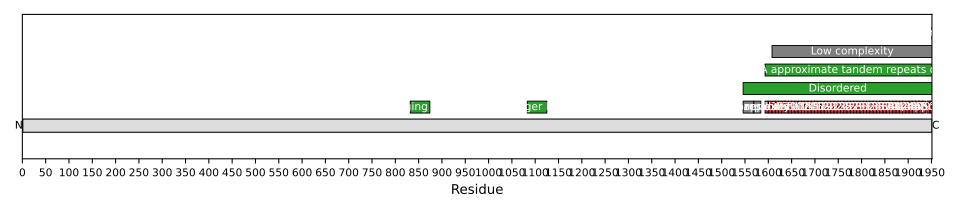
1: Catalytic core component of RNA polymerase II (Pol II), a DNA-dependent RNA polymerase which synthesizes mRNA precursors and many functional non-coding RNAs using the four ribonucleoside triphosphates as substrates (By similarity) (PubMed:23748380, PubMed:27193682, PubMed:30190596, PubMed:9852112). Pol II-mediated transcription cycle proceeds through transcription initiation, transcription elongation and transcription termination stages. During transcription initiation, Pol II pre-initiation complex (PIC) is recruited to DNA promoters, with focused-type promoters containing either the initiator (Inr) element, or the TATA-box found in cell-type specific genes and dispersed-type promoters that often contain hypomethylated CpG islands usually found in housekeeping genes. Once the polymerase has escaped from the promoter it enters the elongation phase during which RNA is actively polymerized, based on complementarity with the template DNA strand. Transcription termination involves the release of the RNA transcript and polymerase from the DNA (By similarity) (PubMed:23748380, PubMed:27193682, PubMed:28108474, PubMed:30190596, PubMed:9852112). Forms Pol II active center together with the second largest subunit POLR2B/RPB2. Appends one nucleotide at a time to the 3' end of the nascent RNA, with POLR2A/RPB1 most likely contributing a Mg(2+)-coordinating DxDGD motif, and POLR2B/RPB2 participating in the coordination of a second Mg(2+) ion and providing lysine residues believed to facilitate Watson-Crick base pairing between the incoming nucleotide and template base. Typically, Mg(2+) ions direct a 5' nucleoside triphosphate to form a phosphodiester bond with the 3' hydroxyl of the preceding nucleotide of the nascent RNA, with the elimination of pyrophosphate. The reversible pyrophosphorolysis can occur at high pyrophosphate concentrations (By similarity) (PubMed:30190596, PubMed:8381534, PubMed:9852112). Can proofread the nascent RNA transcript by means of a 3' -> 5' exonuclease activity. If a ribonucleotide is mis-incorporated, backtracks along the template DNA and cleaves the phosphodiester bond releasing the mis-incorporated 5'-ribonucleotide (By similarity) (PubMed:8381534). Through its unique C-terminal domain (CTD, 52 heptapeptide tandem repeats) serves as a platform for assembly of factors that regulate transcription initiation, elongation and termination. CTD phosphorylation on Ser-5 mediates Pol II promoter escape, whereas phosphorylation on Ser-2 is required for Pol II pause release during transcription elongation and further pre-mRNA processing. Additionally, the regulation of gene expression levels depends on the balance between methylation and acetylation levels of the CTD-lysines. Initiation or early elongation steps of transcription of growth-factor-induced immediate early genes are regulated by the acetylation status of the CTD. Methylation and dimethylation have a repressive effect on target genes expression. Cooperates with mRNA splicing machinery in co-transcriptional 5'-end capping and co-transcriptional splicing of pre-mRNA (By similarity) (PubMed:24207025, PubMed:26124092)
2: RNA-dependent RNA polymerase that catalyzes the extension of a non-coding RNA (ncRNA) at the 3'-end using the four ribonucleoside triphosphates as substrates. An internal ncRNA sequence near the 3'-end serves as a template in a single-round Pol II-mediated RNA polymerization reaction. May decrease the stability of ncRNAs that repress Pol II-mediated gene transcription
3: (Microbial infection) Acts as an RNA-dependent RNA polymerase when associated with small delta antigen of Hepatitis delta virus, acting both as a replicase and transcriptase for the viral RNA circular genome