mRNA decay activator protein ZFP36 (G0/G1 switch regulatory protein 24) (Growth factor-inducible nuclear protein NUP475) (Tristetraprolin) (Zinc finger protein 36) (Zfp-36)
1_MDLTA 6_ IYESL 11_ LSLSP 16_ DVPVP 21_ SDHGG 26_ TESSP 31_ GWGSS 36_ GPWSL 41_ SPSDS 46_ SPSGV 51_ TSRLP 56_ GRSTS 61_ LVEGR 66_ SCGWV 71_ PPPPG 76_ FAPLA 81_ PRLGP 86_ ELSPS 91_ PTSPT 96_ ATSTT 101_ PSRYK 106_ TELCR 111_ TFSES 116_ GRCRY 121_ GAKCQ 126_ FAHGL 131_ GELRQ 136_ ANRHP 141_ KYKTE 146_ LCHKF 151_ YLQGR 156_ CPYGS 161_ RCHFI 166_ HNPSE 171_ DLAAP 176_ GHPPV 181_ LRQSI 186_ SFSGL 191_ PSGRR 196_ TSPPP 201_ PGLAG 206_ PSLSS 211_ SSFSP 216_ SSSPP 221_ PPGDL 226_ PLSPS 231_ AFSAA 236_ PGTPL 241_ ARRDP 246_ TPVCC 251_ PSCRR 256_ ATPIS 261_ VWGPL 266_ GGLVR 271_ TPSVQ 276_ SLGSD 281_ PDEYA 286_ SSGSS 291_ LGGSD 296_ SPVFE 301_ AGVFA 306_ PPQPV 311_ AAPRR 316_ LPIFN 321_RISVS
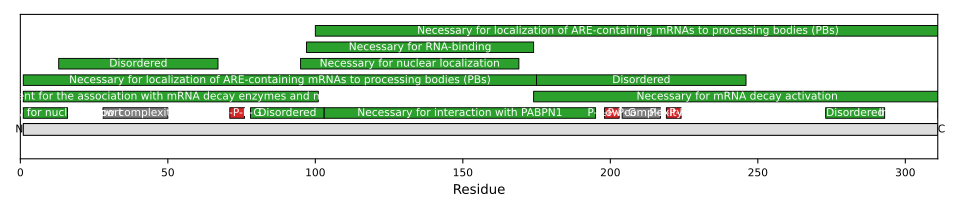
1: Zinc-finger RNA-binding protein that destabilizes several cytoplasmic AU-rich element (ARE)-containing mRNA transcripts by promoting their poly(A) tail removal or deadenylation, and hence provide a mechanism for attenuating protein synthesis (PubMed:10330172, PubMed:10751406, PubMed:11279239, PubMed:12115244, PubMed:12748283, PubMed:15187101, PubMed:15634918, PubMed:16702957, PubMed:17030620, PubMed:20221403, PubMed:20702587, PubMed:21775632, PubMed:23644599, PubMed:25815583, PubMed:27193233, PubMed:31439631, PubMed:9703499). Acts as an 3'-untranslated region (UTR) ARE mRNA-binding adapter protein to communicate signaling events to the mRNA decay machinery (PubMed:15687258, PubMed:23644599). Recruits deadenylase CNOT7 (and probably the CCR4-NOT complex) via association with CNOT1, and hence promotes ARE-mediated mRNA deadenylation (PubMed:23644599). Functions also by recruiting components of the cytoplasmic RNA decay machinery to the bound ARE-containing mRNAs (PubMed:11719186, PubMed:12748283, PubMed:15687258, PubMed:16364915). Self regulates by destabilizing its own mRNA (PubMed:15187101). Binds to 3'-UTR ARE of numerous mRNAs and of its own mRNA (PubMed:10330172, PubMed:10751406, PubMed:12115244, PubMed:15187101, PubMed:15634918, PubMed:16702957, PubMed:17030620, PubMed:19188452, PubMed:20221403, PubMed:20702587, PubMed:21775632, PubMed:25815583). Plays a role in anti-inflammatory responses; suppresses tumor necrosis factor (TNF)-alpha production by stimulating ARE-mediated TNF-alpha mRNA decay and several other inflammatory ARE-containing mRNAs in interferon (IFN)- and/or lipopolysaccharide (LPS)-induced macrophages (By similarity). Also plays a role in the regulation of dendritic cell maturation at the post-transcriptional level, and hence operates as part of a negative feedback loop to limit the inflammatory response (PubMed:18367721). Promotes ARE-mediated mRNA decay of hypoxia-inducible factor HIF1A mRNA during the response of endothelial cells to hypoxia (PubMed:21775632). Positively regulates early adipogenesis of preadipocytes by promoting ARE-mediated mRNA decay of immediate early genes (IEGs) (By similarity). Negatively regulates hematopoietic/erythroid cell differentiation by promoting ARE-mediated mRNA decay of the transcription factor STAT5B mRNA (PubMed:20702587). Plays a role in maintaining skeletal muscle satellite cell quiescence by promoting ARE-mediated mRNA decay of the myogenic determination factor MYOD1 mRNA (By similarity). Associates also with and regulates the expression of non-ARE-containing target mRNAs at the post-transcriptional level, such as MHC class I mRNAs (PubMed:18367721). Participates in association with argonaute RISC catalytic components in the ARE-mediated mRNA decay mechanism; assists microRNA (miRNA) targeting ARE-containing mRNAs (PubMed:15766526). May also play a role in the regulation of cytoplasmic mRNA decapping; enhances decapping of ARE-containing RNAs, in vitro (PubMed:16364915). Involved in the delivery of target ARE-mRNAs to processing bodies (PBs) (PubMed:17369404). In addition to its cytosolic mRNA-decay function, affects nuclear pre-mRNA processing (By similarity). Negatively regulates nuclear poly(A)-binding protein PABPN1-stimulated polyadenylation activity on ARE-containing pre-mRNA during LPS-stimulated macrophages (By similarity). Also involved in the regulation of stress granule (SG) and P-body (PB) formation and fusion (By similarity). Plays a role in the regulation of keratinocyte proliferation, differentiation and apoptosis (PubMed:27182009). Plays a role as a tumor suppressor by inhibiting cell proliferation in breast cancer cells (PubMed:26926077)
2: (Microbial infection) Negatively regulates HTLV-1 TAX-dependent transactivation of viral long terminal repeat (LTR) promoter