NKG2-A/NKG2-B type II integral membrane protein (CD159 antigen-like family member A) (NK cell receptor A) (NKG2-A/B-activating NK receptor) (CD antigen CD159a)
1_MDNQG 6_ VIYSD 11_ LNLPP 16_ NPKRQ 21_ QRKPK 26_ GNKNS 31_ ILATE 36_ QEITY 41_ AELNL 46_ QKASQ 51_ DFQGN 56_ DKTYH 61_ CKDLP 66_ SAPEK 71_ LIVGI 76_ LGIIC 81_ LILMA 86_ SVVTI 91_ VVIPS 96_ TLIQR 101_ HNNSS 106_ LNTRT 111_ QKARH 116_ CGHCP 121_ EEWIT 126_ YSNSC 131_ YYIGK 136_ ERRTW 141_ EESLL 146_ ACTSK 151_ NSSLL 156_ SIDNE 161_ EEMKF 166_ LSIIS 171_ PSSWI 176_ GVFRN 181_ SSHHP 186_ WVTMN 191_ GLAFK 196_ HEIKD 201_ SDNAE 206_ LNCAV 211_ LQVNR 216_ LKSAQ 221_ CGSSI 226_IYHCK
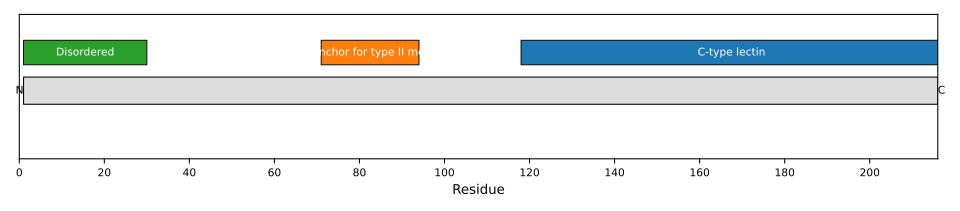
1: Immune inhibitory receptor involved in self-nonself discrimination. In complex with KLRD1 on cytotoxic and regulatory lymphocyte subsets, recognizes non-classical major histocompatibility (MHC) class Ib molecule HLA-E loaded with self-peptides derived from the signal sequence of classical MHC class Ia molecules. Enables cytotoxic cells to monitor the expression of MHC class I molecules in healthy cells and to tolerate self (PubMed:18083576, PubMed:37264229, PubMed:9430220, PubMed:9486650). Upon HLA-E-peptide binding, transmits intracellular signals through two immunoreceptor tyrosine-based inhibition motifs (ITIMs) by recruiting INPP5D/SHP-1 and INPPL1/SHP-2 tyrosine phosphatases to ITIMs, and ultimately opposing signals transmitted by activating receptors through dephosphorylation of proximal signaling molecules (PubMed:12165520, PubMed:9485206). Key inhibitory receptor on natural killer (NK) cells that regulates their activation and effector functions (PubMed:30860984, PubMed:9430220, PubMed:9485206, PubMed:9486650). Dominantly counteracts T cell receptor signaling on a subset of memory/effector CD8-positive T cells as part of an antigen-driven response to avoid autoimmunity (PubMed:12387742). On intraepithelial CD8-positive gamma-delta regulatory T cells triggers TGFB1 secretion, which in turn limits the cytotoxic programming of intraepithelial CD8-positive alpha-beta T cells, distinguishing harmless from pathogenic antigens (PubMed:18064301). In HLA-E-rich tumor microenvironment, acts as an immune inhibitory checkpoint and may contribute to progressive loss of effector functions of NK cells and tumor-specific T cells, a state known as cell exhaustion (PubMed:30503213, PubMed:30860984)
2: (Microbial infection) Viruses like human cytomegalovirus have evolved an escape mechanism whereby virus-induced down-regulation of host MHC class I molecules is coupled to the binding of viral peptides to HLA-E, restoring HLA-E expression and inducing HLA-E-dependent NK cell immune tolerance to infected cells. Recognizes HLA-E in complex with human cytomegalovirus UL40-derived peptide (VMAPRTLIL) and inhibits NK cell cytotoxicity
3: (Microbial infection) May recognize HLA-E in complex with HIV-1 gag/Capsid protein p24-derived peptide (AISPRTLNA) on infected cells and may inhibit NK cell cytotoxicity, a mechanism that allows HIV-1 to escape immune recognition
4: (Microbial infection) Upon SARS-CoV-2 infection, may contribute to functional exhaustion of cytotoxic NK cells and CD8-positive T cells (PubMed:32203188, PubMed:32859121). On NK cells, may recognize HLA-E in complex with SARS-CoV-2 S/Spike protein S1-derived peptide (LQPRTFLL) expressed on the surface of lung epithelial cells, inducing NK cell exhaustion and dampening antiviral immune surveillance (PubMed:32859121)