Mitogen-activated protein kinase 3 (MAP kinase 3) (MAPK 3) (EC 2.7.11.24) (ERT2) (Extracellular signal-regulated kinase 1) (ERK-1) (Insulin-stimulated MAP2 kinase) (MAP kinase isoform p44) (p44-MAPK) (Microtubule-associated protein 2 kinase) (p44-ERK1)
1_MAAAA 6_ AQGGG 11_ GGEPR 16_ RTEGV 21_ GPGVP 26_ GEVEM 31_ VKGQP 36_ FDVGP 41_ RYTQL 46_ QYIGE 51_ GAYGM 56_ VSSAY 61_ DHVRK 66_ TRVAI 71_ KKISP 76_ FEHQT 81_ YCQRT 86_ LREIQ 91_ ILLRF 96_ RHENV 101_ IGIRD 106_ ILRAS 111_ TLEAM 116_ RDVYI 121_ VQDLM 126_ ETDLY 131_ KLLKS 136_ QQLSN 141_ DHICY 146_ FLYQI 151_ LRGLK 156_ YIHSA 161_ NVLHR 166_ DLKPS 171_ NLLIN 176_ TTCDL 181_ KICDF 186_ GLARI 191_ ADPEH 196_ DHTGF 201_ LTEYV 206_ ATRWY 211_ RAPEI 216_ MLNSK 221_ GYTKS 226_ IDIWS 231_ VGCIL 236_ AEMLS 241_ NRPIF 246_ PGKHY 251_ LDQLN 256_ HILGI 261_ LGSPS 266_ QEDLN 271_ CIINM 276_ KARNY 281_ LQSLP 286_ SKTKV 291_ AWAKL 296_ FPKSD 301_ SKALD 306_ LLDRM 311_ LTFNP 316_ NKRIT 321_ VEEAL 326_ AHPYL 331_ EQYYD 336_ PTDEP 341_ VAEEP 346_ FTFAM 351_ ELDDL 356_ PKERL 361_ KELIF 366_ QETAR 371_FQPGV
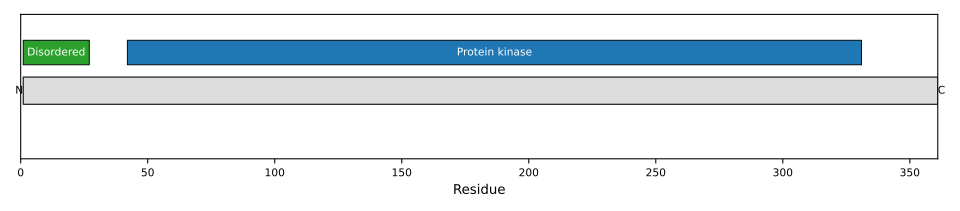
1: Serine/threonine kinase which acts as an essential component of the MAP kinase signal transduction pathway (PubMed:34497368). MAPK1/ERK2 and MAPK3/ERK1 are the 2 MAPKs which play an important role in the MAPK/ERK cascade. They participate also in a signaling cascade initiated by activated KIT and KITLG/SCF. Depending on the cellular context, the MAPK/ERK cascade mediates diverse biological functions such as cell growth, adhesion, survival and differentiation through the regulation of transcription, translation, cytoskeletal rearrangements. The MAPK/ERK cascade also plays a role in initiation and regulation of meiosis, mitosis, and postmitotic functions in differentiated cells by phosphorylating a number of transcription factors. About 160 substrates have already been discovered for ERKs. Many of these substrates are localized in the nucleus, and seem to participate in the regulation of transcription upon stimulation. However, other substrates are found in the cytosol as well as in other cellular organelles, and those are responsible for processes such as translation, mitosis and apoptosis. Moreover, the MAPK/ERK cascade is also involved in the regulation of the endosomal dynamics, including lysosome processing and endosome cycling through the perinuclear recycling compartment (PNRC); as well as in the fragmentation of the Golgi apparatus during mitosis. The substrates include transcription factors (such as ATF2, BCL6, ELK1, ERF, FOS, HSF4 or SPZ1), cytoskeletal elements (such as CANX, CTTN, GJA1, MAP2, MAPT, PXN, SORBS3 or STMN1), regulators of apoptosis (such as BAD, BTG2, CASP9, DAPK1, IER3, MCL1 or PPARG), regulators of translation (such as EIF4EBP1) and a variety of other signaling-related molecules (like ARHGEF2, DEPTOR, FRS2 or GRB10) (PubMed:35216969). Protein kinases (such as RAF1, RPS6KA1/RSK1, RPS6KA3/RSK2, RPS6KA2/RSK3, RPS6KA6/RSK4, SYK, MKNK1/MNK1, MKNK2/MNK2, RPS6KA5/MSK1, RPS6KA4/MSK2, MAPKAPK3 or MAPKAPK5) and phosphatases (such as DUSP1, DUSP4, DUSP6 or DUSP16) are other substrates which enable the propagation the MAPK/ERK signal to additional cytosolic and nuclear targets, thereby extending the specificity of the cascade