Replication protein A 70 kDa DNA-binding subunit (RP-A p70) (Replication factor A protein 1) (RF-A protein 1) (Single-stranded DNA-binding protein) [Cleaved into: Replication protein A 70 kDa DNA-binding subunit, N-terminally processed]
1_MVGQL 6_ SEGAI 11_ AAIMQ 16_ KGDTN 21_ IKPIL 26_ QVINI 31_ RPITT 36_ GNSPP 41_ RYRLL 46_ MSDGL 51_ NTLSS 56_ FMLAT 61_ QLNPL 66_ VEEEQ 71_ LSSNC 76_ VCQIH 81_ RFIVN 86_ TLKDG 91_ RRVVI 96_ LMELE 101_ VLKSA 106_ EAVGV 111_ KIGNP 116_ VPYNE 121_ GLGQP 126_ QVAPP 131_ APAAS 136_ PAASS 141_ RPQPQ 146_ NGSSG 151_ MGSTV 156_ SKAYG 161_ ASKTF 166_ GKAAG 171_ PSLSH 176_ TSGGT 181_ QSKVV 186_ PIASL 191_ TPYQS 196_ KWTIC 201_ ARVTN 206_ KSQIR 211_ TWSNS 216_ RGEGK 221_ LFSLE 226_ LVDES 231_ GEIRA 236_ TAFNE 241_ QVDKF 246_ FPLIE 251_ VNKVY 256_ YFSKG 261_ TLKIA 266_ NKQFT 271_ AVKND 276_ YEMTF 281_ NNETS 286_ VMPCE 291_ DDHHL 296_ PTVQF 301_ DFTGI 306_ DDLEN 311_ KSKDS 316_ LVDII 321_ GICKS 326_ YEDAT 331_ KITVR 336_ SNNRE 341_ VAKRN 346_ IYLMD 351_ TSGKV 356_ VTATL 361_ WGEDA 366_ DKFDG 371_ SRQPV 376_ LAIKG 381_ ARVSD 386_ FGGRS 391_ LSVLS 396_ SSTII 401_ ANPDI 406_ PEAYK 411_ LRGWF 416_ DAEGQ 421_ ALDGV 426_ SISDL 431_ KSGGV 436_ GGSNT 441_ NWKTL 446_ YEVKS 451_ ENLGQ 456_ GDKPD 461_ YFSSV 466_ ATVVY 471_ LRKEN 476_ CMYQA 481_ CPTQD 486_ CNKKV 491_ IDQQN 496_ GLYRC 501_ EKCDT 506_ EFPNF 511_ KYRMI 516_ LSVNI 521_ ADFQE 526_ NQWVT 531_ CFQES 536_ AEAIL 541_ GQNAA 546_ YLGEL 551_ KDKNE 556_ QAFEE 561_ VFQNA 566_ NFRSF 571_ IFRVR 576_ VKVET 581_ YNDES 586_ RIKAT 591_ VMDVK 596_ PVDYR 601_ EYGRR 606_ LVMSI 611_RRSAL
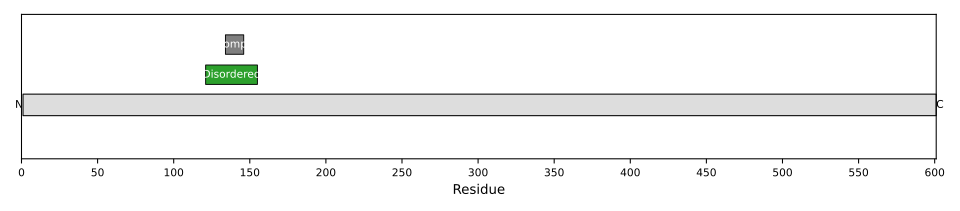
1: As part of the heterotrimeric replication protein A complex (RPA/RP-A), binds and stabilizes single-stranded DNA intermediates that form during DNA replication or upon DNA stress. It prevents their reannealing and in parallel, recruits and activates different proteins and complexes involved in DNA metabolism (PubMed:17596542, PubMed:27723717, PubMed:27723720). Thereby, it plays an essential role both in DNA replication and the cellular response to DNA damage (PubMed:9430682). In the cellular response to DNA damage, the RPA complex controls DNA repair and DNA damage checkpoint activation. Through recruitment of ATRIP activates the ATR kinase a master regulator of the DNA damage response (PubMed:24332808). It is required for the recruitment of the DNA double-strand break repair factors RAD51 and RAD52 to chromatin in response to DNA damage (PubMed:17765923). Also recruits to sites of DNA damage proteins like XPA and XPG that are involved in nucleotide excision repair and is required for this mechanism of DNA repair (PubMed:7697716). Also plays a role in base excision repair (BER) probably through interaction with UNG (PubMed:9765279). Also recruits SMARCAL1/HARP, which is involved in replication fork restart, to sites of DNA damage. Plays a role in telomere maintenance (PubMed:17959650, PubMed:34767620). As part of the alternative replication protein A complex, aRPA, binds single-stranded DNA and probably plays a role in DNA repair. Compared to the RPA2-containing, canonical RPA complex, may not support chromosomal DNA replication and cell cycle progression through S-phase. The aRPA may not promote efficient priming by DNA polymerase alpha but could support DNA synthesis by polymerase delta in presence of PCNA and replication factor C (RFC), the dual incision/excision reaction of nucleotide excision repair and RAD51-dependent strand exchange (PubMed:19996105). RPA stimulates 5'-3' helicase activity of the BRIP1/FANCJ (PubMed:17596542)