DNA-(apurinic or apyrimidinic site) endonuclease (EC 3.1.11.2) (APEX nuclease) (APEN) (Apurinic-apyrimidinic endonuclease 1) (AP endonuclease 1) (APE-1) (REF-1) (Redox factor-1) [Cleaved into: DNA-(apurinic or apyrimidinic site) endonuclease, mitochondrial]
1_MPKRG 6_ KKGAV 11_ AEDGD 16_ ELRTE 21_ PEAKK 26_ SKTAA 31_ KKNDK 36_ EAAGE 41_ GPALY 46_ EDPPD 51_ QKTSP 56_ SGKPA 61_ TLKIC 66_ SWNVD 71_ GLRAW 76_ IKKKG 81_ LDWVK 86_ EEAPD 91_ ILCLQ 96_ ETKCS 101_ ENKLP 106_ AELQE 111_ LPGLS 116_ HQYWS 121_ APSDK 126_ EGYSG 131_ VGLLS 136_ RQCPL 141_ KVSYG 146_ IGDEE 151_ HDQEG 156_ RVIVA 161_ EFDSF 166_ VLVTA 171_ YVPNA 176_ GRGLV 181_ RLEYR 186_ QRWDE 191_ AFRKF 196_ LKGLA 201_ SRKPL 206_ VLCGD 211_ LNVAH 216_ EEIDL 221_ RNPKG 226_ NKKNA 231_ GFTPQ 236_ ERQGF 241_ GELLQ 246_ AVPLA 251_ DSFRH 256_ LYPNT 261_ PYAYT 266_ FWTYM 271_ MNARS 276_ KNVGW 281_ RLDYF 286_ LLSHS 291_ LLPAL 296_ CDSKI 301_ RSKAL 306_ GSDHC 311_PITLY
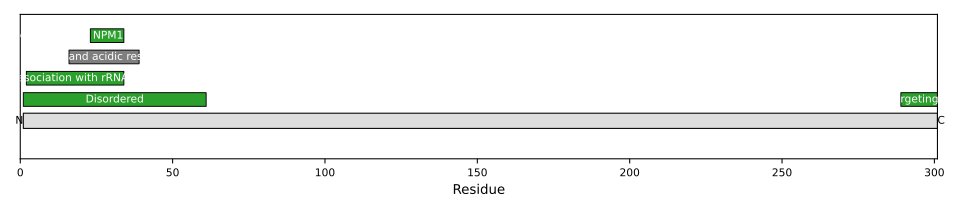
1: Multifunctional protein that plays a central role in the cellular response to oxidative stress. The two major activities of APEX1 are DNA repair and redox regulation of transcriptional factors (PubMed:11118054, PubMed:11452037, PubMed:15831793, PubMed:18439621, PubMed:18579163, PubMed:21762700, PubMed:24079850, PubMed:8355688, PubMed:9108029, PubMed:9560228). Functions as an apurinic/apyrimidinic (AP) endodeoxyribonuclease in the base excision repair (BER) pathway of DNA lesions induced by oxidative and alkylating agents. Initiates repair of AP sites in DNA by catalyzing hydrolytic incision of the phosphodiester backbone immediately adjacent to the damage, generating a single-strand break with 5'-deoxyribose phosphate and 3'-hydroxyl ends. Also incises at AP sites in the DNA strand of DNA/RNA hybrids, single-stranded DNA regions of R-loop structures, and single-stranded RNA molecules (PubMed:15380100, PubMed:16617147, PubMed:18439621, PubMed:19123919, PubMed:19188445, PubMed:19934257, PubMed:20699270, PubMed:21762700, PubMed:24079850, PubMed:8932375, PubMed:8995436, PubMed:9804799). Operates at switch sites of immunoglobulin (Ig) constant regions where it mediates Ig isotype class switch recombination. Processes AP sites induced by successive action of AICDA and UNG. Generates staggered nicks in opposite DNA strands resulting in the formation of double-strand DNA breaks that are finally resolved via non-homologous end joining repair pathway (By similarity). Has 3'-5' exodeoxyribonuclease activity on mismatched deoxyribonucleotides at the 3' termini of nicked or gapped DNA molecules during short-patch BER (PubMed:11832948, PubMed:1719477). Possesses DNA 3' phosphodiesterase activity capable of removing lesions (such as phosphoglycolate and 8-oxoguanine) blocking the 3' side of DNA strand breaks (PubMed:15831793, PubMed:7516064). Also acts as an endoribonuclease involved in the control of single-stranded RNA metabolism. Plays a role in regulating MYC mRNA turnover by preferentially cleaving in between UA and CA dinucleotides of the MYC coding region determinant (CRD). In association with NMD1, plays a role in the rRNA quality control process during cell cycle progression (PubMed:19188445, PubMed:19401441, PubMed:21762700). Acts as a loading factor for POLB onto non-incised AP sites in DNA and stimulates the 5'-terminal deoxyribose 5'-phosphate (dRp) excision activity of POLB (PubMed:9207062). Exerts reversible nuclear redox activity to regulate DNA binding affinity and transcriptional activity of transcriptional factors by controlling the redox status of their DNA-binding domain, such as the FOS/JUN AP-1 complex after exposure to IR (PubMed:10023679, PubMed:11118054, PubMed:11452037, PubMed:18579163, PubMed:8355688, PubMed:9108029). Involved in calcium-dependent down-regulation of parathyroid hormone (PTH) expression by binding to negative calcium response elements (nCaREs). Together with HNRNPL or the dimer XRCC5/XRCC6, associates with nCaRE, acting as an activator of transcriptional repression (PubMed:11809897, PubMed:14633989, PubMed:8621488). May also play a role in the epigenetic regulation of gene expression by participating in DNA demethylation (PubMed:21496894). Stimulates the YBX1-mediated MDR1 promoter activity, when acetylated at Lys-6 and Lys-7, leading to drug resistance (PubMed:18809583). Plays a role in protection from granzyme-mediated cellular repair leading to cell death (PubMed:18179823). Binds DNA and RNA. Associates, together with YBX1, on the MDR1 promoter. Together with NPM1, associates with rRNA (PubMed:19188445, PubMed:19401441, PubMed:20699270)