CD82 antigen (C33 antigen) (IA4) (Inducible membrane protein R2) (Metastasis suppressor Kangai-1) (Suppressor of tumorigenicity 6 protein) (Tetraspanin-27) (Tspan-27) (CD antigen CD82)
1_MGSAC 6_ IKVTK 11_ YFLFL 16_ FNLIF 21_ FILGA 26_ VILGF 31_ GVWIL 36_ ADKSS 41_ FISVL 46_ QTSSS 51_ SLRMG 56_ AYVFI 61_ GVGAV 66_ TMLMG 71_ FLGCI 76_ GAVNE 81_ VRCLL 86_ GLYFA 91_ FLLLI 96_ LIAQV 101_ TAGAL 106_ FYFNM 111_ GKLKQ 116_ EMGGI 121_ VTELI 126_ RDYNS 131_ SREDS 136_ LQDAW 141_ DYVQA 146_ QVKCC 151_ GWVSF 156_ YNWTD 161_ NAELM 166_ NRPEV 171_ TYPCS 176_ CEVKG 181_ EEDNS 186_ LSVRK 191_ GFCEA 196_ PGNRT 201_ QSGNH 206_ PEDWP 211_ VYQEG 216_ CMEKV 221_ QAWLQ 226_ ENLGI 231_ ILGVG 236_ VGVAI 241_ IELLG 246_ MVLSI 251_ CLCRH 256_ VHSED 261_YSKVP
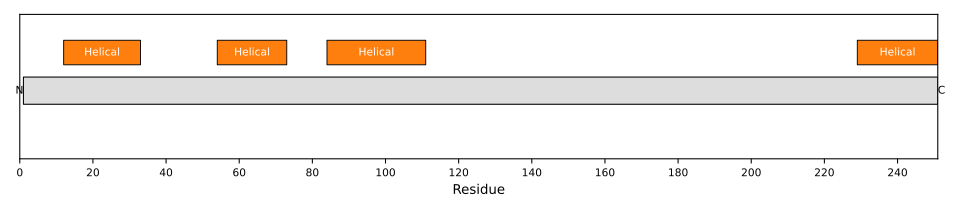
1: Structural component of specialized membrane microdomains known as tetraspanin-enriched microdomains (TERMs), which act as platforms for receptor clustering and signaling (PubMed:19497983). Participates thereby in diverse biological functions such as cell signal transduction, adhesion, migration and protein trafficking. Acts as a attenuator of EGF signaling, facilitating ligand-induced endocytosis of the receptor and its subsequent desensitization (PubMed:10985391, PubMed:35538033). Mechanistically, modulates ligand-induced ubiquitination and trafficking of EGFR via E3 ligase CBL phosphorylation by PKC (PubMed:23897813). Increases cell-matrix adhesion by regulating the membrane organization of integrin alpha4/ITA4 (PubMed:24623721, PubMed:8757325). Modulates adhesion and suppresses cell migration through other integrins such as the alpha6/ITGA6 and beta1/ITGB1 (PubMed:15557282, PubMed:17560548). Decreases cell-associated plasminogen activation by interfering with the interaction between urokinase-type plasminogen activator/PLAU and its receptor PLAUR (PubMed:15677461). Associates with CD4 or CD8 and delivers costimulatory signals for the TCR/CD3 pathway. Plays a role in TLR9 trafficking to acidified CpG-containing compartments by controlling interaction between TLR9 and VAMP3 and subsequent myddosome assembly (By similarity). Inhibits LPS-induced inflammatory response by preventing binding of LPS to TLR4 on the cell surface (PubMed:36945827). Plays a role in the activation of macrophages into anti-inflammatory phenotypes (By similarity). Independently of Toll-like receptor (TLR) signaling, is recruited to pathogen-containing phagosomes prior to fusion with lysosomes and thereby participates in antigen presentation (By similarity). Also acts to control angiogenesis and switch angiogenic milieu to quiescent state by binding and sequestering VEGFA and PDGFB to inhibit the signaling they trigger via their respective cell surface receptor (PubMed:34530889)