Proteasome subunit beta type-5 (EC 3.4.25.1) (Macropain epsilon chain) (Multicatalytic endopeptidase complex epsilon chain) (Proteasome chain 6) (Proteasome epsilon chain) (Proteasome subunit MB1) (Proteasome subunit X)
1_MALAS 6_ VLERP 11_ LPVNQ 16_ RGFFG 21_ LGGRA 26_ DLLDL 31_ GPGSL 36_ SDGLS 41_ LAAPG 46_ WGVPE 51_ EPGIE 56_ MLHGT 61_ TTLAF 66_ KFRHG 71_ VIVAA 76_ DSRAT 81_ AGAYI 86_ ASQTV 91_ KKVIE 96_ INPYL 101_ LGTMA 106_ GGAAD 111_ CSFWE 116_ RLLAR 121_ QCRIY 126_ ELRNK 131_ ERISV 136_ AAASK 141_ LLANM 146_ VYQYK 151_ GMGLS 156_ MGTMI 161_ CGWDK 166_ RGPGL 171_ YYVDS 176_ EGNRI 181_ SGATF 186_ SVGSG 191_ SVYAY 196_ GVMDR 201_ GYSYD 206_ LEVEQ 211_ AYDLA 216_ RRAIY 221_ QATYR 226_ DAYSG 231_ GAVNL 236_ YHVRE 241_ DGWIR 246_ VSSDN 251_ VADLH 256_EKYSG
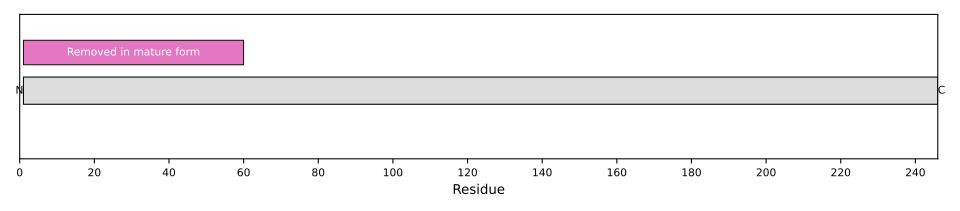
1: Component of the 20S core proteasome complex involved in the proteolytic degradation of most intracellular proteins. This complex plays numerous essential roles within the cell by associating with different regulatory particles. Associated with two 19S regulatory particles, forms the 26S proteasome and thus participates in the ATP-dependent degradation of ubiquitinated proteins. The 26S proteasome plays a key role in the maintenance of protein homeostasis by removing misfolded or damaged proteins that could impair cellular functions, and by removing proteins whose functions are no longer required. Associated with the PA200 or PA28, the 20S proteasome mediates ubiquitin-independent protein degradation. This type of proteolysis is required in several pathways including spermatogenesis (20S-PA200 complex) or generation of a subset of MHC class I-presented antigenic peptides (20S-PA28 complex). Within the 20S core complex, PSMB5 displays a chymotrypsin-like activity