Mitogen-activated protein kinase 1 (MAP kinase 1) (MAPK 1) (EC 2.7.11.24) (ERT1) (Extracellular signal-regulated kinase 2) (ERK-2) (MAP kinase isoform p42) (p42-MAPK) (Mitogen-activated protein kinase 2) (MAP kinase 2) (MAPK 2)
1_MAAAA 6_ AAGAG 11_ PEMVR 16_ GQVFD 21_ VGPRY 26_ TNLSY 31_ IGEGA 36_ YGMVC 41_ SAYDN 46_ VNKVR 51_ VAIKK 56_ ISPFE 61_ HQTYC 66_ QRTLR 71_ EIKIL 76_ LRFRH 81_ ENIIG 86_ INDII 91_ RAPTI 96_ EQMKD 101_ VYIVQ 106_ DLMET 111_ DLYKL 116_ LKTQH 121_ LSNDH 126_ ICYFL 131_ YQILR 136_ GLKYI 141_ HSANV 146_ LHRDL 151_ KPSNL 156_ LLNTT 161_ CDLKI 166_ CDFGL 171_ ARVAD 176_ PDHDH 181_ TGFLT 186_ EYVAT 191_ RWYRA 196_ PEIML 201_ NSKGY 206_ TKSID 211_ IWSVG 216_ CILAE 221_ MLSNR 226_ PIFPG 231_ KHYLD 236_ QLNHI 241_ LGILG 246_ SPSQE 251_ DLNCI 256_ INLKA 261_ RNYLL 266_ SLPHK 271_ NKVPW 276_ NRLFP 281_ NADSK 286_ ALDLL 291_ DKMLT 296_ FNPHK 301_ RIEVE 306_ QALAH 311_ PYLEQ 316_ YYDPS 321_ DEPIA 326_ EAPFK 331_ FDMEL 336_ DDLPK 341_ EKLKE 346_ LIFEE 351_TARFQ
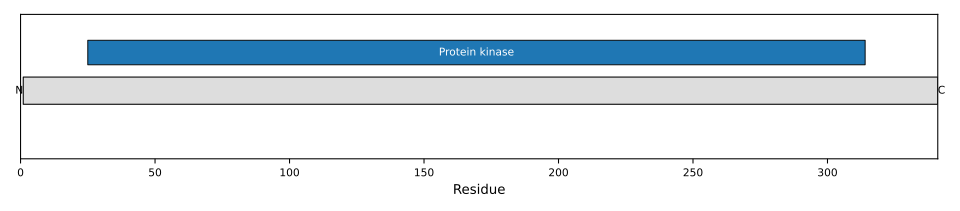
1: Serine/threonine kinase which acts as an essential component of the MAP kinase signal transduction pathway. MAPK1/ERK2 and MAPK3/ERK1 are the 2 MAPKs which play an important role in the MAPK/ERK cascade. They participate also in a signaling cascade initiated by activated KIT and KITLG/SCF. Depending on the cellular context, the MAPK/ERK cascade mediates diverse biological functions such as cell growth, adhesion, survival and differentiation through the regulation of transcription, translation, cytoskeletal rearrangements. The MAPK/ERK cascade also plays a role in initiation and regulation of meiosis, mitosis, and postmitotic functions in differentiated cells by phosphorylating a number of transcription factors. About 160 substrates have already been discovered for ERKs. Many of these substrates are localized in the nucleus, and seem to participate in the regulation of transcription upon stimulation. However, other substrates are found in the cytosol as well as in other cellular organelles, and those are responsible for processes such as translation, mitosis and apoptosis. Moreover, the MAPK/ERK cascade is also involved in the regulation of the endosomal dynamics, including lysosome processing and endosome cycling through the perinuclear recycling compartment (PNRC); as well as in the fragmentation of the Golgi apparatus during mitosis. The substrates include transcription factors (such as ATF2, BCL6, ELK1, ERF, FOS, HSF4 or SPZ1), cytoskeletal elements (such as CANX, CTTN, GJA1, MAP2, MAPT, PXN, SORBS3 or STMN1), regulators of apoptosis (such as BAD, BTG2, CASP9, DAPK1, IER3, MCL1 or PPARG), regulators of translation (such as EIF4EBP1 and FXR1) and a variety of other signaling-related molecules (like ARHGEF2, DCC, FRS2 or GRB10). Protein kinases (such as RAF1, RPS6KA1/RSK1, RPS6KA3/RSK2, RPS6KA2/RSK3, RPS6KA6/RSK4, SYK, MKNK1/MNK1, MKNK2/MNK2, RPS6KA5/MSK1, RPS6KA4/MSK2, MAPKAPK3 or MAPKAPK5) and phosphatases (such as DUSP1, DUSP4, DUSP6 or DUSP16) are other substrates which enable the propagation the MAPK/ERK signal to additional cytosolic and nuclear targets, thereby extending the specificity of the cascade. Mediates phosphorylation of TPR in response to EGF stimulation. May play a role in the spindle assembly checkpoint. Phosphorylates PML and promotes its interaction with PIN1, leading to PML degradation. Phosphorylates CDK2AP2 (By similarity). Phosphorylates phosphoglycerate kinase PGK1 under hypoxic conditions to promote its targeting to the mitochondrion and suppress the formation of acetyl-coenzyme A from pyruvate (PubMed:26942675)
2: Acts as a transcriptional repressor. Binds to a [GC]AAA[GC] consensus sequence. Repress the expression of interferon gamma-induced genes. Seems to bind to the promoter of CCL5, DMP1, IFIH1, IFITM1, IRF7, IRF9, LAMP3, OAS1, OAS2, OAS3 and STAT1. Transcriptional activity is independent of kinase activity