11-beta-hydroxysteroid dehydrogenase 1 (11-DH) (11-beta-HSD1) (EC 1.1.1.146) (7-oxosteroid reductase) (EC 1.1.1.201) (Corticosteroid 11-beta-dehydrogenase isozyme 1) (Short chain dehydrogenase/reductase family 26C member 1)
1_MAFMK 6_ KYLLP 11_ ILGLF 16_ MAYYY 21_ YSANE 26_ EFRPE 31_ MLQGK 36_ KVIVT 41_ GASKG 46_ IGREM 51_ AYHLA 56_ KMGAH 61_ VVVTA 66_ RSKET 71_ LQKVV 76_ SHCLE 81_ LGAAS 86_ AHYIA 91_ GTMED 96_ MTFAE 101_ QFVAQ 106_ AGKLM 111_ GGLDM 116_ LILNH 121_ ITNTS 126_ LNLFH 131_ DDIHH 136_ VRKSM 141_ EVNFL 146_ SYVVL 151_ TVAAL 156_ PMLKQ 161_ SNGSI 166_ VVVSS 171_ LAGKV 176_ AYPMV 181_ AAYSA 186_ SKFAL 191_ DGFFS 196_ SIRKE 201_ YSVSR 206_ VNVSI 211_ TLCVL 216_ GLIDT 221_ ETAMK 226_ AVSGI 231_ VHMQA 236_ APKEE 241_ CALEI 246_ IKGGA 251_ LRQEE 256_ VYYDS 261_ SLWTT 266_ LLIRN 271_ PCRKI 276_ LEFLY 281_ STSYN 286_MDRFI
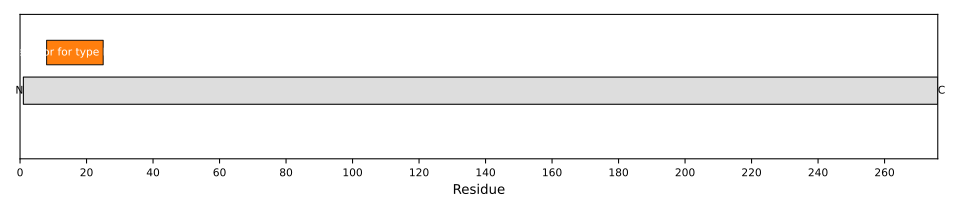
1: Controls the reversible conversion of biologically active glucocorticoids such as cortisone to cortisol, and 11-dehydrocorticosterone to corticosterone in the presence of NADP(H) (PubMed:10497248, PubMed:12460758, PubMed:14973125, PubMed:15152005, PubMed:15280030, PubMed:17593962, PubMed:21453287, PubMed:27927697, PubMed:30902677). Participates in the corticosteroid receptor-mediated anti-inflammatory response, as well as metabolic and homeostatic processes (PubMed:10497248, PubMed:12414862, PubMed:15152005, PubMed:21453287). Plays a role in the secretion of aqueous humor in the eye, maintaining a normotensive, intraocular environment (PubMed:11481269). Bidirectional in vitro, predominantly functions as a reductase in vivo, thereby increasing the concentration of active glucocorticoids (PubMed:10497248, PubMed:11481269, PubMed:12414862, PubMed:12460758). It has broad substrate specificity, besides glucocorticoids, it accepts other steroid and sterol substrates (PubMed:15095019, PubMed:15152005, PubMed:17593962, PubMed:21453287). Interconverts 7-oxo- and 7-hydroxy-neurosteroids such as 7-oxopregnenolone and 7beta-hydroxypregnenolone, 7-oxodehydroepiandrosterone (3beta-hydroxy-5-androstene-7,17-dione) and 7beta-hydroxydehydroepiandrosterone (3beta,7beta-dihydroxyandrost-5-en-17-one), among others (PubMed:17593962). Catalyzes the stereo-specific conversion of the major dietary oxysterol, 7-ketocholesterol (7-oxocholesterol), into the more polar 7-beta-hydroxycholesterol metabolite (PubMed:15095019, PubMed:15152005). 7-oxocholesterol is one of the most important oxysterols, it participates in several events such as induction of apoptosis, accumulation in atherosclerotic lesions, lipid peroxidation, and induction of foam cell formation (PubMed:15095019). Mediates the 7-oxo reduction of 7-oxolithocholate mainly to chenodeoxycholate, and to a lesser extent to ursodeoxycholate, both in its free form and when conjugated to glycine or taurine, providing a link between glucocorticoid activation and bile acid metabolism (PubMed:21453287). Catalyzes the synthesis of 7-beta-25-dihydroxycholesterol from 7-oxo-25-hydroxycholesterol in vitro, which acts as a ligand for the G-protein-coupled receptor (GPCR) Epstein-Barr virus-induced gene 2 (EBI2) and may thereby regulate immune cell migration (PubMed:30902677)