Ephrin type-A receptor 2 (EC 2.7.10.1) (Epithelial cell kinase) (Tyrosine-protein kinase receptor ECK)
1_MELQA 6_ ARACF 11_ ALLWG 16_ CALAA 21_ AAAAQ 26_ GKEVV 31_ LLDFA 36_ AAGGE 41_ LGWLT 46_ HPYGK 51_ GWDLM 56_ QNIMN 61_ DMPIY 66_ MYSVC 71_ NVMSG 76_ DQDNW 81_ LRTNW 86_ VYRGE 91_ AERIF 96_ IELKF 101_ TVRDC 106_ NSFPG 111_ GASSC 116_ KETFN 121_ LYYAE 126_ SDLDY 131_ GTNFQ 136_ KRLFT 141_ KIDTI 146_ APDEI 151_ TVSSD 156_ FEARH 161_ VKLNV 166_ EERSV 171_ GPLTR 176_ KGFYL 181_ AFQDI 186_ GACVA 191_ LLSVR 196_ VYYKK 201_ CPELL 206_ QGLAH 211_ FPETI 216_ AGSDA 221_ PSLAT 226_ VAGTC 231_ VDHAV 236_ VPPGG 241_ EEPRM 246_ HCAVD 251_ GEWLV 256_ PIGQC 261_ LCQAG 266_ YEKVE 271_ DACQA 276_ CSPGF 281_ FKFEA 286_ SESPC 291_ LECPE 296_ HTLPS 301_ PEGAT 306_ SCECE 311_ EGFFR 316_ APQDP 321_ ASMPC 326_ TRPPS 331_ APHYL 336_ TAVGM 341_ GAKVE 346_ LRWTP 351_ PQDSG 356_ GREDI 361_ VYSVT 366_ CEQCW 371_ PESGE 376_ CGPCE 381_ ASVRY 386_ SEPPH 391_ GLTRT 396_ SVTVS 401_ DLEPH 406_ MNYTF 411_ TVEAR 416_ NGVSG 421_ LVTSR 426_ SFRTA 431_ SVSIN 436_ QTEPP 441_ KVRLE 446_ GRSTT 451_ SLSVS 456_ WSIPP 461_ PQQSR 466_ VWKYE 471_ VTYRK 476_ KGDSN 481_ SYNVR 486_ RTEGF 491_ SVTLD 496_ DLAPD 501_ TTYLV 506_ QVQAL 511_ TQEGQ 516_ GAGSK 521_ VHEFQ 526_ TLSPE 531_ GSGNL 536_ AVIGG 541_ VAVGV 546_ VLLLV 551_ LAGVG 556_ FFIHR 561_ RRKNQ 566_ RARQS 571_ PEDVY 576_ FSKSE 581_ QLKPL 586_ KTYVD 591_ PHTYE 596_ DPNQA 601_ VLKFT 606_ TEIHP 611_ SCVTR 616_ QKVIG 621_ AGEFG 626_ EVYKG 631_ MLKTS 636_ SGKKE 641_ VPVAI 646_ KTLKA 651_ GYTEK 656_ QRVDF 661_ LGEAG 666_ IMGQF 671_ SHHNI 676_ IRLEG 681_ VISKY 686_ KPMMI 691_ ITEYM 696_ ENGAL 701_ DKFLR 706_ EKDGE 711_ FSVLQ 716_ LVGML 721_ RGIAA 726_ GMKYL 731_ ANMNY 736_ VHRDL 741_ AARNI 746_ LVNSN 751_ LVCKV 756_ SDFGL 761_ SRVLE 766_ DDPEA 771_ TYTTS 776_ GGKIP 781_ IRWTA 786_ PEAIS 791_ YRKFT 796_ SASDV 801_ WSFGI 806_ VMWEV 811_ MTYGE 816_ RPYWE 821_ LSNHE 826_ VMKAI 831_ NDGFR 836_ LPTPM 841_ DCPSA 846_ IYQLM 851_ MQCWQ 856_ QERAR 861_ RPKFA 866_ DIVSI 871_ LDKLI 876_ RAPDS 881_ LKTLA 886_ DFDPR 891_ VSIRL 896_ PSTSG 901_ SEGVP 906_ FRTVS 911_ EWLES 916_ IKMQQ 921_ YTEHF 926_ MAAGY 931_ TAIEK 936_ VVQMT 941_ NDDIK 946_ RIGVR 951_ LPGHQ 956_ KRIAY 961_ SLLGL 966_ KDQVN 971_TVGIP
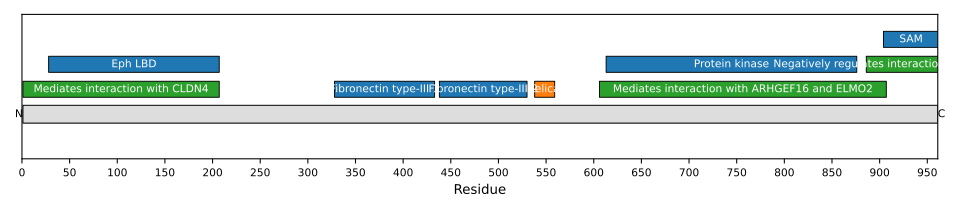
1: Receptor tyrosine kinase which binds promiscuously membrane-bound ephrin-A family ligands residing on adjacent cells, leading to contact-dependent bidirectional signaling into neighboring cells. The signaling pathway downstream of the receptor is referred to as forward signaling while the signaling pathway downstream of the ephrin ligand is referred to as reverse signaling. Activated by the ligand ephrin-A1/EFNA1 regulates migration, integrin-mediated adhesion, proliferation and differentiation of cells. Regulates cell adhesion and differentiation through DSG1/desmoglein-1 and inhibition of the ERK1/ERK2 (MAPK3/MAPK1, respectively) signaling pathway. May also participate in UV radiation-induced apoptosis and have a ligand-independent stimulatory effect on chemotactic cell migration. During development, may function in distinctive aspects of pattern formation and subsequently in development of several fetal tissues. Involved for instance in angiogenesis, in early hindbrain development and epithelial proliferation and branching morphogenesis during mammary gland development. Engaged by the ligand ephrin-A5/EFNA5 may regulate lens fiber cells shape and interactions and be important for lens transparency development and maintenance. With ephrin-A2/EFNA2 may play a role in bone remodeling through regulation of osteoclastogenesis and osteoblastogenesis
2: (Microbial infection) Acts as a receptor for hepatitis C virus (HCV) in hepatocytes and facilitates its cell entry. Mediates HCV entry by promoting the formation of the CD81-CLDN1 receptor complexes that are essential for HCV entry and by enhancing membrane fusion of cells expressing HCV envelope glycoproteins
3: Acts as a receptor for human cytomegalovirus (HCMV) to mediate viral entry and fusion in glioblastoma cells