Ephrin type-B receptor 2 (EC 2.7.10.1) (Developmentally-regulated Eph-related tyrosine kinase) (ELK-related tyrosine kinase) (EPH tyrosine kinase 3) (EPH-like kinase 5) (EK5) (hEK5) (Renal carcinoma antigen NY-REN-47) (Tyrosine-protein kinase TYRO5) (Tyrosine-protein kinase receptor EPH-3) [Cleaved into: EphB2/CTF1; EphB2/CTF2]
1_MALRR 6_ LGAAL 11_ LLLPL 16_ LAAVE 21_ ETLMD 26_ STTAT 31_ AELGW 36_ MVHPP 41_ SGWEE 46_ VSGYD 51_ ENMNT 56_ IRTYQ 61_ VCNVF 66_ ESSQN 71_ NWLRT 76_ KFIRR 81_ RGAHR 86_ IHVEM 91_ KFSVR 96_ DCSSI 101_ PSVPG 106_ SCKET 111_ FNLYY 116_ YEADF 121_ DSATK 126_ TFPNW 131_ MENPW 136_ VKVDT 141_ IAADE 146_ SFSQV 151_ DLGGR 156_ VMKIN 161_ TEVRS 166_ FGPVS 171_ RSGFY 176_ LAFQD 181_ YGGCM 186_ SLIAV 191_ RVFYR 196_ KCPRI 201_ IQNGA 206_ IFQET 211_ LSGAE 216_ STSLV 221_ AARGS 226_ CIANA 231_ EEVDV 236_ PIKLY 241_ CNGDG 246_ EWLVP 251_ IGRCM 256_ CKAGF 261_ EAVEN 266_ GTVCR 271_ GCPSG 276_ TFKAN 281_ QGDEA 286_ CTHCP 291_ INSRT 296_ TSEGA 301_ TNCVC 306_ RNGYY 311_ RADLD 316_ PLDMP 321_ CTTIP 326_ SAPQA 331_ VISSV 336_ NETSL 341_ MLEWT 346_ PPRDS 351_ GGRED 356_ LVYNI 361_ ICKSC 366_ GSGRG 371_ ACTRC 376_ GDNVQ 381_ YAPRQ 386_ LGLTE 391_ PRIYI 396_ SDLLA 401_ HTQYT 406_ FEIQA 411_ VNGVT 416_ DQSPF 421_ SPQFA 426_ SVNIT 431_ TNQAA 436_ PSAVS 441_ IMHQV 446_ SRTVD 451_ SITLS 456_ WSQPD 461_ QPNGV 466_ ILDYE 471_ LQYYE 476_ KELSE 481_ YNATA 486_ IKSPT 491_ NTVTV 496_ QGLKA 501_ GAIYV 506_ FQVRA 511_ RTVAG 516_ YGRYS 521_ GKMYF 526_ QTMTE 531_ AEYQT 536_ SIQEK 541_ LPLII 546_ GSSAA 551_ GLVFL 556_ IAVVV 561_ IAIVC 566_ NRRGF 571_ ERADS 576_ EYTDK 581_ LQHYT 586_ SGHMT 591_ PGMKI 596_ YIDPF 601_ TYEDP 606_ NEAVR 611_ EFAKE 616_ IDISC 621_ VKIEQ 626_ VIGAG 631_ EFGEV 636_ CSGHL 641_ KLPGK 646_ REIFV 651_ AIKTL 656_ KSGYT 661_ EKQRR 666_ DFLSE 671_ ASIMG 676_ QFDHP 681_ NVIHL 686_ EGVVT 691_ KSTPV 696_ MIITE 701_ FMENG 706_ SLDSF 711_ LRQND 716_ GQFTV 721_ IQLVG 726_ MLRGI 731_ AAGMK 736_ YLADM 741_ NYVHR 746_ DLAAR 751_ NILVN 756_ SNLVC 761_ KVSDF 766_ GLSRF 771_ LEDDT 776_ SDPTY 781_ TSALG 786_ GKIPI 791_ RWTAP 796_ EAIQY 801_ RKFTS 806_ ASDVW 811_ SYGIV 816_ MWEVM 821_ SYGER 826_ PYWDM 831_ TNQDV 836_ INAIE 841_ QDYRL 846_ PPPMD 851_ CPSAL 856_ HQLML 861_ DCWQK 866_ DRNHR 871_ PKFGQ 876_ IVNTL 881_ DKMIR 886_ NPNSL 891_ KAMAP 896_ LSSGI 901_ NLPLL 906_ DRTIP 911_ DYTSF 916_ NTVDE 921_ WLEAI 926_ KMGQY 931_ KESFA 936_ NAGFT 941_ SFDVV 946_ SQMMM 951_ EDILR 956_ VGVTL 961_ AGHQK 966_ KILNS 971_ IQVMR 976_ AQMNQ 981_ IQSVE 986_ GQPLA 991_ RRPRA 996_ TGRTK 1001_ RCQPR 1006_ DVTKK 1011_ TCNSN 1016_ DGKKK 1021_ GMGKK 1026_ KTDPG 1031_ RGREI 1036_ QGIFF 1041_ KEDSH 1046_KESND
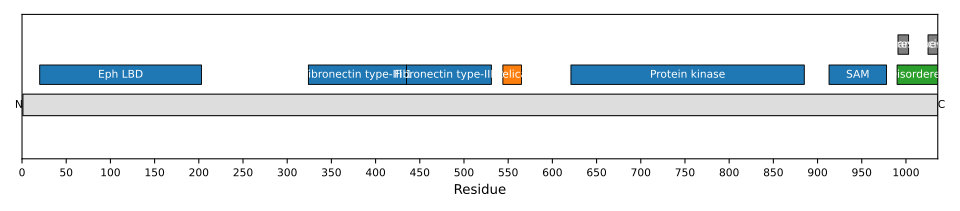
1: Receptor tyrosine kinase which binds promiscuously transmembrane ephrin-B family ligands residing on adjacent cells, leading to contact-dependent bidirectional signaling into neighboring cells. The signaling pathway downstream of the receptor is referred to as forward signaling while the signaling pathway downstream of the ephrin ligand is referred to as reverse signaling. Functions in axon guidance during development. Involved in the guidance of commissural axons, that form a major interhemispheric connection between the 2 temporal lobes of the cerebral cortex. Also involved in guidance of contralateral inner ear efferent growth cones at the midline and of retinal ganglion cell axons to the optic disk. In addition to axon guidance, also regulates dendritic spines development and maturation and stimulates the formation of excitatory synapses. Upon activation by EFNB1, abolishes the ARHGEF15-mediated negative regulation on excitatory synapse formation. Controls other aspects of development including angiogenesis, palate development and in inner ear development through regulation of endolymph production. Forward and reverse signaling through the EFNB2/EPHB2 complex regulate movement and adhesion of cells that tubularize the urethra and septate the cloaca. May function as a tumor suppressor. May be involved in the regulation of platelet activation and blood coagulation (PubMed:30213874)