Protein PML (E3 SUMO-protein ligase PML) (EC 2.3.2.-) (Promyelocytic leukemia protein) (RING finger protein 71) (RING-type E3 SUMO transferase PML) (Tripartite motif-containing protein 19) (TRIM19)
1_MEPAP 6_ ARSPR 11_ PQQDP 16_ ARPQE 21_ PTMPP 26_ PETPS 31_ EGRQP 36_ SPSPS 41_ PTERA 46_ PASEE 51_ EFQFL 56_ RCQQC 61_ QAEAK 66_ CPKLL 71_ PCLHT 76_ LCSGC 81_ LEASG 86_ MQCPI 91_ CQAPW 96_ PLGAD 101_ TPALD 106_ NVFFE 111_ SLQRR 116_ LSVYR 121_ QIVDA 126_ QAVCT 131_ RCKES 136_ ADFWC 141_ FECEQ 146_ LLCAK 151_ CFEAH 156_ QWFLK 161_ HEARP 166_ LAELR 171_ NQSVR 176_ EFLDG 181_ TRKTN 186_ NIFCS 191_ NPNHR 196_ TPTLT 201_ SIYCR 206_ GCSKP 211_ LCCSC 216_ ALLDS 221_ SHSEL 226_ KCDIS 231_ AEIQQ 236_ RQEEL 241_ DAMTQ 246_ ALQEQ 251_ DSAFG 256_ AVHAQ 261_ MHAAV 266_ GQLGR 271_ ARAET 276_ EELIR 281_ ERVRQ 286_ VVAHV 291_ RAQER 296_ ELLEA 301_ VDARY 306_ QRDYE 311_ EMASR 316_ LGRLD 321_ AVLQR 326_ IRTGS 331_ ALVQR 336_ MKCYA 341_ SDQEV 346_ LDMHG 351_ FLRQA 356_ LCRLR 361_ QEEPQ 366_ SLQAA 371_ VRTDG 376_ FDEFK 381_ VRLQD 386_ LSSCI 391_ TQGKD 396_ AAVSK 401_ KASPE 406_ AASTP 411_ RDPID 416_ VDLPE 421_ EAERV 426_ KAQVQ 431_ ALGLA 436_ EAQPM 441_ AVVQS 446_ VPGAH 451_ PVPVY 456_ AFSIK 461_ GPSYG 466_ EDVSN 471_ TTTAQ 476_ KRKCS 481_ QTQCP 486_ RKVIK 491_ MESEE 496_ GKEAR 501_ LARSS 506_ PEQPR 511_ PSTSK 516_ AVSPP 521_ HLDGP 526_ PSPRS 531_ PVIGS 536_ EVFLP 541_ NSNHV 546_ ASGAG 551_ EAEER 556_ VVVIS 561_ SSEDS 566_ DAENS 571_ SSREL 576_ DDSSS 581_ ESSDL 586_ QLEGP 591_ STLRV 596_ LDENL 601_ ADPQA 606_ EDRPL 611_ VFFDL 616_ KIDNE 621_ TQKIS 626_ QLAAV 631_ NRESK 636_ FRVVI 641_ QPEAF 646_ FSIYS 651_ KAVSL 656_ EVGLQ 661_ HFLSF 666_ LSSMR 671_ RPILA 676_ CYKLW 681_ GPGLP 686_ NFFRA 691_ LEDIN 696_ RLWEF 701_ QEAIS 706_ GFLAA 711_ LPLIR 716_ ERVPG 721_ ASSFK 726_ LKNLA 731_ QTYLA 736_ RNMSE 741_ RSAMA 746_ AVLAM 751_ RDLCR 756_ LLEVS 761_ PGPQL 766_ AQHVY 771_ PFSSL 776_ QCFAS 781_ LQPLV 786_ QAAVL 791_ PRAEA 796_ RLLAL 801_ HNVSF 806_ MELLS 811_ AHRRD 816_ RQGGL 821_ KKYSR 826_ YLSLQ 831_ TTTLP 836_ PAQPA 841_ FNLQA 846_ LGTYF 851_ EGLLE 856_ GPALA 861_ RAEGV 866_ STPLA 871_ GRGLA 876_ERASQ
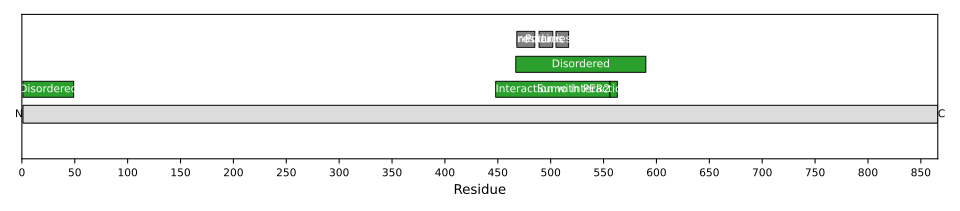
1: Functions via its association with PML-nuclear bodies (PML-NBs) in a wide range of important cellular processes, including tumor suppression, transcriptional regulation, apoptosis, senescence, DNA damage response, and viral defense mechanisms. Acts as the scaffold of PML-NBs allowing other proteins to shuttle in and out, a process which is regulated by SUMO-mediated modifications and interactions. Inhibits EIF4E-mediated mRNA nuclear export by reducing EIF4E affinity for the 5' 7-methylguanosine (m7G) cap of target mRNAs (PubMed:11500381, PubMed:11575918, PubMed:18391071). Isoform PML-4 has a multifaceted role in the regulation of apoptosis and growth suppression: activates RB1 and inhibits AKT1 via interactions with PP1 and PP2A phosphatases respectively, negatively affects the PI3K pathway by inhibiting MTOR and activating PTEN, and positively regulates p53/TP53 by acting at different levels (by promoting its acetylation and phosphorylation and by inhibiting its MDM2-dependent degradation). Isoform PML-4 also: acts as a transcriptional repressor of TBX2 during cellular senescence and the repression is dependent on a functional RBL2/E2F4 repressor complex, regulates double-strand break repair in gamma-irradiation-induced DNA damage responses via its interaction with WRN, acts as a negative regulator of telomerase by interacting with TERT, and regulates PER2 nuclear localization and circadian function. Isoform PML-6 inhibits specifically the activity of the tetrameric form of PKM. The nuclear isoforms (isoform PML-1, isoform PML-2, isoform PML-3, isoform PML-4 and isoform PML-5) in concert with SATB1 are involved in local chromatin-loop remodeling and gene expression regulation at the MHC-I locus. Isoform PML-2 is required for efficient IFN-gamma induced MHC II gene transcription via regulation of CIITA. Cytoplasmic PML is involved in the regulation of the TGF-beta signaling pathway. PML also regulates transcription activity of ELF4 and can act as an important mediator for TNF-alpha- and IFN-alpha-mediated inhibition of endothelial cell network formation and migration
2: Exhibits antiviral activity against both DNA and RNA viruses. The antiviral activity can involve one or several isoform(s) and can be enhanced by the permanent PML-NB-associated protein DAXX or by the recruitment of p53/TP53 within these structures. Isoform PML-4 restricts varicella zoster virus (VZV) via sequestration of virion capsids in PML-NBs thereby preventing their nuclear egress and inhibiting formation of infectious virus particles. The sumoylated isoform PML-4 restricts rabies virus by inhibiting viral mRNA and protein synthesis. The cytoplasmic isoform PML-14 can restrict herpes simplex virus-1 (HHV-1) replication by sequestering the viral E3 ubiquitin-protein ligase ICP0 in the cytoplasm. Isoform PML-6 shows restriction activity towards human cytomegalovirus (HHV-5) and influenza A virus strains PR8(H1N1) and ST364(H3N2). Sumoylated isoform PML-4 and isoform PML-12 show antiviral activity against encephalomyocarditis virus (EMCV) by promoting nuclear sequestration of viral polymerase (P3D-POL) within PML NBs. Isoform PML-3 exhibits antiviral activity against poliovirus by inducing apoptosis in infected cells through the recruitment and the activation of p53/TP53 in the PML-NBs. Isoform PML-3 represses human foamy virus (HFV) transcription by complexing the HFV transactivator, bel1/tas, preventing its binding to viral DNA. PML may positively regulate infectious hepatitis C viral (HCV) production and isoform PML-2 may enhance adenovirus transcription. Functions as an E3 SUMO-protein ligase that sumoylates (HHV-5) immediate early protein IE1, thereby participating in the antiviral response (PubMed:20972456, PubMed:28250117). Isoforms PML-3 and PML-6 display the highest levels of sumoylation activity (PubMed:20972456, PubMed:28250117)