G1/S-specific cyclin-D3
1_MELLC 6_ CEGTR 11_ HAPRA 16_ GPDPR 21_ LLGDQ 26_ RVLQS 31_ LLRLE 36_ ERYVP 41_ RASYF 46_ QCVQR 51_ EIKPH 56_ MRKML 61_ AYWML 66_ EVCEE 71_ QRCEE 76_ EVFPL 81_ AMNYL 86_ DRYLS 91_ CVPTR 96_ KAQLQ 101_ LLGAV 106_ CMLLA 111_ SKLRE 116_ TTPLT 121_ IEKLC 126_ IYTDH 131_ AVSPR 136_ QLRDW 141_ EVLVL 146_ GKLKW 151_ DLAAV 156_ IAHDF 161_ LAFIL 166_ HRLSL 171_ PRDRQ 176_ ALVKK 181_ HAQTF 186_ LALCA 191_ TDYTF 196_ AMYPP 201_ SMIAT 206_ GSIGA 211_ AVQGL 216_ GACSM 221_ SGDEL 226_ TELLA 231_ GITGT 236_ EVDCL 241_ RACQE 246_ QIEAA 251_ LRESL 256_ REASQ 261_ TSSSP 266_ APKAP 271_ RGSSS 276_ QGPSQ 281_ TSTPT 286_DVTAI
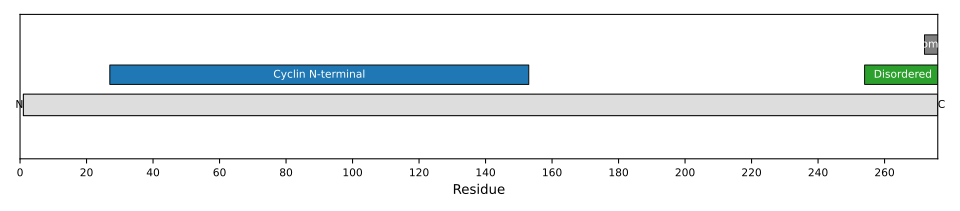
1: Regulatory component of the cyclin D3-CDK4 (DC) complex that phosphorylates and inhibits members of the retinoblastoma (RB) protein family including RB1 and regulates the cell-cycle during G(1)/S transition (PubMed:8114739). Phosphorylation of RB1 allows dissociation of the transcription factor E2F from the RB/E2F complex and the subsequent transcription of E2F target genes which are responsible for the progression through the G(1) phase (PubMed:8114739). Hypophosphorylates RB1 in early G(1) phase (PubMed:8114739). Cyclin D-CDK4 complexes are major integrators of various mitogenenic and antimitogenic signals (PubMed:8114739). Component of the ternary complex, cyclin D3/CDK4/CDKN1B, required for nuclear translocation and activity of the cyclin D-CDK4 complex (PubMed:16782892). Shows transcriptional coactivator activity with ATF5 independently of CDK4 (PubMed:15358120)