HLA class I histocompatibility antigen, alpha chain F (CDA12) (HLA F antigen) (Leukocyte antigen F) (MHC class I antigen F)
1_MAPRS 6_ LLLLL 11_ SGALA 16_ LTDTW 21_ AGSHS 26_ LRYFS 31_ TAVSR 36_ PGRGE 41_ PRYIA 46_ VEYVD 51_ DTQFL 56_ RFDSD 61_ AAIPR 66_ MEPRE 71_ PWVEQ 76_ EGPQY 81_ WEWTT 86_ GYAKA 91_ NAQTD 96_ RVALR 101_ NLLRR 106_ YNQSE 111_ AGSHT 116_ LQGMN 121_ GCDMG 126_ PDGRL 131_ LRGYH 136_ QHAYD 141_ GKDYI 146_ SLNED 151_ LRSWT 156_ AADTV 161_ AQITQ 166_ RFYEA 171_ EEYAE 176_ EFRTY 181_ LEGEC 186_ LELLR 191_ RYLEN 196_ GKETL 201_ QRADP 206_ PKAHV 211_ AHHPI 216_ SDHEA 221_ TLRCW 226_ ALGFY 231_ PAEIT 236_ LTWQR 241_ DGEEQ 246_ TQDTE 251_ LVETR 256_ PAGDG 261_ TFQKW 266_ AAVVV 271_ PPGEE 276_ QRYTC 281_ HVQHE 286_ GLPQP 291_ LILRW 296_ EQSPQ 301_ PTIPI 306_ VGIVA 311_ GLVVL 316_ GAVVT 321_ GAVVA 326_ AVMWR 331_ KKSSD 336_ RNRGS 341_YSQAA
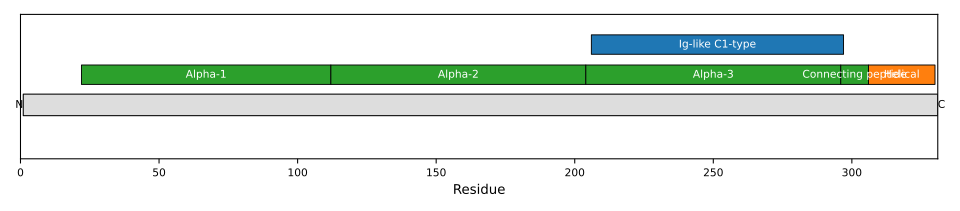
1: Non-classical major histocompatibility class Ib molecule postulated to play a role in immune surveillance, immune tolerance and inflammation. Functions in two forms, as a heterotrimeric complex with B2M/beta-2 microglobulin and a peptide (peptide-bound HLA-F-B2M) and as an open conformer (OC) devoid of peptide and B2M (peptide-free OC). In complex with B2M, presents non-canonical self-peptides carrying post-translational modifications, particularly phosphorylated self-peptides. Peptide-bound HLA-F-B2M acts as a ligand for LILRB1 inhibitory receptor, a major player in maternal-fetal tolerance. Peptide-free OC acts as a ligand for KIR3DS1 and KIR3DL2 receptors (PubMed:28636952). Upon interaction with activating KIR3DS1 receptor on NK cells, triggers NK cell degranulation and anti-viral cytokine production (PubMed:27455421). Through interaction with KIR3DL2 receptor, inhibits NK and T cell effector functions (PubMed:24018270). May interact with other MHC class I OCs to cross-present exogenous viral, tumor or minor histompatibility antigens to cytotoxic CD8+ T cells, triggering effector and memory responses (PubMed:23851683). May play a role in inflammatory responses in the peripheral nervous system. Through interaction with KIR3DL2, may protect motor neurons from astrocyte-induced toxicity (PubMed:26928464)