Sodium-dependent serotonin transporter (SERT) (5HT transporter) (5HTT) (Solute carrier family 6 member 4)
1_METTP 6_ LNSQK 11_ QLSAC 16_ EDGED 21_ CQENG 26_ VLQKV 31_ VPTPG 36_ DKVES 41_ GQISN 46_ GYSAV 51_ PSPGA 56_ GDDTR 61_ HSIPA 66_ TTTTL 71_ VAELH 76_ QGERE 81_ TWGKK 86_ VDFLL 91_ SVIGY 96_ AVDLG 101_ NVWRF 106_ PYICY 111_ QNGGG 116_ AFLLP 121_ YTIMA 126_ IFGGI 131_ PLFYM 136_ ELALG 141_ QYHRN 146_ GCISI 151_ WRKIC 156_ PIFKG 161_ IGYAI 166_ CIIAF 171_ YIASY 176_ YNTIM 181_ AWALY 186_ YLISS 191_ FTDQL 196_ PWTSC 201_ KNSWN 206_ TGNCT 211_ NYFSE 216_ DNITW 221_ TLHST 226_ SPAEE 231_ FYTRH 236_ VLQIH 241_ RSKGL 246_ QDLGG 251_ ISWQL 256_ ALCIM 261_ LIFTV 266_ IYFSI 271_ WKGVK 276_ TSGKV 281_ VWVTA 286_ TFPYI 291_ ILSVL 296_ LVRGA 301_ TLPGA 306_ WRGVL 311_ FYLKP 316_ NWQKL 321_ LETGV 326_ WIDAA 331_ AQIFF 336_ SLGPG 341_ FGVLL 346_ AFASY 351_ NKFNN 356_ NCYQD 361_ ALVTS 366_ VVNCM 371_ TSFVS 376_ GFVIF 381_ TVLGY 386_ MAEMR 391_ NEDVS 396_ EVAKD 401_ AGPSL 406_ LFITY 411_ AEAIA 416_ NMPAS 421_ TFFAI 426_ IFFLM 431_ LITLG 436_ LDSTF 441_ AGLEG 446_ VITAV 451_ LDEFP 456_ HVWAK 461_ RRERF 466_ VLAVV 471_ ITCFF 476_ GSLVT 481_ LTFGG 486_ AYVVK 491_ LLEEY 496_ ATGPA 501_ VLTVA 506_ LIEAV 511_ AVSWF 516_ YGITQ 521_ FCRDV 526_ KEMLG 531_ FSPGW 536_ FWRIC 541_ WVAIS 546_ PLFLL 551_ FIICS 556_ FLMSP 561_ PQLRL 566_ FQYNY 571_ PYWSI 576_ ILGYC 581_ IGTSS 586_ FICIP 591_ TYIAY 596_ RLIIT 601_ PGTFK 606_ ERIIK 611_ SITPE 616_ TPTEI 621_PCGDI
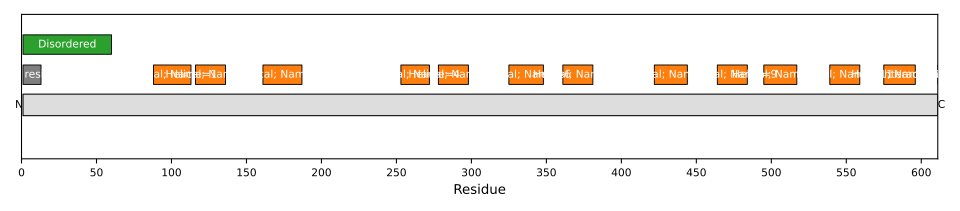
1: Serotonin transporter that cotransports serotonin with one Na(+) ion in exchange for one K(+) ion and possibly one proton in an overall electroneutral transport cycle. Transports serotonin across the plasma membrane from the extracellular compartment to the cytosol thus limiting serotonin intercellular signaling (PubMed:10407194, PubMed:12869649, PubMed:21730057, PubMed:27049939, PubMed:27756841, PubMed:34851672). Essential for serotonin homeostasis in the central nervous system. In the developing somatosensory cortex, acts in glutamatergic neurons to control serotonin uptake and its trophic functions accounting for proper spatial organization of cortical neurons and elaboration of sensory circuits. In the mature cortex, acts primarily in brainstem raphe neurons to mediate serotonin uptake from the synaptic cleft back into the pre-synaptic terminal thus terminating serotonin signaling at the synapse (By similarity). Modulates mucosal serotonin levels in the gastrointestinal tract through uptake and clearance of serotonin in enterocytes. Required for enteric neurogenesis and gastrointestinal reflexes (By similarity). Regulates blood serotonin levels by ensuring rapid high affinity uptake of serotonin from plasma to platelets, where it is further stored in dense granules via vesicular monoamine transporters and then released upon stimulation (PubMed:17506858, PubMed:18317590). Mechanistically, the transport cycle starts with an outward-open conformation having Na1(+) and Cl(-) sites occupied. The binding of a second extracellular Na2(+) ion and serotonin substrate leads to structural changes to outward-occluded to inward-occluded to inward-open, where the Na2(+) ion and serotonin are released into the cytosol. Binding of intracellular K(+) ion induces conformational transitions to inward-occluded to outward-open and completes the cycle by releasing K(+) possibly together with a proton bound to Asp-98 into the extracellular compartment. Na1(+) and Cl(-) ions remain bound throughout the transport cycle (PubMed:10407194, PubMed:12869649, PubMed:21730057, PubMed:27049939, PubMed:27756841, PubMed:34851672). Additionally, displays serotonin-induced channel-like conductance for monovalent cations, mainly Na(+) ions. The channel activity is uncoupled from the transport cycle and may contribute to the membrane resting potential or excitability (By similarity)