RAC-alpha serine/threonine-protein kinase (EC 2.7.11.1) (Protein kinase B) (PKB) (Protein kinase B alpha) (PKB alpha) (Proto-oncogene c-Akt) (RAC-PK-alpha)
1_MSDVA 6_ IVKEG 11_ WLHKR 16_ GEYIK 21_ TWRPR 26_ YFLLK 31_ NDGTF 36_ IGYKE 41_ RPQDV 46_ DQREA 51_ PLNNF 56_ SVAQC 61_ QLMKT 66_ ERPRP 71_ NTFII 76_ RCLQW 81_ TTVIE 86_ RTFHV 91_ ETPEE 96_ REEWT 101_ TAIQT 106_ VADGL 111_ KKQEE 116_ EEMDF 121_ RSGSP 126_ SDNSG 131_ AEEME 136_ VSLAK 141_ PKHRV 146_ TMNEF 151_ EYLKL 156_ LGKGT 161_ FGKVI 166_ LVKEK 171_ ATGRY 176_ YAMKI 181_ LKKEV 186_ IVAKD 191_ EVAHT 196_ LTENR 201_ VLQNS 206_ RHPFL 211_ TALKY 216_ SFQTH 221_ DRLCF 226_ VMEYA 231_ NGGEL 236_ FFHLS 241_ RERVF 246_ SEDRA 251_ RFYGA 256_ EIVSA 261_ LDYLH 266_ SEKNV 271_ VYRDL 276_ KLENL 281_ MLDKD 286_ GHIKI 291_ TDFGL 296_ CKEGI 301_ KDGAT 306_ MKTFC 311_ GTPEY 316_ LAPEV 321_ LEDND 326_ YGRAV 331_ DWWGL 336_ GVVMY 341_ EMMCG 346_ RLPFY 351_ NQDHE 356_ KLFEL 361_ ILMEE 366_ IRFPR 371_ TLGPE 376_ AKSLL 381_ SGLLK 386_ KDPKQ 391_ RLGGG 396_ SEDAK 401_ EIMQH 406_ RFFAG 411_ IVWQH 416_ VYEKK 421_ LSPPF 426_ KPQVT 431_ SETDT 436_ RYFDE 441_ EFTAQ 446_ MITIT 451_ PPDQD 456_ DSMEC 461_ VDSER 466_ RPHFP 471_QFSYS
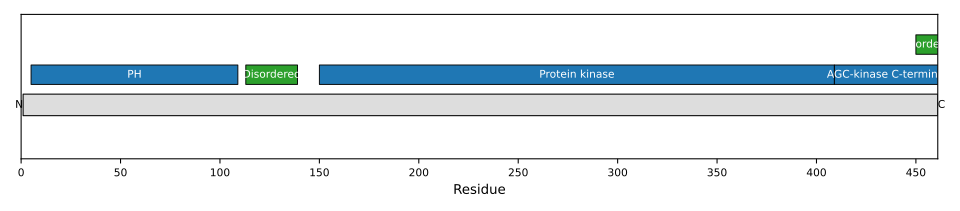
1: AKT1 is one of 3 closely related serine/threonine-protein kinases (AKT1, AKT2 and AKT3) called the AKT kinase, and which regulate many processes including metabolism, proliferation, cell survival, growth and angiogenesis (PubMed:11882383, PubMed:15526160, PubMed:15861136, PubMed:21432781, PubMed:21620960, PubMed:31204173). This is mediated through serine and/or threonine phosphorylation of a range of downstream substrates (PubMed:11882383, PubMed:15526160, PubMed:21432781, PubMed:21620960, PubMed:29343641, PubMed:31204173). Over 100 substrate candidates have been reported so far, but for most of them, no isoform specificity has been reported (PubMed:11882383, PubMed:15526160, PubMed:21432781, PubMed:21620960). AKT is responsible of the regulation of glucose uptake by mediating insulin-induced translocation of the SLC2A4/GLUT4 glucose transporter to the cell surface (By similarity). Phosphorylation of PTPN1 at 'Ser-50' negatively modulates its phosphatase activity preventing dephosphorylation of the insulin receptor and the attenuation of insulin signaling (By similarity). Phosphorylation of TBC1D4 triggers the binding of this effector to inhibitory 14-3-3 proteins, which is required for insulin-stimulated glucose transport (PubMed:11994271). AKT also regulates the storage of glucose in the form of glycogen by phosphorylating GSK3A at 'Ser-21' and GSK3B at 'Ser-9', resulting in inhibition of its kinase activity (By similarity). Phosphorylation of GSK3 isoforms by AKT is also thought to be one mechanism by which cell proliferation is driven (By similarity). AKT also regulates cell survival via the phosphorylation of MAP3K5 (apoptosis signal-related kinase) (PubMed:11154276). Phosphorylation of 'Ser-83' decreases MAP3K5 kinase activity stimulated by oxidative stress and thereby prevents apoptosis (PubMed:11154276). AKT mediates insulin-stimulated protein synthesis by phosphorylating TSC2 at 'Ser-939' and 'Thr-1462', thereby activating the mTORC1 signaling pathway, and leading to both phosphorylation of 4E-BP1 and in activation of RPS6KB1 (PubMed:12150915, PubMed:12172553). Also regulates the mTORC1 signaling pathway by catalyzing phosphorylation of CASTOR1 and DEPDC5 (PubMed:31548394, PubMed:33594058). AKT plays a role as key modulator of the AKT-mTOR signaling pathway controlling the tempo of the process of newborn neurons integration during adult neurogenesis, including correct neuron positioning, dendritic development and synapse formation (By similarity). Part of a positive feedback loop of mTORC2 signaling by mediating phosphorylation of MAPKAP1/SIN1, promoting mTORC2 activation (By similarity). AKT is involved in the phosphorylation of members of the FOXO factors (Forkhead family of transcription factors), leading to binding of 14-3-3 proteins and cytoplasmic localization (PubMed:10358075). In particular, FOXO1 is phosphorylated at 'Thr-24', 'Ser-256' and 'Ser-319' (PubMed:10358075). FOXO3 and FOXO4 are phosphorylated on equivalent sites (PubMed:10358075). AKT has an important role in the regulation of NF-kappa-B-dependent gene transcription and positively regulates the activity of CREB1 (cyclic AMP (cAMP)-response element binding protein) (PubMed:9829964). The phosphorylation of CREB1 induces the binding of accessory proteins that are necessary for the transcription of pro-survival genes such as BCL2 and MCL1 (PubMed:9829964). AKT phosphorylates 'Ser-454' on ATP citrate lyase (ACLY), thereby potentially regulating ACLY activity and fatty acid synthesis (By similarity). Activates the 3B isoform of cyclic nucleotide phosphodiesterase (PDE3B) via phosphorylation of 'Ser-273', resulting in reduced cyclic AMP levels and inhibition of lipolysis (By similarity). Phosphorylates PIKFYVE on 'Ser-318', which results in increased PI(3)P-5 activity (By similarity). The Rho GTPase-activating protein DLC1 is another substrate and its phosphorylation is implicated in the regulation cell proliferation and cell growth (By similarity). Signals downstream of phosphatidylinositol 3-kinase (PI(3)K) to mediate the effects of various growth factors such as platelet-derived growth factor (PDGF), epidermal growth factor (EGF), insulin and insulin-like growth factor 1 (IGF1) (PubMed:12176338, PubMed:12964941). AKT mediates the antiapoptotic effects of IGF1 (By similarity). Essential for the SPATA13-mediated regulation of cell migration and adhesion assembly and disassembly (PubMed:19934221). May be involved in the regulation of the placental development (By similarity). Phosphorylates STK4/MST1 at 'Thr-120' and 'Thr-387' leading to inhibition of its: kinase activity, nuclear translocation, autophosphorylation and ability to phosphorylate FOXO3 (PubMed:17726016). Phosphorylates STK3/MST2 at 'Thr-117' and 'Thr-384' leading to inhibition of its: cleavage, kinase activity, autophosphorylation at Thr-180, binding to RASSF1 and nuclear translocation (PubMed:20086174). Phosphorylates SRPK2 and enhances its kinase activity towards SRSF2 and ACIN1 and promotes its nuclear translocation (PubMed:19592491). Phosphorylates RAF1 at 'Ser-259' and negatively regulates its activity (PubMed:10576742). Phosphorylation of BAD stimulates its pro-apoptotic activity (PubMed:10926925). Phosphorylates KAT6A at 'Thr-369' and this phosphorylation inhibits the interaction of KAT6A with PML and negatively regulates its acetylation activity towards p53/TP53 (PubMed:23431171). Phosphorylates palladin (PALLD), modulating cytoskeletal organization and cell motility (PubMed:20471940). Phosphorylates prohibitin (PHB), playing an important role in cell metabolism and proliferation (PubMed:18507042). Phosphorylates CDKN1A, for which phosphorylation at 'Thr-145' induces its release from CDK2 and cytoplasmic relocalization (PubMed:16982699). These recent findings indicate that the AKT1 isoform has a more specific role in cell motility and proliferation (PubMed:16139227). Phosphorylates CLK2 thereby controlling cell survival to ionizing radiation (PubMed:20682768). Phosphorylates PCK1 at 'Ser-90', reducing the binding affinity of PCK1 to oxaloacetate and changing PCK1 into an atypical protein kinase activity using GTP as donor (PubMed:32322062). Also acts as an activator of TMEM175 potassium channel activity in response to growth factors: forms the lysoK(GF) complex together with TMEM175 and acts by promoting TMEM175 channel activation, independently of its protein kinase activity (PubMed:32228865). Acts as a regulator of mitochondrial calcium uptake by mediating phosphorylation of MICU1 in the mitochondrial intermembrane space, impairing MICU1 maturation (PubMed:30504268). Acts as an inhibitor of tRNA methylation by mediating phosphorylation of the N-terminus of METTL1, thereby inhibiting METTL1 methyltransferase activity (PubMed:15861136). In response to LPAR1 receptor pathway activation, phosphorylates Rabin8/RAB3IP which alters its activity and phosphorylates WDR44 which induces WDR44 binding to Rab11, thereby switching Rab11 vesicular function from preciliary trafficking to endocytic recycling (PubMed:31204173)