Guanylate-binding protein 1 (EC 3.6.5.-) (GTP-binding protein 1) (GBP-1) (HuGBP-1) (Guanine nucleotide-binding protein 1) (Interferon-induced guanylate-binding protein 1)
1_MASEI 6_ HMTGP 11_ MCLIE 16_ NTNGR 21_ LMANP 26_ EALKI 31_ LSAIT 36_ QPMVV 41_ VAIVG 46_ LYRTG 51_ KSYLM 56_ NKLAG 61_ KKKGF 66_ SLGST 71_ VQSHT 76_ KGIWM 81_ WCVPH 86_ PKKPG 91_ HILVL 96_ LDTEG 101_ LGDVE 106_ KGDNQ 111_ NDSWI 116_ FALAV 121_ LLSST 126_ FVYNS 131_ IGTIN 136_ QQAMD 141_ QLYYV 146_ TELTH 151_ RIRSK 156_ SSPDE 161_ NENEV 166_ EDSAD 171_ FVSFF 176_ PDFVW 181_ TLRDF 186_ SLDLE 191_ ADGQP 196_ LTPDE 201_ YLTYS 206_ LKLKK 211_ GTSQK 216_ DETFN 221_ LPRLC 226_ IRKFF 231_ PKKKC 236_ FVFDR 241_ PVHRR 246_ KLAQL 251_ EKLQD 256_ EELDP 261_ EFVQQ 266_ VADFC 271_ SYIFS 276_ NSKTK 281_ TLSGG 286_ IQVNG 291_ PRLES 296_ LVLTY 301_ VNAIS 306_ SGDLP 311_ CMENA 316_ VLALA 321_ QIENS 326_ AAVQK 331_ AIAHY 336_ EQQMG 341_ QKVQL 346_ PTETL 351_ QELLD 356_ LHRDS 361_ EREAI 366_ EVFIR 371_ SSFKD 376_ VDHLF 381_ QKELA 386_ AQLEK 391_ KRDDF 396_ CKQNQ 401_ EASSD 406_ RCSAL 411_ LQVIF 416_ SPLEE 421_ EVKAG 426_ IYSKP 431_ GGYRL 436_ FVQKL 441_ QDLKK 446_ KYYEE 451_ PRKGI 456_ QAEEI 461_ LQTYL 466_ KSKES 471_ MTDAI 476_ LQTDQ 481_ TLTEK 486_ EKEIE 491_ VERVK 496_ AESAQ 501_ ASAKM 506_ LQEMQ 511_ RKNEQ 516_ MMEQK 521_ ERSYQ 526_ EHLKQ 531_ LTEKM 536_ ENDRV 541_ QLLKE 546_ QERTL 551_ ALKLQ 556_ EQEQL 561_ LKEGF 566_ QKESR 571_ IMKNE 576_ IQDLQ 581_ TKMRR 586_RKACT
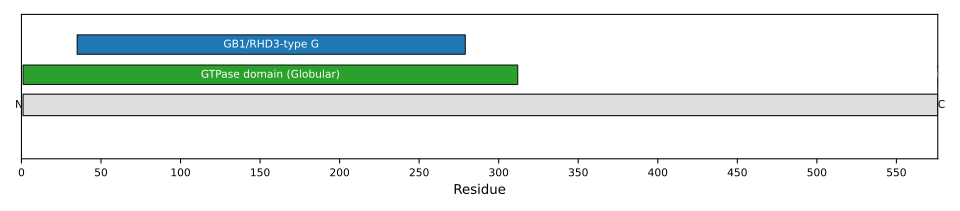
1: Interferon (IFN)-inducible GTPase that plays important roles in innate immunity against a diverse range of bacterial, viral and protozoan pathogens (PubMed:16511497, PubMed:22106366, PubMed:29144452, PubMed:31268602, PubMed:32510692, PubMed:32581219, PubMed:37797010, PubMed:7512561). Hydrolyzes GTP to GMP in two consecutive cleavage reactions: GTP is first hydrolyzed to GDP and then to GMP in a processive manner (PubMed:16511497, PubMed:32510692, PubMed:7512561). Following infection, recruited to the pathogen-containing vacuoles or vacuole-escaped bacteria and promotes both inflammasome assembly and autophagy (PubMed:29144452, PubMed:31268602). Acts as a positive regulator of inflammasome assembly by facilitating the detection of inflammasome ligands from pathogens (PubMed:31268602, PubMed:32510692, PubMed:32581219). Involved in the lysis of pathogen-containing vacuoles, releasing pathogens into the cytosol (By similarity). Following pathogen release in the cytosol, forms a protein coat in a GTPase-dependent manner that encapsulates pathogens and promotes the detection of ligands by pattern recognition receptors (PubMed:32510692, PubMed:32581219). Plays a key role in inflammasome assembly in response to infection by Gram-negative bacteria: following pathogen release in the cytosol, forms a protein coat that encapsulates Gram-negative bacteria and directly binds to lipopolysaccharide (LPS), disrupting the O-antigen barrier and unmasking lipid A that is that detected by the non-canonical inflammasome effector CASP4/CASP11 (PubMed:32510692, PubMed:32581219). Also promotes recruitment of proteins that mediate bacterial cytolysis, leading to release double-stranded DNA (dsDNA) that activates the AIM2 inflammasome (PubMed:31268602). Involved in autophagy by regulating bacteriolytic peptide generation via its interaction with ubiquitin-binding protein SQSTM1, which delivers monoubiquitinated proteins to autolysosomes for the generation of bacteriolytic peptides (By similarity). Confers protection to several pathogens, including the bacterial pathogens L.monocytogenes and M.bovis BCG as well as the protozoan pathogen T.gondii (PubMed:31268602). Exhibits antiviral activity against influenza virus (PubMed:22106366)