DNA replication licensing factor MCM5 (EC 3.6.4.12) (CDC46 homolog) (P1-CDC46)
1_MSGFD 6_ DPGIF 11_ YSDSF 16_ GGDAQ 21_ ADEGQ 26_ ARKSQ 31_ LQRRF 36_ KEFLR 41_ QYRVG 46_ TDRTG 51_ FTFKY 56_ RDELK 61_ RHYNL 66_ GEYWI 71_ EVEME 76_ DLASF 81_ DEDLA 86_ DYLYK 91_ QPAEH 96_ LQLLE 101_ EAAKE 106_ VADEV 111_ TRPRP 116_ SGEEV 121_ LQDIQ 126_ VMLKS 131_ DASPS 136_ SIRSL 141_ KSDMM 146_ SHLVK 151_ IPGII 156_ IAASA 161_ VRAKA 166_ TRISI 171_ QCRSC 176_ RNTLT 181_ NIAMR 186_ PGLEG 191_ YALPR 196_ KCNTD 201_ QAGRP 206_ KCPLD 211_ PYFIM 216_ PDKCK 221_ CVDFQ 226_ TLKLQ 231_ ELPDA 236_ VPHGE 241_ MPRHM 246_ QLYCD 251_ RYLCD 256_ KVVPG 261_ NRVTI 266_ MGIYS 271_ IKKFG 276_ LTTSR 281_ GRDRV 286_ GVGIR 291_ SSYIR 296_ VLGIQ 301_ VDTDG 306_ SGRSF 311_ AGAVS 316_ PQEEE 321_ EFRRL 326_ AALPN 331_ VYEVI 336_ SKSIA 341_ PSIFG 346_ GTDMK 351_ KAIAC 356_ LLFGG 361_ SRKRL 366_ PDGLT 371_ RRGDI 376_ NLLML 381_ GDPGT 386_ AKSQL 391_ LKFVE 396_ KCSPI 401_ GVYTS 406_ GKGSS 411_ AAGLT 416_ ASVMR 421_ DPSSR 426_ NFIME 431_ GGAMV 436_ LADGG 441_ VVCID 446_ EFDKM 451_ REDDR 456_ VAIHE 461_ AMEQQ 466_ TISIA 471_ KAGIT 476_ TTLNS 481_ RCSVL 486_ AAANS 491_ VFGRW 496_ DETKG 501_ EDNID 506_ FMPTI 511_ LSRFD 516_ MIFIV 521_ KDEHN 526_ EERDV 531_ MLAKH 536_ VITLH 541_ VSALT 546_ QTQAV 551_ EGEID 556_ LAKLK 561_ KFIAY 566_ CRVKC 571_ GPRLS 576_ AEAAE 581_ KLKNR 586_ YIIMR 591_ SGARQ 596_ HERDS 601_ DRRSS 606_ IPITV 611_ RQLEA 616_ IVRIA 621_ EALSK 626_ MKLQP 631_ FATEA 636_ DVEEA 641_ LRLFQ 646_ VSTLD 651_ AALSG 656_ TLSGV 661_ EGFTS 666_ QEDQE 671_ MLSRI 676_ EKQLK 681_ RRFAI 686_ GSQVS 691_ EHSII 696_ KDFTK 701_ QKYPE 706_ HAIHK 711_ VLQLM 716_ LRRGE 721_ IQHRM 726_QRKVL
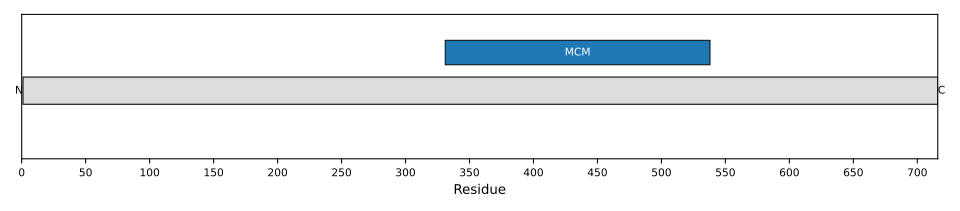
1: Acts as a component of the MCM2-7 complex (MCM complex) which is the replicative helicase essential for 'once per cell cycle' DNA replication initiation and elongation in eukaryotic cells. Core component of CDC45-MCM-GINS (CMG) helicase, the molecular machine that unwinds template DNA during replication, and around which the replisome is built (PubMed:16899510, PubMed:32453425, PubMed:34694004, PubMed:34700328, PubMed:35585232). The active ATPase sites in the MCM2-7 ring are formed through the interaction surfaces of two neighboring subunits such that a critical structure of a conserved arginine finger motif is provided in trans relative to the ATP-binding site of the Walker A box of the adjacent subunit. The six ATPase active sites, however, are likely to contribute differentially to the complex helicase activity (PubMed:32453425)