DNA replication licensing factor MCM7 (EC 3.6.4.12) (CDC47 homolog) (P1.1-MCM3)
1_MALKD 6_ YALEK 11_ EKVKK 16_ FLQEF 21_ YQDDE 26_ LGKKQ 31_ FKYGN 36_ QLVRL 41_ AHREQ 46_ VALYV 51_ DLDDV 56_ AEDDP 61_ ELVDS 66_ ICENA 71_ RRYAK 76_ LFADA 81_ VQELL 86_ PQYKE 91_ REVVN 96_ KDVLD 101_ VYIEH 106_ RLMME 111_ QRSRD 116_ PGMVR 121_ SPQNQ 126_ YPAEL 131_ MRRFE 136_ LYFQG 141_ PSSNK 146_ PRVIR 151_ EVRAD 156_ SVGKL 161_ VTVRG 166_ IVTRV 171_ SEVKP 176_ KMVVA 181_ TYTCD 186_ QCGAE 191_ TYQPI 196_ QSPTF 201_ MPLIM 206_ CPSQE 211_ CQTNR 216_ SGGRL 221_ YLQTR 226_ GSRFI 231_ KFQEM 236_ KMQEH 241_ SDQVP 246_ VGNIP 251_ RSITV 256_ LVEGE 261_ NTRIA 266_ QPGDH 271_ VSVTG 276_ IFLPI 281_ LRTGF 286_ RQVVQ 291_ GLLSE 296_ TYLEA 301_ HRIVK 306_ MNKSE 311_ DDESG 316_ AGELT 321_ REELR 326_ QIAEE 331_ DFYEK 336_ LAASI 341_ APEIY 346_ GHEDV 351_ KKALL 356_ LLLVG 361_ GVDQS 366_ PRGMK 371_ IRGNI 376_ NICLM 381_ GDPGV 386_ AKSQL 391_ LSYID 396_ RLAPR 401_ SQYTT 406_ GRGSS 411_ GVGLT 416_ AAVLR 421_ DSVSG 426_ ELTLE 431_ GGALV 436_ LADQG 441_ VCCID 446_ EFDKM 451_ AEADR 456_ TAIHE 461_ VMEQQ 466_ TISIA 471_ KAGIL 476_ TTLNA 481_ RCSIL 486_ AAANP 491_ AYGRY 496_ NPRRS 501_ LEQNI 506_ QLPAA 511_ LLSRF 516_ DLLWL 521_ IQDRP 526_ DRDND 531_ LRLAQ 536_ HITYV 541_ HQHSR 546_ QPPSQ 551_ FEPLD 556_ MKLMR 561_ RYIAM 566_ CREKQ 571_ PMVPE 576_ SLADY 581_ ITAAY 586_ VEMRR 591_ EAWAS 596_ KDATY 601_ TSART 606_ LLAIL 611_ RLSTA 616_ LARLR 621_ MVDVV 626_ EKEDV 631_ NEAIR 636_ LMEMS 641_ KDSLL 646_ GDKGQ 651_ TARTQ 656_ RPADV 661_ IFATV 666_ RELVS 671_ GGRSV 676_ RFSEA 681_ EQRCV 686_ SRGFT 691_ PAQFQ 696_ AALDE 701_ YEELN 706_ VWQVN 711_ASRTR
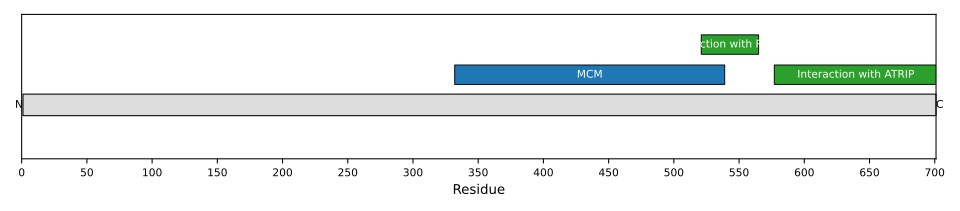
1: Acts as a component of the MCM2-7 complex (MCM complex) which is the replicative helicase essential for 'once per cell cycle' DNA replication initiation and elongation in eukaryotic cells. Core component of CDC45-MCM-GINS (CMG) helicase, the molecular machine that unwinds template DNA during replication, and around which the replisome is built (PubMed:25661590, PubMed:32453425, PubMed:34694004, PubMed:34700328, PubMed:35585232, PubMed:9305914). The active ATPase sites in the MCM2-7 ring are formed through the interaction surfaces of two neighboring subunits such that a critical structure of a conserved arginine finger motif is provided in trans relative to the ATP-binding site of the Walker A box of the adjacent subunit. The six ATPase active sites, however, are likely to contribute differentially to the complex helicase activity (PubMed:32453425). Required for S-phase checkpoint activation upon UV-induced damage