Heat shock 70 kDa protein 1-like (Heat shock 70 kDa protein 1L) (Heat shock 70 kDa protein 1-Hom) (HSP70-Hom)
1_MATAK 6_ GIAIG 11_ IDLGT 16_ TYSCV 21_ GVFQH 26_ GKVEI 31_ IANDQ 36_ GNRTT 41_ PSYVA 46_ FTDTE 51_ RLIGD 56_ AAKNQ 61_ VAMNP 66_ QNTVF 71_ DAKRL 76_ IGRKF 81_ NDPVV 86_ QADMK 91_ LWPFQ 96_ VINEG 101_ GKPKV 106_ LVSYK 111_ GENKA 116_ FYPEE 121_ ISSMV 126_ LTKLK 131_ ETAEA 136_ FLGHP 141_ VTNAV 146_ ITVPA 151_ YFNDS 156_ QRQAT 161_ KDAGV 166_ IAGLN 171_ VLRII 176_ NEPTA 181_ AAIAY 186_ GLDKG 191_ GQGER 196_ HVLIF 201_ DLGGG 206_ TFDVS 211_ ILTID 216_ DGIFE 221_ VKATA 226_ GDTHL 231_ GGEDF 236_ DNRLV 241_ SHFVE 246_ EFKRK 251_ HKKDI 256_ SQNKR 261_ AVRRL 266_ RTACE 271_ RAKRT 276_ LSSST 281_ QANLE 286_ IDSLY 291_ EGIDF 296_ YTSIT 301_ RARFE 306_ ELCAD 311_ LFRGT 316_ LEPVE 321_ KALRD 326_ AKMDK 331_ AKIHD 336_ IVLVG 341_ GSTRI 346_ PKVQR 351_ LLQDY 356_ FNGRD 361_ LNKSI 366_ NPDEA 371_ VAYGA 376_ AVQAA 381_ ILMGD 386_ KSEKV 391_ QDLLL 396_ LDVAP 401_ LSLGL 406_ ETAGG 411_ VMTAL 416_ IKRNS 421_ TIPTK 426_ QTQIF 431_ TTYSD 436_ NQPGV 441_ LIQVY 446_ EGERA 451_ MTKDN 456_ NLLGR 461_ FDLTG 466_ IPPAP 471_ RGVPQ 476_ IEVTF 481_ DIDAN 486_ GILNV 491_ TATDK 496_ STGKV 501_ NKITI 506_ TNDKG 511_ RLSKE 516_ EIERM 521_ VLDAE 526_ KYKAE 531_ DEVQR 536_ EKIAA 541_ KNALE 546_ SYAFN 551_ MKSVV 556_ SDEGL 561_ KGKIS 566_ ESDKN 571_ KILDK 576_ CNELL 581_ SWLEV 586_ NQLAE 591_ KDEFD 596_ HKRKE 601_ LEQMC 606_ NPIIT 611_ KLYQG 616_ GCTGP 621_ ACGTG 626_ YVPGR 631_ PATGP 636_TIEEV
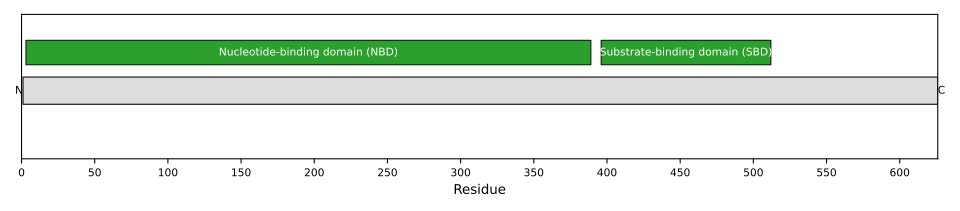
1: Molecular chaperone implicated in a wide variety of cellular processes, including protection of the proteome from stress, folding and transport of newly synthesized polypeptides, activation of proteolysis of misfolded proteins and the formation and dissociation of protein complexes. Plays a pivotal role in the protein quality control system, ensuring the correct folding of proteins, the re-folding of misfolded proteins and controlling the targeting of proteins for subsequent degradation. This is achieved through cycles of ATP binding, ATP hydrolysis and ADP release, mediated by co-chaperones. The affinity for polypeptides is regulated by its nucleotide bound state. In the ATP-bound form, it has a low affinity for substrate proteins. However, upon hydrolysis of the ATP to ADP, it undergoes a conformational change that increases its affinity for substrate proteins. It goes through repeated cycles of ATP hydrolysis and nucleotide exchange, which permits cycles of substrate binding and release (PubMed:26865365). Positive regulator of PRKN translocation to damaged mitochondria (PubMed:24270810)