Prostaglandin G/H synthase 2 (EC 1.14.99.1) (Cyclooxygenase-2) (COX-2) (PHS II) (Prostaglandin H2 synthase 2) (PGH synthase 2) (PGHS-2) (Prostaglandin-endoperoxide synthase 2)
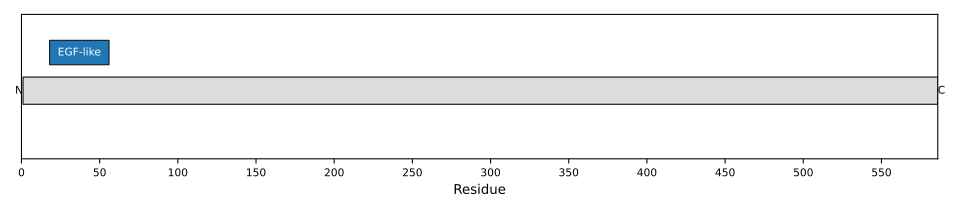
1_MLARA 6_ LLLCA 11_ VLALS 16_ HTANP 21_ CCSHP 26_ CQNRG 31_ VCMSV 36_ GFDQY 41_ KCDCT 46_ RTGFY 51_ GENCS 56_ TPEFL 61_ TRIKL 66_ FLKPT 71_ PNTVH 76_ YILTH 81_ FKGFW 86_ NVVNN 91_ IPFLR 96_ NAIMS 101_ YVLTS 106_ RSHLI 111_ DSPPT 116_ YNADY 121_ GYKSW 126_ EAFSN 131_ LSYYT 136_ RALPP 141_ VPDDC 146_ PTPLG 151_ VKGKK 156_ QLPDS 161_ NEIVE 166_ KLLLR 171_ RKFIP 176_ DPQGS 181_ NMMFA 186_ FFAQH 191_ FTHQF 196_ FKTDH 201_ KRGPA 206_ FTNGL 211_ GHGVD 216_ LNHIY 221_ GETLA 226_ RQRKL 231_ RLFKD 236_ GKMKY 241_ QIIDG 246_ EMYPP 251_ TVKDT 256_ QAEMI 261_ YPPQV 266_ PEHLR 271_ FAVGQ 276_ EVFGL 281_ VPGLM 286_ MYATI 291_ WLREH 296_ NRVCD 301_ VLKQE 306_ HPEWG 311_ DEQLF 316_ QTSRL 321_ ILIGE 326_ TIKIV 331_ IEDYV 336_ QHLSG 341_ YHFKL 346_ KFDPE 351_ LLFNK 356_ QFQYQ 361_ NRIAA 366_ EFNTL 371_ YHWHP 376_ LLPDT 381_ FQIHD 386_ QKYNY 391_ QQFIY 396_ NNSIL 401_ LEHGI 406_ TQFVE 411_ SFTRQ 416_ IAGRV 421_ AGGRN 426_ VPPAV 431_ QKVSQ 436_ ASIDQ 441_ SRQMK 446_ YQSFN 451_ EYRKR 456_ FMLKP 461_ YESFE 466_ ELTGE 471_ KEMSA 476_ ELEAL 481_ YGDID 486_ AVELY 491_ PALLV 496_ EKPRP 501_ DAIFG 506_ ETMVE 511_ VGAPF 516_ SLKGL 521_ MGNVI 526_ CSPAY 531_ WKPST 536_ FGGEV 541_ GFQII 546_ NTASI 551_ QSLIC 556_ NNVKG 561_ CPFTS 566_ FSVPD 571_ PELIK 576_ TVTIN 581_ ASSSR 586_ SGLDD 591_ INPTV 596_LLKER
1: Dual cyclooxygenase and peroxidase in the biosynthesis pathway of prostanoids, a class of C20 oxylipins mainly derived from arachidonate ((5Z,8Z,11Z,14Z)-eicosatetraenoate, AA, C20:4(n-6)), with a particular role in the inflammatory response (PubMed:11939906, PubMed:16373578, PubMed:19540099, PubMed:22942274, PubMed:26859324, PubMed:27226593, PubMed:7592599, PubMed:7947975, PubMed:9261177). The cyclooxygenase activity oxygenates AA to the hydroperoxy endoperoxide prostaglandin G2 (PGG2), and the peroxidase activity reduces PGG2 to the hydroxy endoperoxide prostaglandin H2 (PGH2), the precursor of all 2-series prostaglandins and thromboxanes (PubMed:16373578, PubMed:22942274, PubMed:26859324, PubMed:27226593, PubMed:7592599, PubMed:7947975, PubMed:9261177). This complex transformation is initiated by abstraction of hydrogen at carbon 13 (with S-stereochemistry), followed by insertion of molecular O2 to form the endoperoxide bridge between carbon 9 and 11 that defines prostaglandins. The insertion of a second molecule of O2 (bis-oxygenase activity) yields a hydroperoxy group in PGG2 that is then reduced to PGH2 by two electrons (PubMed:16373578, PubMed:22942274, PubMed:26859324, PubMed:27226593, PubMed:7592599, PubMed:7947975, PubMed:9261177). Similarly catalyzes successive cyclooxygenation and peroxidation of dihomo-gamma-linoleate (DGLA, C20:3(n-6)) and eicosapentaenoate (EPA, C20:5(n-3)) to corresponding PGH1 and PGH3, the precursors of 1- and 3-series prostaglandins (PubMed:11939906, PubMed:19540099). In an alternative pathway of prostanoid biosynthesis, converts 2-arachidonoyl lysophopholipids to prostanoid lysophopholipids, which are then hydrolyzed by intracellular phospholipases to release free prostanoids (PubMed:27642067). Metabolizes 2-arachidonoyl glycerol yielding the glyceryl ester of PGH2, a process that can contribute to pain response (PubMed:22942274). Generates lipid mediators from n-3 and n-6 polyunsaturated fatty acids (PUFAs) via a lipoxygenase-type mechanism. Oxygenates PUFAs to hydroperoxy compounds and then reduces them to corresponding alcohols (PubMed:11034610, PubMed:11192938, PubMed:9048568, PubMed:9261177). Plays a role in the generation of resolution phase interaction products (resolvins) during both sterile and infectious inflammation (PubMed:12391014). Metabolizes docosahexaenoate (DHA, C22:6(n-3)) to 17R-HDHA, a precursor of the D-series resolvins (RvDs) (PubMed:12391014). As a component of the biosynthetic pathway of E-series resolvins (RvEs), converts eicosapentaenoate (EPA, C20:5(n-3)) primarily to 18S-HEPE that is further metabolized by ALOX5 and LTA4H to generate 18S-RvE1 and 18S-RvE2 (PubMed:21206090). In vascular endothelial cells, converts docosapentaenoate (DPA, C22:5(n-3)) to 13R-HDPA, a precursor for 13-series resolvins (RvTs) shown to activate macrophage phagocytosis during bacterial infection (PubMed:26236990). In activated leukocytes, contributes to oxygenation of hydroxyeicosatetraenoates (HETE) to diHETES (5,15-diHETE and 5,11-diHETE) (PubMed:22068350, PubMed:26282205). Can also use linoleate (LA, (9Z,12Z)-octadecadienoate, C18:2(n-6)) as substrate and produce hydroxyoctadecadienoates (HODEs) in a regio- and stereospecific manner, being (9R)-HODE ((9R)-hydroxy-(10E,12Z)-octadecadienoate) and (13S)-HODE ((13S)-hydroxy-(9Z,11E)-octadecadienoate) its major products (By similarity). During neuroinflammation, plays a role in neuronal secretion of specialized preresolving mediators (SPMs) 15R-lipoxin A4 that regulates phagocytic microglia (By similarity)