Mu-type opioid receptor (M-OR-1) (MOR-1) (Mu opiate receptor) (Mu opioid receptor) (MOP) (hMOP)
1_MDSSA 6_ APTNA 11_ SNCTD 16_ ALAYS 21_ SCSPA 26_ PSPGS 31_ WVNLS 36_ HLDGN 41_ LSDPC 46_ GPNRT 51_ DLGGR 56_ DSLCP 61_ PTGSP 66_ SMITA 71_ ITIMA 76_ LYSIV 81_ CVVGL 86_ FGNFL 91_ VMYVI 96_ VRYTK 101_ MKTAT 106_ NIYIF 111_ NLALA 116_ DALAT 121_ STLPF 126_ QSVNY 131_ LMGTW 136_ PFGTI 141_ LCKIV 146_ ISIDY 151_ YNMFT 156_ SIFTL 161_ CTMSV 166_ DRYIA 171_ VCHPV 176_ KALDF 181_ RTPRN 186_ AKIIN 191_ VCNWI 196_ LSSAI 201_ GLPVM 206_ FMATT 211_ KYRQG 216_ SIDCT 221_ LTFSH 226_ PTWYW 231_ ENLLK 236_ ICVFI 241_ FAFIM 246_ PVLII 251_ TVCYG 256_ LMILR 261_ LKSVR 266_ MLSGS 271_ KEKDR 276_ NLRRI 281_ TRMVL 286_ VVVAV 291_ FIVCW 296_ TPIHI 301_ YVIIK 306_ ALVTI 311_ PETTF 316_ QTVSW 321_ HFCIA 326_ LGYTN 331_ SCLNP 336_ VLYAF 341_ LDENF 346_ KRCFR 351_ EFCIP 356_ TSSNI 361_ EQQNS 366_ TRIRQ 371_ NTRDH 376_ PSTAN 381_ TVDRT 386_ NHQLE 391_NLEAE
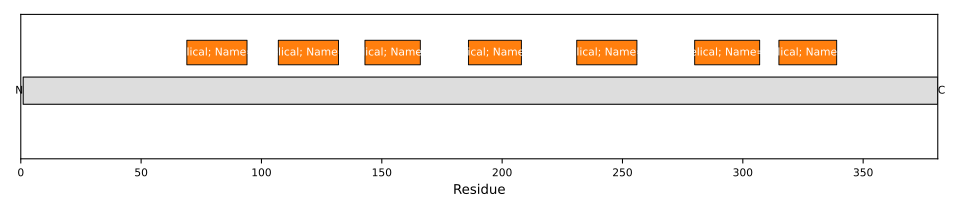
1: Receptor for endogenous opioids such as beta-endorphin and endomorphin (PubMed:10529478, PubMed:12589820, PubMed:7891175, PubMed:7905839, PubMed:7957926, PubMed:9689128). Receptor for natural and synthetic opioids including morphine, heroin, DAMGO, fentanyl, etorphine, buprenorphin and methadone (PubMed:10529478, PubMed:10836142, PubMed:12589820, PubMed:19300905, PubMed:7891175, PubMed:7905839, PubMed:7957926, PubMed:9689128). Also activated by enkephalin peptides, such as Met-enkephalin or Met-enkephalin-Arg-Phe, with higher affinity for Met-enkephalin-Arg-Phe (By similarity). Agonist binding to the receptor induces coupling to an inactive GDP-bound heterotrimeric G-protein complex and subsequent exchange of GDP for GTP in the G-protein alpha subunit leading to dissociation of the G-protein complex with the free GTP-bound G-protein alpha and the G-protein beta-gamma dimer activating downstream cellular effectors (PubMed:7905839). The agonist- and cell type-specific activity is predominantly coupled to pertussis toxin-sensitive G(i) and G(o) G alpha proteins, GNAI1, GNAI2, GNAI3 and GNAO1 isoforms Alpha-1 and Alpha-2, and to a lesser extent to pertussis toxin-insensitive G alpha proteins GNAZ and GNA15 (PubMed:12068084). They mediate an array of downstream cellular responses, including inhibition of adenylate cyclase activity and both N-type and L-type calcium channels, activation of inward rectifying potassium channels, mitogen-activated protein kinase (MAPK), phospholipase C (PLC), phosphoinositide/protein kinase (PKC), phosphoinositide 3-kinase (PI3K) and regulation of NF-kappa-B (By similarity). Also couples to adenylate cyclase stimulatory G alpha proteins (By similarity). The selective temporal coupling to G-proteins and subsequent signaling can be regulated by RGSZ proteins, such as RGS9, RGS17 and RGS4 (By similarity). Phosphorylation by members of the GPRK subfamily of Ser/Thr protein kinases and association with beta-arrestins is involved in short-term receptor desensitization (By similarity). Beta-arrestins associate with the GPRK-phosphorylated receptor and uncouple it from the G-protein thus terminating signal transduction (By similarity). The phosphorylated receptor is internalized through endocytosis via clathrin-coated pits which involves beta-arrestins (By similarity). The activation of the ERK pathway occurs either in a G-protein-dependent or a beta-arrestin-dependent manner and is regulated by agonist-specific receptor phosphorylation (By similarity). Acts as a class A G-protein coupled receptor (GPCR) which dissociates from beta-arrestin at or near the plasma membrane and undergoes rapid recycling (By similarity). Receptor down-regulation pathways are varying with the agonist and occur dependent or independent of G-protein coupling (By similarity). Endogenous ligands induce rapid desensitization, endocytosis and recycling (By similarity). Heterooligomerization with other GPCRs can modulate agonist binding, signaling and trafficking properties (By similarity)
2: Couples to GNAS and is proposed to be involved in excitatory effects
3: Does not bind agonists but may act through oligomerization with binding-competent OPRM1 isoforms and reduce their ligand binding activity
4: Does not bind agonists but may act through oligomerization with binding-competent OPRM1 isoforms and reduce their ligand binding activity