Nuclear receptor ROR-alpha (Nuclear receptor RZR-alpha) (Nuclear receptor subfamily 1 group F member 1) (RAR-related orphan receptor A) (Retinoid-related orphan receptor-alpha)
1_MESAP 6_ AAPDP 11_ AASEP 16_ GSSGA 21_ DAAAG 26_ SRETP 31_ LNQES 36_ ARKSE 41_ PPAPV 46_ RRQSY 51_ SSTSR 56_ GISVT 61_ KKTHT 66_ SQIEI 71_ IPCKI 76_ CGDKS 81_ SGIHY 86_ GVITC 91_ EGCKG 96_ FFRRS 101_ QQSNA 106_ TYSCP 111_ RQKNC 116_ LIDRT 121_ SRNRC 126_ QHCRL 131_ QKCLA 136_ VGMSR 141_ DAVKF 146_ GRMSK 151_ KQRDS 156_ LYAEV 161_ QKHRM 166_ QQQQR 171_ DHQQQ 176_ PGEAE 181_ PLTPT 186_ YNISA 191_ NGLTE 196_ LHDDL 201_ SNYID 206_ GHTPE 211_ GSKAD 216_ SAVSS 221_ FYLDI 226_ QPSPD 231_ QSGLD 236_ INGIK 241_ PEPIC 246_ DYTPA 251_ SGFFP 256_ YCSFT 261_ NGETS 266_ PTVSM 271_ AELEH 276_ LAQNI 281_ SKSHL 286_ ETCQY 291_ LREEL 296_ QQITW 301_ QTFLQ 306_ EEIEN 311_ YQNKQ 316_ REVMW 321_ QLCAI 326_ KITEA 331_ IQYVV 336_ EFAKR 341_ IDGFM 346_ ELCQN 351_ DQIVL 356_ LKAGS 361_ LEVVF 366_ IRMCR 371_ AFDSQ 376_ NNTVY 381_ FDGKY 386_ ASPDV 391_ FKSLG 396_ CEDFI 401_ SFVFE 406_ FGKSL 411_ CSMHL 416_ TEDEI 421_ ALFSA 426_ FVLMS 431_ ADRSW 436_ LQEKV 441_ KIEKL 446_ QQKIQ 451_ LALQH 456_ VLQKN 461_ HREDG 466_ ILTKL 471_ ICKVS 476_ TLRAL 481_ CGRHT 486_ EKLMA 491_ FKAIY 496_ PDIVR 501_ LHFPP 506_ LYKEL 511_ FTSEF 516_EPAMQ
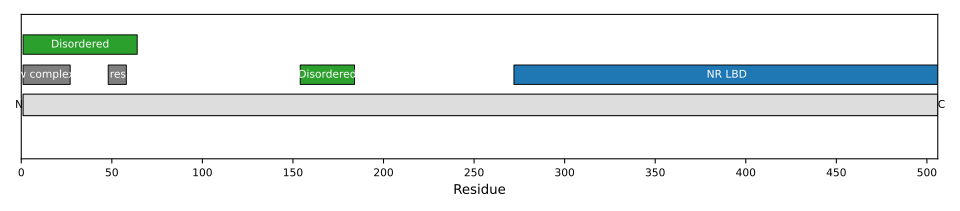
1: Nuclear receptor that binds DNA as a monomer to ROR response elements (RORE) containing a single core motif half-site 5'-AGGTCA-3' preceded by a short A-T-rich sequence. Key regulator of embryonic development, cellular differentiation, immunity, circadian rhythm as well as lipid, steroid, xenobiotics and glucose metabolism. Considered to have intrinsic transcriptional activity, have some natural ligands like oxysterols that act as agonists (25-hydroxycholesterol) or inverse agonists (7-oxygenated sterols), enhancing or repressing the transcriptional activity, respectively. Recruits distinct combinations of cofactors to target genes regulatory regions to modulate their transcriptional expression, depending on the tissue, time and promoter contexts. Regulates genes involved in photoreceptor development including OPN1SW, OPN1SM and ARR3 and skeletal muscle development with MYOD1. Required for proper cerebellum development (PubMed:29656859). Regulates SHH gene expression, among others, to induce granule cells proliferation as well as expression of genes involved in calcium-mediated signal transduction. Regulates the circadian expression of several clock genes, including CLOCK, BMAL1, NPAS2 and CRY1. Competes with NR1D1 for binding to their shared DNA response element on some clock genes such as BMAL1, CRY1 and NR1D1 itself, resulting in NR1D1-mediated repression or RORA-mediated activation of clock genes expression, leading to the circadian pattern of clock genes expression. Therefore influences the period length and stability of the clock. Regulates genes involved in lipid metabolism such as apolipoproteins APOA1, APOA5, APOC3 and PPARG. In liver, has specific and redundant functions with RORC as positive or negative modulator of expression of genes encoding phase I and phase II proteins involved in the metabolism of lipids, steroids and xenobiotics, such as CYP7B1 and SULT2A1. Induces a rhythmic expression of some of these genes. In addition, interplays functionally with NR1H2 and NR1H3 for the regulation of genes involved in cholesterol metabolism. Also involved in the regulation of hepatic glucose metabolism through the modulation of G6PC1 and PCK1. In adipose tissue, plays a role as negative regulator of adipocyte differentiation, probably acting through dual mechanisms. May suppress CEBPB-dependent adipogenesis through direct interaction and PPARG-dependent adipogenesis through competition for DNA-binding. Downstream of IL6 and TGFB and synergistically with RORC isoform 2, is implicated in the lineage specification of uncommitted CD4(+) T-helper (T(H)) cells into T(H)17 cells, antagonizing the T(H)1 program. Probably regulates IL17 and IL17F expression on T(H) by binding to the essential enhancer conserved non-coding sequence 2 (CNS2) in the IL17-IL17F locus. Involved in hypoxia signaling by interacting with and activating the transcriptional activity of HIF1A. May inhibit cell growth in response to cellular stress. May exert an anti-inflammatory role by inducing CHUK expression and inhibiting NF-kappa-B signaling