Hexokinase-4 (HK4) (EC 2.7.1.1) (Glucokinase) (Hexokinase type IV) (HK IV) (Hexokinase-D)
1_MLDDR 6_ ARMEA 11_ AKKEK 16_ VEQIL 21_ AEFQL 26_ QEEDL 31_ KKVMR 36_ RMQKE 41_ MDRGL 46_ RLETH 51_ EEASV 56_ KMLPT 61_ YVRST 66_ PEGSE 71_ VGDFL 76_ SLDLG 81_ GTNFR 86_ VMLVK 91_ VGEGE 96_ EGQWS 101_ VKTKH 106_ QMYSI 111_ PEDAM 116_ TGTAE 121_ MLFDY 126_ ISECI 131_ SDFLD 136_ KHQMK 141_ HKKLP 146_ LGFTF 151_ SFPVR 156_ HEDID 161_ KGILL 166_ NWTKG 171_ FKASG 176_ AEGNN 181_ VVGLL 186_ RDAIK 191_ RRGDF 196_ EMDVV 201_ AMVND 206_ TVATM 211_ ISCYY 216_ EDHQC 221_ EVGMI 226_ VGTGC 231_ NACYM 236_ EEMQN 241_ VELVE 246_ GDEGR 251_ MCVNT 256_ EWGAF 261_ GDSGE 266_ LDEFL 271_ LEYDR 276_ LVDES 281_ SANPG 286_ QQLYE 291_ KLIGG 296_ KYMGE 301_ LVRLV 306_ LLRLV 311_ DENLL 316_ FHGEA 321_ SEQLR 326_ TRGAF 331_ ETRFV 336_ SQVES 341_ DTGDR 346_ KQIYN 351_ ILSTL 356_ GLRPS 361_ TTDCD 366_ IVRRA 371_ CESVS 376_ TRAAH 381_ MCSAG 386_ LAGVI 391_ NRMRE 396_ SRSED 401_ VMRIT 406_ VGVDG 411_ SVYKL 416_ HPSFK 421_ ERFHA 426_ SVRRL 431_ TPSCE 436_ ITFIE 441_ SEEGS 446_ GRGAA 451_ LVSAV 456_ACKKA
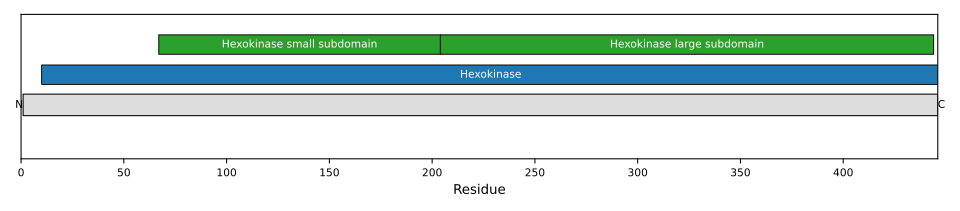
1: Catalyzes the phosphorylation of hexose, such as D-glucose, D-fructose and D-mannose, to hexose 6-phosphate (D-glucose 6-phosphate, D-fructose 6-phosphate and D-mannose 6-phosphate, respectively) (PubMed:11916951, PubMed:15277402, PubMed:17082186, PubMed:18322640, PubMed:19146401, PubMed:25015100, PubMed:7742312, PubMed:8325892). Compared to other hexokinases, has a weak affinity for D-glucose, and is effective only when glucose is abundant (By similarity). Mainly expressed in pancreatic beta cells and the liver and constitutes a rate-limiting step in glucose metabolism in these tissues (PubMed:11916951, PubMed:15277402, PubMed:18322640, PubMed:25015100, PubMed:8325892). Since insulin secretion parallels glucose metabolism and the low glucose affinity of GCK ensures that it can change its enzymatic activity within the physiological range of glucose concentrations, GCK acts as a glucose sensor in the pancreatic beta cell (By similarity). In pancreas, plays an important role in modulating insulin secretion (By similarity). In liver, helps to facilitate the uptake and conversion of glucose by acting as an insulin-sensitive determinant of hepatic glucose usage (By similarity). Required to provide D-glucose 6-phosphate for the synthesis of glycogen (PubMed:8878425). Mediates the initial step of glycolysis by catalyzing phosphorylation of D-glucose to D-glucose 6-phosphate (PubMed:7742312)