DNA damage-inducible transcript 3 protein (DDIT-3) (C/EBP zeta) (C/EBP-homologous protein) (CHOP) (C/EBP-homologous protein 10) (CHOP-10) (CCAAT/enhancer-binding protein homologous protein) (Growth arrest and DNA damage-inducible protein GADD153)
1_MAAES 6_ LPFSF 11_ GTLSS 16_ WELEA 21_ WYEDL 26_ QEVLS 31_ SDENG 36_ GTYVS 41_ PPGNE 46_ EEESK 51_ IFTTL 56_ DPASL 61_ AWLTE 66_ EEPEP 71_ AEVTS 76_ TSQSP 81_ HSPDS 86_ SQSSL 91_ AQEEE 96_ EEDQG 101_ RTRKR 106_ KQSGH 111_ SPARA 116_ GKQRM 121_ KEKEQ 126_ ENERK 131_ VAQLA 136_ EENER 141_ LKQEI 146_ ERLTR 151_ EVEAT 156_ RRALI 161_DRMVN
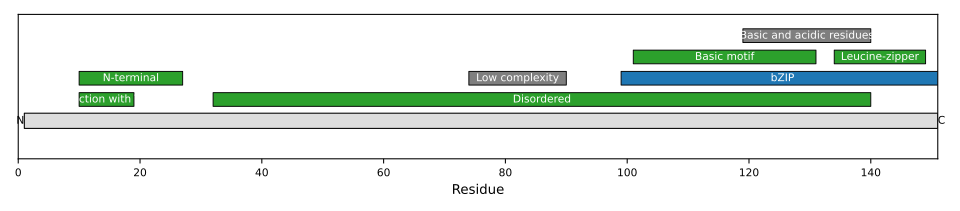
1: Multifunctional transcription factor in endoplasmic reticulum (ER) stress response (PubMed:15322075, PubMed:15775988, PubMed:19672300). Plays an essential role in the response to a wide variety of cell stresses and induces cell cycle arrest and apoptosis in response to ER stress (PubMed:15322075, PubMed:15775988). Plays a dual role both as an inhibitor of CCAAT/enhancer-binding protein (C/EBP) function and as an activator of other genes (By similarity). Acts as a dominant-negative regulator of C/EBP-induced transcription: dimerizes with members of the C/EBP family, impairs their association with C/EBP binding sites in the promoter regions, and inhibits the expression of C/EBP regulated genes (By similarity). Positively regulates the transcription of TRIB3, IL6, IL8, IL23, TNFRSF10B/DR5, PPP1R15A/GADD34, BBC3/PUMA, BCL2L11/BIM and ERO1L (PubMed:15775988, PubMed:17709599, PubMed:20876114, PubMed:22761832). Negatively regulates; expression of BCL2 and MYOD1, ATF4-dependent transcriptional activation of asparagine synthetase (ASNS), CEBPA-dependent transcriptional activation of hepcidin (HAMP) and CEBPB-mediated expression of peroxisome proliferator-activated receptor gamma (PPARG) (PubMed:18940792, PubMed:19672300, PubMed:20829347). Together with ATF4, mediates ER-mediated cell death by promoting expression of genes involved in cellular amino acid metabolic processes, mRNA translation and the unfolded protein response (UPR) in response to ER stress (By similarity). Inhibits the canonical Wnt signaling pathway by binding to TCF7L2/TCF4, impairing its DNA-binding properties and repressing its transcriptional activity (PubMed:16434966). Plays a regulatory role in the inflammatory response through the induction of caspase-11 (CASP4/CASP11) which induces the activation of caspase-1 (CASP1) and both these caspases increase the activation of pro-IL1B to mature IL1B which is involved in the inflammatory response (By similarity). Acts as a major regulator of postnatal neovascularization through regulation of endothelial nitric oxide synthase (NOS3)-related signaling (By similarity)