Aryl hydrocarbon receptor (Ah receptor) (AhR) (Class E basic helix-loop-helix protein 76) (bHLHe76)
1_MNSSS 6_ ANITY 11_ ASRKR 16_ RKPVQ 21_ KTVKP 26_ IPAEG 31_ IKSNP 36_ SKRHR 41_ DRLNT 46_ ELDRL 51_ ASLLP 56_ FPQDV 61_ INKLD 66_ KLSVL 71_ RLSVS 76_ YLRAK 81_ SFFDV 86_ ALKSS 91_ PTERN 96_ GGQDN 101_ CRAAN 106_ FREGL 111_ NLQEG 116_ EFLLQ 121_ ALNGF 126_ VLVVT 131_ TDALV 136_ FYASS 141_ TIQDY 146_ LGFQQ 151_ SDVIH 156_ QSVYE 161_ LIHTE 166_ DRAEF 171_ QRQLH 176_ WALNP 181_ SQCTE 186_ SGQGI 191_ EEATG 196_ LPQTV 201_ VCYNP 206_ DQIPP 211_ ENSPL 216_ MERCF 221_ ICRLR 226_ CLLDN 231_ SSGFL 236_ AMNFQ 241_ GKLKY 246_ LHGQK 251_ KKGKD 256_ GSILP 261_ PQLAL 266_ FAIAT 271_ PLQPP 276_ SILEI 281_ RTKNF 286_ IFRTK 291_ HKLDF 296_ TPIGC 301_ DAKGR 306_ IVLGY 311_ TEAEL 316_ CTRGS 321_ GYQFI 326_ HAADM 331_ LYCAE 336_ SHIRM 341_ IKTGE 346_ SGMIV 351_ FRLLT 356_ KNNRW 361_ TWVQS 366_ NARLL 371_ YKNGR 376_ PDYII 381_ VTQRP 386_ LTDEE 391_ GTEHL 396_ RKRNT 401_ KLPFM 406_ FTTGE 411_ AVLYE 416_ ATNPF 421_ PAIMD 426_ PLPLR 431_ TKNGT 436_ SGKDS 441_ ATTST 446_ LSKDS 451_ LNPSS 456_ LLAAM 461_ MQQDE 466_ SIYLY 471_ PASST 476_ SSTAP 481_ FENNF 486_ FNESM 491_ NECRN 496_ WQDNT 501_ APMGN 506_ DTILK 511_ HEQID 516_ QPQDV 521_ NSFAG 526_ GHPGL 531_ FQDSK 536_ NSDLY 541_ SIMKN 546_ LGIDF 551_ EDIRH 556_ MQNEK 561_ FFRND 566_ FSGEV 571_ DFRDI 576_ DLTDE 581_ ILTYV 586_ QDSLS 591_ KSPFI 596_ PSDYQ 601_ QQQSL 606_ ALNSS 611_ CMVQE 616_ HLHLE 621_ QQQQH 626_ HQKQV 631_ VVEPQ 636_ QQLCQ 641_ KMKHM 646_ QVNGM 651_ FENWN 656_ SNQFV 661_ PFNCP 666_ QQDPQ 671_ QYNVF 676_ TDLHG 681_ ISQEF 686_ PYKSE 691_ MDSMP 696_ YTQNF 701_ ISCNQ 706_ PVLPQ 711_ HSKCT 716_ ELDYP 721_ MGSFE 726_ PSPYP 731_ TTSSL 736_ EDFVT 741_ CLQLP 746_ ENQKH 751_ GLNPQ 756_ SAIIT 761_ PQTCY 766_ AGAVS 771_ MYQCQ 776_ PEPQH 781_ THVGQ 786_ MQYNP 791_ VLPGQ 796_ QAFLN 801_ KFQNG 806_ VLNET 811_ YPAEL 816_ NNINN 821_ TQTTT 826_ HLQPL 831_ HHPSE 836_ ARPFP 841_DLTSS
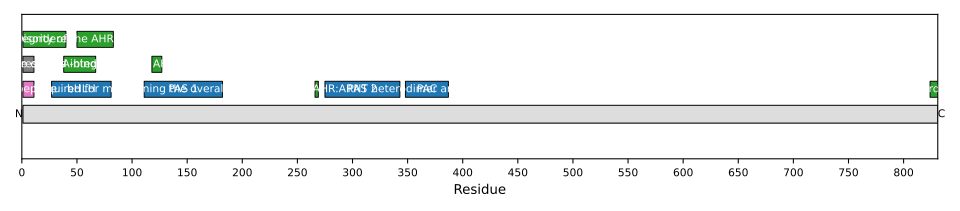
1: Ligand-activated transcription factor that enables cells to adapt to changing conditions by sensing compounds from the environment, diet, microbiome and cellular metabolism, and which plays important roles in development, immunity and cancer (PubMed:23275542, PubMed:30373764, PubMed:32818467, PubMed:7961644). Upon ligand binding, translocates into the nucleus, where it heterodimerizes with ARNT and induces transcription by binding to xenobiotic response elements (XRE) (PubMed:23275542, PubMed:30373764, PubMed:7961644). Regulates a variety of biological processes, including angiogenesis, hematopoiesis, drug and lipid metabolism, cell motility and immune modulation (PubMed:12213388). Xenobiotics can act as ligands: upon xenobiotic-binding, activates the expression of multiple phase I and II xenobiotic chemical metabolizing enzyme genes (such as the CYP1A1 gene) (PubMed:7961644, PubMed:33193710). Mediates biochemical and toxic effects of halogenated aromatic hydrocarbons (PubMed:34521881, PubMed:7961644). Next to xenobiotics, natural ligands derived from plants, microbiota, and endogenous metabolism are potent AHR agonists (PubMed:18076143). Tryptophan (Trp) derivatives constitute an important class of endogenous AHR ligands (PubMed:32818467, PubMed:32866000). Acts as a negative regulator of anti-tumor immunity: indoles and kynurenic acid generated by Trp catabolism act as ligand and activate AHR, thereby promoting AHR-driven cancer cell motility and suppressing adaptive immunity (PubMed:32818467). Regulates the circadian clock by inhibiting the basal and circadian expression of the core circadian component PER1 (PubMed:28602820). Inhibits PER1 by repressing the CLOCK-BMAL1 heterodimer mediated transcriptional activation of PER1 (PubMed:28602820). The heterodimer ARNT:AHR binds to core DNA sequence 5'-TGCGTG-3' within the dioxin response element (DRE) of target gene promoters and activates their transcription (PubMed:28602820)