Activin receptor type-1B (EC 2.7.11.30) (Activin receptor type IB) (ACTR-IB) (Activin receptor-like kinase 4) (ALK-4) (Serine/threonine-protein kinase receptor R2) (SKR2)
1_MAESA 6_ GASSF 11_ FPLVV 16_ LLLAG 21_ SGGSG 26_ PRGVQ 31_ ALLCA 36_ CTSCL 41_ QANYT 46_ CETDG 51_ ACMVS 56_ IFNLD 61_ GMEHH 66_ VRTCI 71_ PKVEL 76_ VPAGK 81_ PFYCL 86_ SSEDL 91_ RNTHC 96_ CYTDY 101_ CNRID 106_ LRVPS 111_ GHLKE 116_ PEHPS 121_ MWGPV 126_ ELVGI 131_ IAGPV 136_ FLLFL 141_ IIIIV 146_ FLVIN 151_ YHQRV 156_ YHNRQ 161_ RLDME 166_ DPSCE 171_ MCLSK 176_ DKTLQ 181_ DLVYD 186_ LSTSG 191_ SGSGL 196_ PLFVQ 201_ RTVAR 206_ TIVLQ 211_ EIIGK 216_ GRFGE 221_ VWRGR 226_ WRGGD 231_ VAVKI 236_ FSSRE 241_ ERSWF 246_ REAEI 251_ YQTVM 256_ LRHEN 261_ ILGFI 266_ AADNK 271_ DNGTW 276_ TQLWL 281_ VSDYH 286_ EHGSL 291_ FDYLN 296_ RYTVT 301_ IEGMI 306_ KLALS 311_ AASGL 316_ AHLHM 321_ EIVGT 326_ QGKPG 331_ IAHRD 336_ LKSKN 341_ ILVKK 346_ NGMCA 351_ IADLG 356_ LAVRH 361_ DAVTD 366_ TIDIA 371_ PNQRV 376_ GTKRY 381_ MAPEV 386_ LDETI 391_ NMKHF 396_ DSFKC 401_ ADIYA 406_ LGLVY 411_ WEIAR 416_ RCNSG 421_ GVHEE 426_ YQLPY 431_ YDLVP 436_ SDPSI 441_ EEMRK 446_ VVCDQ 451_ KLRPN 456_ IPNWW 461_ QSYEA 466_ LRVMG 471_ KMMRE 476_ CWYAN 481_ GAARL 486_ TALRI 491_ KKTLS 496_QLSVQ
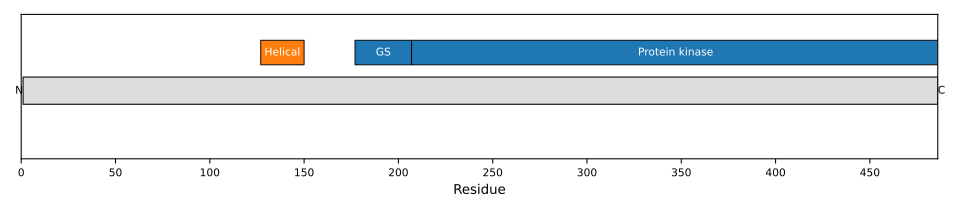
1: Transmembrane serine/threonine kinase activin type-1 receptor forming an activin receptor complex with activin receptor type-2 (ACVR2A or ACVR2B). Transduces the activin signal from the cell surface to the cytoplasm and is thus regulating a many physiological and pathological processes including neuronal differentiation and neuronal survival, hair follicle development and cycling, FSH production by the pituitary gland, wound healing, extracellular matrix production, immunosuppression and carcinogenesis. Activin is also thought to have a paracrine or autocrine role in follicular development in the ovary. Within the receptor complex, type-2 receptors (ACVR2A and/or ACVR2B) act as a primary activin receptors whereas the type-1 receptors like ACVR1B act as downstream transducers of activin signals. Activin binds to type-2 receptor at the plasma membrane and activates its serine-threonine kinase. The activated receptor type-2 then phosphorylates and activates the type-1 receptor such as ACVR1B. Once activated, the type-1 receptor binds and phosphorylates the SMAD proteins SMAD2 and SMAD3, on serine residues of the C-terminal tail. Soon after their association with the activin receptor and subsequent phosphorylation, SMAD2 and SMAD3 are released into the cytoplasm where they interact with the common partner SMAD4. This SMAD complex translocates into the nucleus where it mediates activin-induced transcription. Inhibitory SMAD7, which is recruited to ACVR1B through FKBP1A, can prevent the association of SMAD2 and SMAD3 with the activin receptor complex, thereby blocking the activin signal. Activin signal transduction is also antagonized by the binding to the receptor of inhibin-B via the IGSF1 inhibin coreceptor. ACVR1B also phosphorylates TDP2