TGF-beta receptor type-1 (TGFR-1) (EC 2.7.11.30) (Activin A receptor type II-like protein kinase of 53kD) (Activin receptor-like kinase 5) (ALK-5) (ALK5) (Serine/threonine-protein kinase receptor R4) (SKR4) (TGF-beta type I receptor) (Transforming growth factor-beta receptor type I) (TGF-beta receptor type I) (TbetaR-I)
1_MEAAV 6_ AAPRP 11_ RLLLL 16_ VLAAA 21_ AAAAA 26_ ALLPG 31_ ATALQ 36_ CFCHL 41_ CTKDN 46_ FTCVT 51_ DGLCF 56_ VSVTE 61_ TTDKV 66_ IHNSM 71_ CIAEI 76_ DLIPR 81_ DRPFV 86_ CAPSS 91_ KTGSV 96_ TTTYC 101_ CNQDH 106_ CNKIE 111_ LPTTV 116_ KSSPG 121_ LGPVE 126_ LAAVI 131_ AGPVC 136_ FVCIS 141_ LMLMV 146_ YICHN 151_ RTVIH 156_ HRVPN 161_ EEDPS 166_ LDRPF 171_ ISEGT 176_ TLKDL 181_ IYDMT 186_ TSGSG 191_ SGLPL 196_ LVQRT 201_ IARTI 206_ VLQES 211_ IGKGR 216_ FGEVW 221_ RGKWR 226_ GEEVA 231_ VKIFS 236_ SREER 241_ SWFRE 246_ AEIYQ 251_ TVMLR 256_ HENIL 261_ GFIAA 266_ DNKDN 271_ GTWTQ 276_ LWLVS 281_ DYHEH 286_ GSLFD 291_ YLNRY 296_ TVTVE 301_ GMIKL 306_ ALSTA 311_ SGLAH 316_ LHMEI 321_ VGTQG 326_ KPAIA 331_ HRDLK 336_ SKNIL 341_ VKKNG 346_ TCCIA 351_ DLGLA 356_ VRHDS 361_ ATDTI 366_ DIAPN 371_ HRVGT 376_ KRYMA 381_ PEVLD 386_ DSINM 391_ KHFES 396_ FKRAD 401_ IYAMG 406_ LVFWE 411_ IARRC 416_ SIGGI 421_ HEDYQ 426_ LPYYD 431_ LVPSD 436_ PSVEE 441_ MRKVV 446_ CEQKL 451_ RPNIP 456_ NRWQS 461_ CEALR 466_ VMAKI 471_ MRECW 476_ YANGA 481_ ARLTA 486_ LRIKK 491_ TLSQL 496_SQQEG
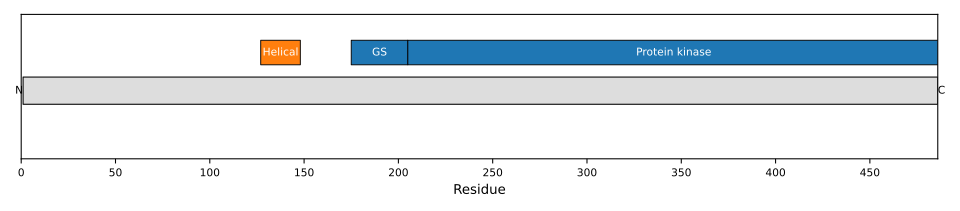
1: Transmembrane serine/threonine kinase forming with the TGF-beta type II serine/threonine kinase receptor, TGFBR2, the non-promiscuous receptor for the TGF-beta cytokines TGFB1, TGFB2 and TGFB3. Transduces the TGFB1, TGFB2 and TGFB3 signal from the cell surface to the cytoplasm and is thus regulating a plethora of physiological and pathological processes including cell cycle arrest in epithelial and hematopoietic cells, control of mesenchymal cell proliferation and differentiation, wound healing, extracellular matrix production, immunosuppression and carcinogenesis (PubMed:33914044). The formation of the receptor complex composed of 2 TGFBR1 and 2 TGFBR2 molecules symmetrically bound to the cytokine dimer results in the phosphorylation and the activation of TGFBR1 by the constitutively active TGFBR2. Activated TGFBR1 phosphorylates SMAD2 which dissociates from the receptor and interacts with SMAD4. The SMAD2-SMAD4 complex is subsequently translocated to the nucleus where it modulates the transcription of the TGF-beta-regulated genes. This constitutes the canonical SMAD-dependent TGF-beta signaling cascade. Also involved in non-canonical, SMAD-independent TGF-beta signaling pathways. For instance, TGFBR1 induces TRAF6 autoubiquitination which in turn results in MAP3K7 ubiquitination and activation to trigger apoptosis. Also regulates epithelial to mesenchymal transition through a SMAD-independent signaling pathway through PARD6A phosphorylation and activation