TGF-beta receptor type-2 (TGFR-2) (EC 2.7.11.30) (TGF-beta type II receptor) (Transforming growth factor-beta receptor type II) (TGF-beta receptor type II) (TbetaR-II)
1_MGRGL 6_ LRGLW 11_ PLHIV 16_ LWTRI 21_ ASTIP 26_ PHVQK 31_ SVNND 36_ MIVTD 41_ NNGAV 46_ KFPQL 51_ CKFCD 56_ VRFST 61_ CDNQK 66_ SCMSN 71_ CSITS 76_ ICEKP 81_ QEVCV 86_ AVWRK 91_ NDENI 96_ TLETV 101_ CHDPK 106_ LPYHD 111_ FILED 116_ AASPK 121_ CIMKE 126_ KKKPG 131_ ETFFM 136_ CSCSS 141_ DECND 146_ NIIFS 151_ EEYNT 156_ SNPDL 161_ LLVIF 166_ QVTGI 171_ SLLPP 176_ LGVAI 181_ SVIII 186_ FYCYR 191_ VNRQQ 196_ KLSST 201_ WETGK 206_ TRKLM 211_ EFSEH 216_ CAIIL 221_ EDDRS 226_ DISST 231_ CANNI 236_ NHNTE 241_ LLPIE 246_ LDTLV 251_ GKGRF 256_ AEVYK 261_ AKLKQ 266_ NTSEQ 271_ FETVA 276_ VKIFP 281_ YEEYA 286_ SWKTE 291_ KDIFS 296_ DINLK 301_ HENIL 306_ QFLTA 311_ EERKT 316_ ELGKQ 321_ YWLIT 326_ AFHAK 331_ GNLQE 336_ YLTRH 341_ VISWE 346_ DLRKL 351_ GSSLA 356_ RGIAH 361_ LHSDH 366_ TPCGR 371_ PKMPI 376_ VHRDL 381_ KSSNI 386_ LVKND 391_ LTCCL 396_ CDFGL 401_ SLRLD 406_ PTLSV 411_ DDLAN 416_ SGQVG 421_ TARYM 426_ APEVL 431_ ESRMN 436_ LENVE 441_ SFKQT 446_ DVYSM 451_ ALVLW 456_ EMTSR 461_ CNAVG 466_ EVKDY 471_ EPPFG 476_ SKVRE 481_ HPCVE 486_ SMKDN 491_ VLRDR 496_ GRPEI 501_ PSFWL 506_ NHQGI 511_ QMVCE 516_ TLTEC 521_ WDHDP 526_ EARLT 531_ AQCVA 536_ ERFSE 541_ LEHLD 546_ RLSGR 551_ SCSEE 556_ KIPED 561_GSLNT
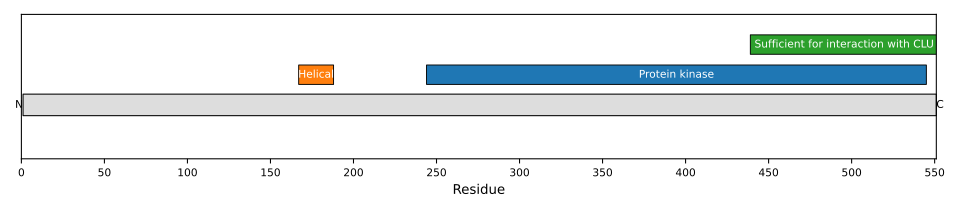
1: Transmembrane serine/threonine kinase forming with the TGF-beta type I serine/threonine kinase receptor, TGFBR1, the non-promiscuous receptor for the TGF-beta cytokines TGFB1, TGFB2 and TGFB3. Transduces the TGFB1, TGFB2 and TGFB3 signal from the cell surface to the cytoplasm and thus regulates a plethora of physiological and pathological processes including cell cycle arrest in epithelial and hematopoietic cells, control of mesenchymal cell proliferation and differentiation, wound healing, extracellular matrix production, immunosuppression and carcinogenesis. The formation of the receptor complex composed of 2 TGFBR1 and 2 TGFBR2 molecules symmetrically bound to the cytokine dimer results in the phosphorylation and activation of TGFBR1 by the constitutively active TGFBR2. Activated TGFBR1 phosphorylates SMAD2 which dissociates from the receptor and interacts with SMAD4. The SMAD2-SMAD4 complex is subsequently translocated to the nucleus where it modulates the transcription of the TGF-beta-regulated genes. This constitutes the canonical SMAD-dependent TGF-beta signaling cascade. Also involved in non-canonical, SMAD-independent TGF-beta signaling pathways
2: Has transforming growth factor beta-activated receptor activity
3: Has transforming growth factor beta-activated receptor activity
4: Binds TGFB1, TGFB2 and TGFB3 in the picomolar affinity range without the participation of additional receptors. Blocks activation of SMAD2 and SMAD3 by TGFB1