Stress-70 protein, mitochondrial (75 kDa glucose-regulated protein) (GRP-75) (Heat shock 70 kDa protein 9) (Mortalin) (MOT) (Peptide-binding protein 74) (PBP74)
1_MISAS 6_ RAAAA 11_ RLVGA 16_ AASRG 21_ PTAAR 26_ HQDSW 31_ NGLSH 36_ EAFRL 41_ VSRRD 46_ YASEA 51_ IKGAV 56_ VGIDL 61_ GTTNS 66_ CVAVM 71_ EGKQA 76_ KVLEN 81_ AEGAR 86_ TTPSV 91_ VAFTA 96_ DGERL 101_ VGMPA 106_ KRQAV 111_ TNPNN 116_ TFYAT 121_ KRLIG 126_ RRYDD 131_ PEVQK 136_ DIKNV 141_ PFKIV 146_ RASNG 151_ DAWVE 156_ AHGKL 161_ YSPSQ 166_ IGAFV 171_ LMKMK 176_ ETAEN 181_ YLGHT 186_ AKNAV 191_ ITVPA 196_ YFNDS 201_ QRQAT 206_ KDAGQ 211_ ISGLN 216_ VLRVI 221_ NEPTA 226_ AALAY 231_ GLDKS 236_ EDKVI 241_ AVYDL 246_ GGGTF 251_ DISIL 256_ EIQKG 261_ VFEVK 266_ STNGD 271_ TFLGG 276_ EDFDQ 281_ ALLRH 286_ IVKEF 291_ KRETG 296_ VDLTK 301_ DNMAL 306_ QRVRE 311_ AAEKA 316_ KCELS 321_ SSVQT 326_ DINLP 331_ YLTMD 336_ SSGPK 341_ HLNMK 346_ LTRAQ 351_ FEGIV 356_ TDLIR 361_ RTIAP 366_ CQKAM 371_ QDAEV 376_ SKSDI 381_ GEVIL 386_ VGGMT 391_ RMPKV 396_ QQTVQ 401_ DLFGR 406_ APSKA 411_ VNPDE 416_ AVAIG 421_ AAIQG 426_ GVLAG 431_ DVTDV 436_ LLLDV 441_ TPLSL 446_ GIETL 451_ GGVFT 456_ KLINR 461_ NTTIP 466_ TKKSQ 471_ VFSTA 476_ ADGQT 481_ QVEIK 486_ VCQGE 491_ REMAG 496_ DNKLL 501_ GQFTL 506_ IGIPP 511_ APRGV 516_ PQIEV 521_ TFDID 526_ ANGIV 531_ HVSAK 536_ DKGTG 541_ REQQI 546_ VIQSS 551_ GGLSK 556_ DDIEN 561_ MVKNA 566_ EKYAE 571_ EDRRK 576_ KERVE 581_ AVNMA 586_ EGIIH 591_ DTETK 596_ MEEFK 601_ DQLPA 606_ DECNK 611_ LKEEI 616_ SKMRE 621_ LLARK 626_ DSETG 631_ ENIRQ 636_ AASSL 641_ QQASL 646_ KLFEM 651_ AYKKM 656_ ASERE 661_ GSGSS 666_ GTGEQ 671_KEDQK
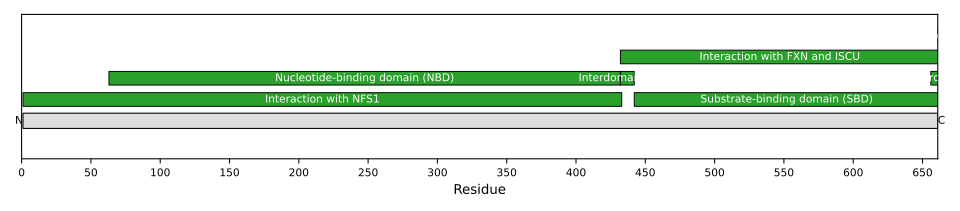
1: Mitochondrial chaperone that plays a key role in mitochondrial protein import, folding, and assembly. Plays an essential role in the protein quality control system, the correct folding of proteins, the re-folding of misfolded proteins, and the targeting of proteins for subsequent degradation. These processes are achieved through cycles of ATP binding, ATP hydrolysis, and ADP release, mediated by co-chaperones (PubMed:18632665, PubMed:25615450, PubMed:28848044, PubMed:30933555, PubMed:31177526). In mitochondria, it associates with the TIM (translocase of the inner membrane) protein complex to assist in the import and folding of mitochondrial proteins (By similarity). Plays an important role in mitochondrial iron-sulfur cluster (ISC) biogenesis, interacts with and stabilizes ISC cluster assembly proteins FXN, NFU1, NFS1 and ISCU (PubMed:26702583). Regulates erythropoiesis via stabilization of ISC assembly (PubMed:21123823, PubMed:26702583). Regulates mitochondrial calcium-dependent apoptosis by coupling two calcium channels, ITPR1 and VDAC1, at the mitochondria-associated endoplasmic reticulum (ER) membrane to facilitate calcium transport from the ER lumen to the mitochondria intermembrane space, providing calcium for the downstream calcium channel MCU, which releases it into the mitochondrial matrix (By similarity). Although primarily located in the mitochondria, it is also found in other cellular compartments. In the cytosol, it associates with proteins involved in signaling, apoptosis, or senescence. It may play a role in cell cycle regulation via its interaction with and promotion of degradation of TP53 (PubMed:24625977, PubMed:26634371). May play a role in the control of cell proliferation and cellular aging (By similarity). Protects against reactive oxygen species (ROS) (By similarity). Extracellular HSPA9 plays a cytoprotective role by preventing cell lysis following immune attack by the membrane attack complex by disrupting formation of the complex (PubMed:16091382)