DNA mismatch repair protein Mlh1 (MutL protein homolog 1)
1_MSFVA 6_ GVIRR 11_ LDETV 16_ VNRIA 21_ AGEVI 26_ QRPAN 31_ AIKEM 36_ IENCL 41_ DAKST 46_ SIQVI 51_ VKEGG 56_ LKLIQ 61_ IQDNG 66_ TGIRK 71_ EDLDI 76_ VCERF 81_ TTSKL 86_ QSFED 91_ LASIS 96_ TYGFR 101_ GEALA 106_ SISHV 111_ AHVTI 116_ TTKTA 121_ DGKCA 126_ YRASY 131_ SDGKL 136_ KAPPK 141_ PCAGN 146_ QGTQI 151_ TVEDL 156_ FYNIA 161_ TRRKA 166_ LKNPS 171_ EEYGK 176_ ILEVV 181_ GRYSV 186_ HNAGI 191_ SFSVK 196_ KQGET 201_ VADVR 206_ TLPNA 211_ STVDN 216_ IRSIF 221_ GNAVS 226_ RELIE 231_ IGCED 236_ KTLAF 241_ KMNGY 246_ ISNAN 251_ YSVKK 256_ CIFLL 261_ FINHR 266_ LVEST 271_ SLRKA 276_ IETVY 281_ AAYLP 286_ KNTHP 291_ FLYLS 296_ LEISP 301_ QNVDV 306_ NVHPT 311_ KHEVH 316_ FLHEE 321_ SILER 326_ VQQHI 331_ ESKLL 336_ GSNSS 341_ RMYFT 346_ QTLLP 351_ GLAGP 356_ SGEMV 361_ KSTTS 366_ LTSSS 371_ TSGSS 376_ DKVYA 381_ HQMVR 386_ TDSRE 391_ QKLDA 396_ FLQPL 401_ SKPLS 406_ SQPQA 411_ IVTED 416_ KTDIS 421_ SGRAR 426_ QQDEE 431_ MLELP 436_ APAEV 441_ AAKNQ 446_ SLEGD 451_ TTKGT 456_ SEMSE 461_ KRGPT 466_ SSNPR 471_ KRHRE 476_ DSDVE 481_ MVEDD 486_ SRKEM 491_ TAACT 496_ PRRRI 501_ INLTS 506_ VLSLQ 511_ EEINE 516_ QGHEV 521_ LREML 526_ HNHSF 531_ VGCVN 536_ PQWAL 541_ AQHQT 546_ KLYLL 551_ NTTKL 556_ SEELF 561_ YQILI 566_ YDFAN 571_ FGVLR 576_ LSEPA 581_ PLFDL 586_ AMLAL 591_ DSPES 596_ GWTEE 601_ DGPKE 606_ GLAEY 611_ IVEFL 616_ KKKAE 621_ MLADY 626_ FSLEI 631_ DEEGN 636_ LIGLP 641_ LLIDN 646_ YVPPL 651_ EGLPI 656_ FILRL 661_ ATEVN 666_ WDEEK 671_ ECFES 676_ LSKEC 681_ AMFYS 686_ IRKQY 691_ ISEES 696_ TLSGQ 701_ QSEVP 706_ GSIPN 711_ SWKWT 716_ VEHIV 721_ YKALR 726_ SHILP 731_ PKHFT 736_ EDGNI 741_ LQLAN 746_ LPDLY 751_KVFER
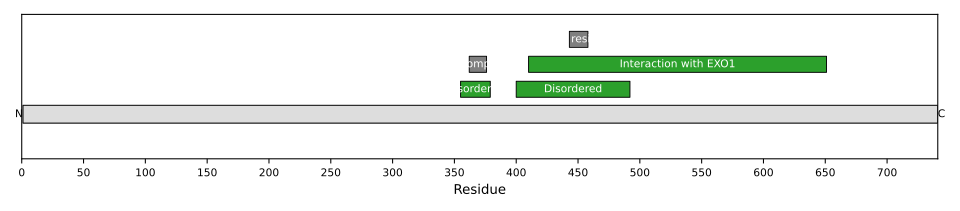
1: Heterodimerizes with PMS2 to form MutL alpha, a component of the post-replicative DNA mismatch repair system (MMR). DNA repair is initiated by MutS alpha (MSH2-MSH6) or MutS beta (MSH2-MSH3) binding to a dsDNA mismatch, then MutL alpha is recruited to the heteroduplex. Assembly of the MutL-MutS-heteroduplex ternary complex in presence of RFC and PCNA is sufficient to activate endonuclease activity of PMS2. It introduces single-strand breaks near the mismatch and thus generates new entry points for the exonuclease EXO1 to degrade the strand containing the mismatch. DNA methylation would prevent cleavage and therefore assure that only the newly mutated DNA strand is going to be corrected. MutL alpha (MLH1-PMS2) interacts physically with the clamp loader subunits of DNA polymerase III, suggesting that it may play a role to recruit the DNA polymerase III to the site of the MMR. Also implicated in DNA damage signaling, a process which induces cell cycle arrest and can lead to apoptosis in case of major DNA damages. Heterodimerizes with MLH3 to form MutL gamma which plays a role in meiosis