Kappa-type opioid receptor (K-OR-1) (KOR-1)
1_MDSPI 6_ QIFRG 11_ EPGPT 16_ CAPSA 21_ CLPPN 26_ SSAWF 31_ PGWAE 36_ PDSNG 41_ SAGSE 46_ DAQLE 51_ PAHIS 56_ PAIPV 61_ IITAV 66_ YSVVF 71_ VVGLV 76_ GNSLV 81_ MFVII 86_ RYTKM 91_ KTATN 96_ IYIFN 101_ LALAD 106_ ALVTT 111_ TMPFQ 116_ STVYL 121_ MNSWP 126_ FGDVL 131_ CKIVI 136_ SIDYY 141_ NMFTS 146_ IFTLT 151_ MMSVD 156_ RYIAV 161_ CHPVK 166_ ALDFR 171_ TPLKA 176_ KIINI 181_ CIWLL 186_ SSSVG 191_ ISAIV 196_ LGGTK 201_ VREDV 206_ DVIEC 211_ SLQFP 216_ DDDYS 221_ WWDLF 226_ MKICV 231_ FIFAF 236_ VIPVL 241_ IIIVC 246_ YTLMI 251_ LRLKS 256_ VRLLS 261_ GSREK 266_ DRNLR 271_ RITRL 276_ VLVVV 281_ AVFVV 286_ CWTPI 291_ HIFIL 296_ VEALG 301_ STSHS 306_ TAALS 311_ SYYFC 316_ IALGY 321_ TNSSL 326_ NPILY 331_ AFLDE 336_ NFKRC 341_ FRDFC 346_ FPLKM 351_ RMERQ 356_ STSRV 361_ RNTVQ 366_ DPAYL 371_RDIDG
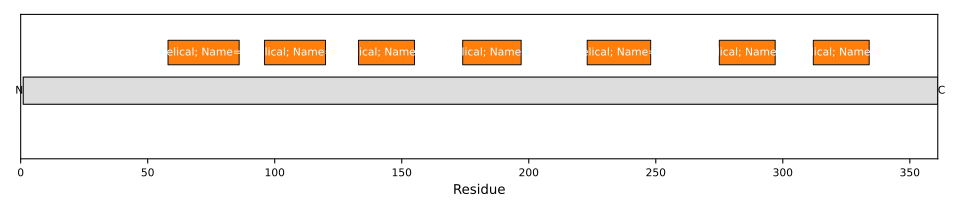
1: G-protein coupled opioid receptor that functions as a receptor for endogenous alpha-neoendorphins and dynorphins, but has low affinity for beta-endorphins. Also functions as a receptor for various synthetic opioids and for the psychoactive diterpene salvinorin A. Ligand binding causes a conformation change that triggers signaling via guanine nucleotide-binding proteins (G proteins) and modulates the activity of down-stream effectors, such as adenylate cyclase. Signaling leads to the inhibition of adenylate cyclase activity. Inhibits neurotransmitter release by reducing calcium ion currents and increasing potassium ion conductance. Plays a role in the perception of pain. Plays a role in mediating reduced physical activity upon treatment with synthetic opioids. Plays a role in the regulation of salivation in response to synthetic opioids. May play a role in arousal and regulation of autonomic and neuroendocrine functions