B-cell lymphoma 6 protein (BCL-6) (B-cell lymphoma 5 protein) (BCL-5) (Protein LAZ-3) (Zinc finger and BTB domain-containing protein 27) (Zinc finger protein 51)
1_MASPA 6_ DSCIQ 11_ FTRHA 16_ SDVLL 21_ NLNRL 26_ RSRDI 31_ LTDVV 36_ IVVSR 41_ EQFRA 46_ HKTVL 51_ MACSG 56_ LFYSI 61_ FTDQL 66_ KCNLS 71_ VINLD 76_ PEINP 81_ EGFCI 86_ LLDFM 91_ YTSRL 96_ NLREG 101_ NIMAV 106_ MATAM 111_ YLQME 116_ HVVDT 121_ CRKFI 126_ KASEA 131_ EMVSA 136_ IKPPR 141_ EEFLN 146_ SRMLM 151_ PQDIM 156_ AYRGR 161_ EVVEN 166_ NLPLR 171_ SAPGC 176_ ESRAF 181_ APSLY 186_ SGLST 191_ PPASY 196_ SMYSH 201_ LPVSS 206_ LLFSD 211_ EEFRD 216_ VRMPV 221_ ANPFP 226_ KERAL 231_ PCDSA 236_ RPVPG 241_ EYSRP 246_ TLEVS 251_ PNVCH 256_ SNIYS 261_ PKETI 266_ PEEAR 271_ SDMHY 276_ SVAEG 281_ LKPAA 286_ PSARN 291_ APYFP 296_ CDKAS 301_ KEEER 306_ PSSED 311_ EIALH 316_ FEPPN 321_ APLNR 326_ KGLVS 331_ PQSPQ 336_ KSDCQ 341_ PNSPT 346_ ESCSS 351_ KNACI 356_ LQASG 361_ SPPAK 366_ SPTDP 371_ KACNW 376_ KKYKF 381_ IVLNS 386_ LNQNA 391_ KPEGP 396_ EQAEL 401_ GRLSP 406_ RAYTA 411_ PPACQ 416_ PPMEP 421_ ENLDL 426_ QSPTK 431_ LSASG 436_ EDSTI 441_ PQASR 446_ LNNIV 451_ NRSMT 456_ GSPRS 461_ SSESH 466_ SPLYM 471_ HPPKC 476_ TSCGS 481_ QSPQH 486_ AEMCL 491_ HTAGP 496_ TFPEE 501_ MGETQ 506_ SEYSD 511_ SSCEN 516_ GAFFC 521_ NECDC 526_ RFSEE 531_ ASLKR 536_ HTLQT 541_ HSDKP 546_ YKCDR 551_ CQASF 556_ RYKGN 561_ LASHK 566_ TVHTG 571_ EKPYR 576_ CNICG 581_ AQFNR 586_ PANLK 591_ THTRI 596_ HSGEK 601_ PYKCE 606_ TCGAR 611_ FVQVA 616_ HLRAH 621_ VLIHT 626_ GEKPY 631_ PCEIC 636_ GTRFR 641_ HLQTL 646_ KSHLR 651_ IHTGE 656_ KPYHC 661_ EKCNL 666_ HFRHK 671_ SQLRL 676_ HLRQK 681_ HGAIT 686_ NTKVQ 691_ YRVSA 696_ TDLPP 701_ELPKA
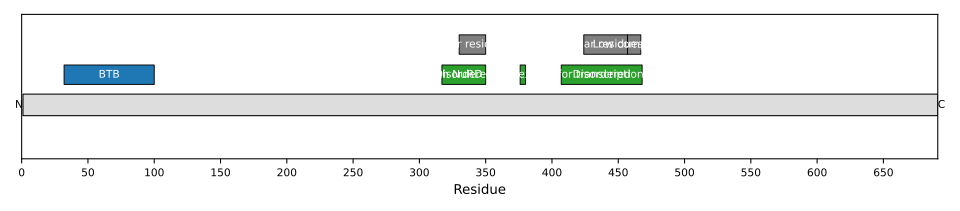
1: Transcriptional repressor mainly required for germinal center (GC) formation and antibody affinity maturation which has different mechanisms of action specific to the lineage and biological functions. Forms complexes with different corepressors and histone deacetylases to repress the transcriptional expression of different subsets of target genes. Represses its target genes by binding directly to the DNA sequence 5'-TTCCTAGAA-3' (BCL6-binding site) or indirectly by repressing the transcriptional activity of transcription factors. In GC B-cells, represses genes that function in differentiation, inflammation, apoptosis and cell cycle control, also autoregulates its transcriptional expression and up-regulates, indirectly, the expression of some genes important for GC reactions, such as AICDA, through the repression of microRNAs expression, like miR155. An important function is to allow GC B-cells to proliferate very rapidly in response to T-cell dependent antigens and tolerate the physiological DNA breaks required for immunglobulin class switch recombination and somatic hypermutation without inducing a p53/TP53-dependent apoptotic response. In follicular helper CD4(+) T-cells (T(FH) cells), promotes the expression of T(FH)-related genes but inhibits the differentiation of T(H)1, T(H)2 and T(H)17 cells. Also required for the establishment and maintenance of immunological memory for both T- and B-cells. Suppresses macrophage proliferation through competition with STAT5 for STAT-binding motifs binding on certain target genes, such as CCL2 and CCND2. In response to genotoxic stress, controls cell cycle arrest in GC B-cells in both p53/TP53-dependedent and -independent manners. Besides, also controls neurogenesis through the alteration of the composition of NOTCH-dependent transcriptional complexes at selective NOTCH targets, such as HES5, including the recruitment of the deacetylase SIRT1 and resulting in an epigenetic silencing leading to neuronal differentiation